Friday, 31 May 2019

British common law may have been good for development, but not for women

For the most part, former colonies adopted the legal systems and processes of their colonisers. Countries that were former British colonies adopted a common law system, while those that were former colonies of French, Spanish, Portuguese, or other continental powers, adopted a civil law system. There is plenty of research that strongly suggests that British common law was good for development (for example, see this 2008 review of the literature). One of the underlying reasons for this is that civil law has weaker enforcement of contracts and property rights, which inhibits investment.

However, it appears that all is not rosy in the common law world. A 2018 article by Siwan Anderson (Vancouver School of Economics), published in the American Economic Review (currently ungated, but just in case here is an earlier ungated version), identifies a substantial negative consequence of British common law in sub-Saharan Africa. This arises because of differences in the treatment of marital property between civil law and common law countries. Anderson explains that:
...the community marital property regime of the civil law countries gives equal protection to women in case of divorce, typically an even split of property between spouses, and legally protects widows. This is in stark contrast to the separate marital property regime of the former British colonies who adopted the Married Women’s Property Act of 1882. Very few of these countries have added provisions to these outdated marriage laws and they provide little, or no, protection for women in event of marital dissolution.
I think in this quote, Anderson has 'community marital property' and 'separate marital property' back-to-front (and checking on her reference to this World Bank report, it seems so). Civil law countries have a separate marital property regime (each spouse retains individual ownership over their own assets), while common law countries have a community marital property regime (spouses have joint ownership of assets, but in this case men may have additional rights over this property when a marriage is dissolved). Anderson notes that Muslim women, and those in polygynous marriages (marriages with multiple wives), have a 'separate marital property' regime, even in common law countries:
Separate marital property is the default regime in classical Islamic law... The default marital property regime for polygynous marriages is also separate as, in this case, it protects a wife from having to share her private property with other wives...
These differences in marital property regimes have implications for bargaining power within the household. In a household bargaining model, decisions made within the household are determined by the relative bargaining power of the decision-makers (e.g. the spouses). A spouse who will have greater access to property in the case of divorce has a higher 'threat point' - they have more bargaining power, and can exert more influence over household decision-making.

In the case of divorce, non-Muslim women in common law countries (who are not in polygynous marriages) will be much worse off (because they keep a smaller share of the property) than women in civil law countries. This means that women in civil law countries have a higher threat point and therefore greater bargaining power within the marriage. This increases their influence over household decisions, including increasing their ability to negotiate safer sex practices with their husband, and therefore reducing their susceptibility to HIV.

Using data on around 308,000 women and 190,000 men from the Demographic and Health Surveys in 25 sub-Saharan African countries, Anderson tests for differences in HIV rates between common law and civil law countries. About 45 percent of the countries in Anderson's sample have common law, and the rest have civil law. As a starting point, it is worth noting that:
On average, 6.8 percent of women in our sample are HIV positive (this compares to 4.6 percent of men). In common law countries, the average female HIV infection rate is approximately 9.5 percent. It is close to one-half, at 4.6 percent, in civil law countries.
You might legitimately worry that there are ethnic differences between countries that are former British colonies (and therefore common law) and other countries (civil law), but Anderson notes that national boundaries are not consistent with boundaries of ethnic groups, and many ethnic groups cross borders, and that:
51 percent of the individual sample (a total of roughly 157,000 women) fall into partitioned ethnic groups, and 35 percent of the total sample (approximately 108,000 women) are in partitioned ethnic homelands with different legal origins.
That provides enough variation to separately identify the effects of common law from any confounding by ethnic differences. Anderson finds that:
...female HIV infection rates are at least 25 percent higher in common law countries...
We see that the positive correlation between common law and female HIV only holds for non-Muslim and non- polygynous women. By contrast, there are no significant effects for the sample comprised only of Muslim and/or polygynous women. Therefore, the key correlation only exists for those women who should be affected by the differences in marital property law across civil and common law countries.
There are no significant effects of common law on HIV infection among men. Anderson goes on to show that:
...all else equal, women residing in common law countries are significantly less likely to use a contraception method requiring consent from her male partner, and incidentally protecting her from contracting HIV. The estimated coefficient... reflects about a 30 percent decrease... in women using protective contraception in common law compared to civil law countries.
Again, this relationship is not significant for Muslim women, or women in polygynous marriages. Similar results are found for men, in terms of contraceptive use. Finally, Anderson finds:
...a consistently negative relationship between this index of female autonomy and weaker marital property laws (common law). Once again, the relationship only holds for those women for which the legal variation is relevant (non-Muslim and non-polygynous).
Overall, this paper provides strong evidence that common law was not in all ways good for countries, or more specifically for women. These countries have retained outdated laws, and while Western common law countries have long since moved on and given equal property rights to women, many sub-Saharan African countries lag behind. One consequence has been the feminisation of the HIV epidemic in Africa. Legal reform in these countries is urgently needed.

[HT: Marginal Revolution, last year]

Thursday, 30 May 2019

Transaction utility and the behavioural economics of discounts

Ralph-Christopher Bayer (University of Adelaide) wrote in The Conversation yesterday about the behavioural economics of discounting:
Because consumers are human beings, our actions aren’t necessarily rational. We have strong emotional reactions to price signals. The sheer ubiquity of discounts demonstrate they must work.
Lets review a couple of findings from behavioural (and traditional) economics that help explain why discounting – both real and fake – is such an effective marketing ploy.
When will firms offer discounts on their products? If they are profit-maximising firms (the assumption we usually make in economics), then they will lower prices if it increases profits. When prices are lowered consumers will buy more. That is the straightforward Law of Demand. However, lower prices don't automatically raise profits, because while the firm will sell more items, it sells those extra items and all the rest of the items that they could have sold at the higher price at the new lower price. Profits might even go down.

So, firms will only lower prices if it is more profitable to do so. However, if firms are better off with lower prices, you would (rightly) wonder why they need to discount - why would they ever offer the higher price, if they already know the lower price is more profitable? They should just start with the lower price.

There can be good reason for discounting. For some retailers, starting with a high price and discounting later has nothing to do with behavioural economics. For instance, consumers who wait until later to buy may have a lower willingness-to-pay (or be more price sensitive) than consumers who buy early. In this situation, it makes sense for the retailer to sell 'new season' items at a high price, but heavily discount those same items at the end of the season (this is what economists refer to as 'temporal price discrimination'). However, this is not what most retailers are doing when they discount items.

Most retailers are trying to take advantage of behavioural economics, as Bayer explains:
The prospect of buying something leads us to compare two different changes: the positive change in perceived value from taking ownership of a good (the gain); and the negative change experienced from handing over money (the loss). We buy if we perceive the gain to outweigh the loss.
Suppose you are looking to buy a toaster. You see one for $99. Another is $110, with a 10% discount – making it $99. Which one would you choose?
Evaluating the first toaster’s value to you is reasonably straightforward. You will consider the item’s attributes against other toasters and how much you like toast versus some other benefit you might attain for $99.
Standard economics says your emotional response involves weighing the loss of $99 against the gain of owning the toaster.
For the second toaster you might do all the same calculations about features and value for money. But behavioural economics tells us the discount will provoke a more complex emotional reaction than the first toaster.
Research shows most of us will tend to “segregate” the price from the discount; we will feel separately the emotion from the loss of spending $99 and the gain of “saving” $11.
Bayer is describing the idea of transaction utility (which I have blogged about before in this context). When we buy an item, we get utility (satisfaction or happiness) from receiving the item (which we call consumption utility), plus we get utility from the transaction itself (transaction utility). If we feel like we are getting a good deal, that makes us happier about our purchase. It doesn't make us any more satisfied with the item itself, but it increases our transaction utility. Higher total utility (consumption utility plus transaction utility) makes us more likely to buy the item.

Retailers can exploit this, and often do. By posting a high 'regular price' or 'recommended price' and showing a deep discount, they increase the consumer's perception of getting a good deal, and increase their transaction utility. This makes them more likely to make the purchase, because it increases their total utility.

Transaction utility can wear off pretty quickly though. You know that feeling of buyer's remorse, when you've bought something and you felt really good about it at the time, but soon after you think it wasn't worth it and maybe you want to change your mind? That's the transaction utility wearing off, and you're realising that the consumption utility alone is not enough to make the item worthwhile. But it's too late! Bayer's conclusion is relevant here:
The bottom line: beware the emotional appeal of the discount. Whether real or fake, the human tendency is to overrate them.
Read more:


Wednesday, 29 May 2019

Higher minimum wages and youth crime

Does a higher minimum wage reduce crime? The White House Council of Economic Advisors thinks so. However, from the perspective of basic economics, it is an open question. On the one hand, we might expect higher minimum wages to increase income for low-income workers. That increases the opportunity costs of property crime - if these low-income workers engage in property crime and are caught, they give up more income as a result (because of jail time, etc.). On the other hand, the evidence strongly suggests that higher minimum wages reduce employment (see my latest post on this topic here). So, even if low-income workers earn more, fewer of them have jobs. Those that are made unemployed have greater incentives to engage in property crime.

A recent NBER Working Paper (ungated version here) by Zachary Fone (University of New Hampshire), Joseph Sabia (San Diego State University), and Resul Cesur (University of Connecticut) addresses this open question. They use data from the U.S. crime data and data from the National Longitudinal Study of Youth over the period 1998 to 2016, and data on national, state, and local minimum wages. Over that period, there were:
...3 Federal minimum wage increases, 217 state minimum wage increases, 77 local minimum wage increases, and 116 living wage ordinances enacted.
So, there is more than enough variation in the data to identify the relationships between minimum wage increases and crime. Fone et al. focus on youth crime, which is sensible because youths are more likely to be affected by higher minimum wages (either positively or negatively). They also compare the effects for those aged 16-19 years and 20-24 years with those aged over 25 years. They find that:
...minimum wage increases enacted from 1998 to 2016 led to increases in property crime for those between the ages of 16-to-24, with an estimated elasticity of 0.2. This finding is robust to the inclusion of controls for state-specific time trends, survive falsification tests on policy leads, and persist for workers who earn wages such that minimum wage changes bind. Increases in property crime appear to be driven by adverse employment and hours effects of minimum wages. We find little evidence that minimum wage increases affect violent or drug crimes.
The elasticity of 0.2 means that a 10% increase in the minimum wage is associated with a 2% increase in property crime. Interestingly, and importantly, the effects are statistically significant for younger people (aged 16-19 or 20-24), but not statistically significant for those aged over 25 years. This can provide some confidence that what they are finding is related to the minimum wage changes, and not to some underlying overall crime trends (although underlying youth crime trends might still be a problem), because if it was driven by underlying trends there would be a significant effect for the 25+ age group as well. They also find that living wage provisions (which are usually larger than minimum wages, but affect only a subset of those working for low wages) increase property crime by 9.1%.

Of course, this paper is far from the last word on the effects of minimum wages on crime, and is inconsistent with previous evidence (including a paper I blogged about last year on minimum wages, earned income tax credits and female recidivism). However, it does show that we need to take more than just the standard welfare effects of the minimum wage into account when evaluating the costs and benefits of a higher minimum wage.

Read more:


Tuesday, 28 May 2019

Autonomous cars, pedestrians, and the game of chicken

I was interested to read this article in The Conversation last month by Jason Thompson (University of Melbourne) and Gemma Read (University of the Sunshine Coast), about the interactions of humans and autonomous cars. In particular, they use some very simple game theory to represent the interaction between cars (autonomous or otherwise) and humans:
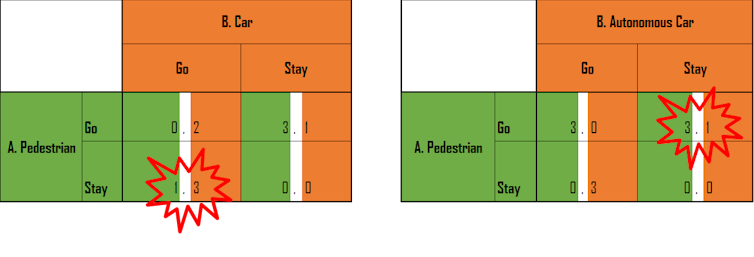
A simple example of how this might happen comes from game theory. Take two scenarios at an intersection where pedestrians and vehicles negotiate priority to cross first. Each receives known “pay-offs” for behaviour in the context of the other’s action. The higher the comparative pay-off for either party, the more likely the action.
In the left-hand scenario below, the Nash equilibrium (the optimum combined action of both parties) exists in the lower left quadrant where the pedestrian has a small incentive to “stay” to avoid being injured by the manually driven car, and the driver has a strong incentive to “go”.
However, in the scenario on the right, the autonomous vehicles has a desire to act flawlessly and pose no threat to the pedestrian at all. While this might be great for safety, the pedestrian can now adopt a strategy of “go” at all times, forcing the AV to stay put.
Here's their associated diagram. The red explosions show the Nash equilibrium in each case:

However, I think they have their analysis wrong. I don't think they've really considered the game theory implications here fully. In the game on the left, the car has a dominant strategy to "Go" - going provides a payoff that is always higher than staying. The car driver should never choose to stay, including if the pedestrian chooses to "Go" as well. But, if both pedestrian and driver choose to "Go", then the car runs over the pedestrian. It's hard to see how the car driver is better off going if the pedestrian goes (unless the disutility of washing the blood off their car really is less than the utility gained from getting through the intersection faster).

Similarly, in the game on the right, the pedestrian has a dominant strategy to "Go". But again, would they really choose to "Go" if the car is going too? Maybe in Thompson and Read's world, pedestrians aren't seriously injured or killed when they run into cars, but in the real world it seems like a pedestrian would be pretty stupid to go if a car is going.

A more realistic representation of the game is in the payoff table below. If both the car and the pedestrian go, then both lose. The loss to the car driver is pretty high (damage to their car; maybe jail time for running down a pedestrian), but not as high as the loss to the pedestrian (being injured or killed by a car is pretty serious). If car or pedestrian goes, and the other doesn't, then whichever one goes gets a larger positive payoff. If both car and pedestrian stay, then a standoff ensues, and both get a payoff of zero.


Where is the Nash equilibrium in this game? We can use the 'best response method' to find the equilibrium. To do this, we track: for each player, for each strategy, what is the best response of the other player. Where both players are selecting a best response, they are doing the best they can, given the choice of the other player (this is the textbook definition of Nash equilibrium). In this game, the best responses are:
  1. If the car chooses to go, the pedestrian's best response is to stay (since 1 is a better payoff than -5) [we track the best responses with ticks, and not-best-responses with crosses; Note: I'm also tracking which payoffs I am comparing with numbers corresponding to the numbers in this list];
  2. If the car chooses to stay, the pedestrian's best response is to go (since 3 is a better payoff than 0);
  3. If the pedestrian chooses to go, the car's best response is to stay (since 1 is a better payoff than -3); and
  4. If the pedestrian chooses to stay, the car's best response is to go (since 3 is a better payoff than 0).
There are two Nash equilibriums in this game: (1) where the car goes and the pedestrian stays; and (2) where the pedestrian goes and the car stays. Notice that both players in this game would be better off if they are the one to go, and worse off if they are the one to stay. But, if both choose to go, then they end up in the worst possible outcome! This is an example of the chicken game (which I have previously blogged about here).

A game with two Nash equilibriums doesn't really give us much guidance as to what the ultimate outcome will be. Both players want to go, but both want to avoid the situation where they are both trying to go at the same time. So, how do we solve this problem?

Currently, we solve the problem using a mixture of road rules and social norms. At pedestrian crossings, cars always stay and pedestrians can go. At traffic lights, cars and pedestrians stay or go depending on whether their light is red or green. At other places, pedestrians stay and cars go - that's why we learn as children to look both ways before crossing the road (a social norm).

However, autonomous cars create an interesting situation, as Thompson and Read highlight in their article. If autonomous cars are programmed to always give way to pedestrians (or, equivalently, to always avoid a collision with a pedestrian where possible), then that means the car will always stay. If the pedestrian knew (for sure) that the car was going to stay, they would choose to go. Every time. Suddenly, we end up in the top right box of the payoff table.

Why is this a problem? As Thompson and Read note:
Now imagine crossing a road or highway in a city saturated by autonomous cars where the threat of being run over disappears. You⁠ ⁠(⁠o⁠r⁠ ⁠a⁠n⁠y⁠ ⁠o⁠t⁠h⁠e⁠r⁠ ⁠mildly i⁠n⁠t⁠e⁠l⁠l⁠i⁠g⁠e⁠n⁠t⁠ ⁠a⁠n⁠i⁠m⁠a⁠l⁠)⁠ might quickly learn that ⁠⁠oncoming traffic poses no threat at all. Replicated thousands of times across a dense inner city, this could produce gridlock among safety-conscious autonomous vehicles, but virtual freedom of movement for humans – maybe even heralding a return to pedestrian rights of yesteryear.
Thompson and Read make the (obviously tongue-in-cheek) suggestion that a solution is for autonomous cars to occasionally, purposefully, run into pedestrians. That seems unlikely (though potentially effective).

Ultimately, this game of chicken is one that pedestrians are likely to win. So, while many are claiming that autonomous vehicles are the solution to traffic problems, they could actually end up making them worse.