Showing posts with label Development Economics. Show all posts

Wednesday, 7 December 2022

Dietrich Vollrath on why the whole world isn't rich

You could argue that the original question of economics is why some countries are rich, and others are poor. After all, it was the topic of Adam Smith's 1776 book An Inquiry into the Nature and Causes of the Wealth of Nations. After 250 years of study, we must have a pretty good idea of the answer. And yet, as Dietrich Vollrath outlined in this article in Asterisk last month, we really don't. Vollrath (who blogs at growthecon.com) does a great job of summarising what we know and, importantly, what we don't know. The latter is, unfortunately, still a lot.

The causes of economic growth and development remain a bit of a mystery. Factors of production obviously matter, but why some countries have rapidly increased their factors of production and others have not is unclear. Institutions also seem to matter. I recommend that you read the whole article, as it gives a very clear sense of the state of knowledge. In terms of institutions though, this bit on democracy seems the most important in terms of what we know with some certainty:

A good example is from Acemoglu and Robinson along with coauthors Suresh Naidu and Pascual Restrepo... They show that the transition to democracy leads to higher economic growth in the future, finding GDP per capita is around 20% higher in a democracy compared to an otherwise identical nondemocracy. What they see is that countries that democratize invest significantly more in public health and education, consistent with the initial work that Mankiw, Romer and Weil and Alwyn Young did on economic growth.

They explicitly take on all of the empirical issues I complained about above. They do not try to quantify “democracy” along some arbitrary scale (e.g., North Korea is a one, the U.S. is a seven, etc.). They instead focus on a simple comparison of places that clearly democratized versus those that did not. They use several methods to try to assure themselves, and us, that their results are coming from the causal effect of democracy on growth, and not the other way around. This includes a sort of natural experiment where democratization is more likely to occur when more neighboring countries are democracies.

Some counterexamples may immediately come to mind. South Korea, whose economy took off in the ’60s, did not democratize until 1988, and China has undergone impressive economic growth without democratizing at all. But once Acemoglu, Naidu, Restrepo and Robinson make the comparison across all countries, it turns out that their experiences are something of an outlier, not the norm.

The research by Acemoglu et al. that Vollrath refers to is here (with ungated earlier version here). Development economics was where I started my journey as an economist. There has been a large-scale shift from 'macro' development towards 'micro' development in recent years. That may help to explain why we don't have answers to the macro questions of development (and is related to critiques that Lant Pritchett has made of randomised control trials in development - for example, see here). Perhaps economics needs to go back to its roots, and study the question that occupied Adam Smith nearly 250 years ago.

[HT: Ranil Dissanayake]

Sunday, 8 May 2022

Why are aid projects less effective in the Pacific?

In a new article published in the journal Development Policy Review (open access), Terence Wood, Sabit Otor, (both Development Policy Centre, Australia), and Matthew Dornan (World Bank) attempt to answer the question of why aid projects are less effective in the Pacific. In case you wonder whether the premise for their question is correct, here's their Figure 1, which shows how much less effective aid projects are in the Pacific, compared with the rest of the world:

Putting aside the fact that the y-axis for column graphs should start at zero (and so to the naked eye this figure very much overstates the difference between Pacific countries and other countries), the probability of an aid project under-delivering is significantly higher in the Pacific than in other developing countries. To answer the question of why, Wood et al. collate data on aid project effectiveness from a range of donors, including:

...the Australian Government Aid Program; the World Bank; the ADB; the UK’s Department for International Development (DFID) (now part of the Foreign, Commonwealth & Development Office); Deutsche Gesellschaft für Internationale Zusammenarbeit (GIZ), the German government’s development agency; KfW, the German government’s development bank; the International Fund for Agricultural Development (IFAD), a specialized agency of the United Nations; Japan International Cooperation Agency (JICA), the Japanese government aid program; and The Global Fund to Fight AIDS, Tuberculosis and Malaria (GFATM).

In each case, effectiveness is standardised to a score from one (worst) to six (best). Their dataset includes 4128 projects from 1996 onwards. They apply causal mediation analysis, which effectively means that in their primary analysis they add various plausible factors that might explain the Pacific's poor aid performance, one at a time, to a regression model that includes a dummy variable for the Pacific. They then look at the effect of adding each of these mediating variables on the coefficient of the Pacific dummy variable, and its statistical significance. Wood et al. find that:

First, when governance is added, the Pacific coefficient actually becomes larger (that is, its difference from zero becomes greater). This suggests governance is a moderating variable: because good governance boosts aid project effectiveness, and because governance is better in the Pacific, the finding indicates the negative effect of the Pacific on project effectiveness would actually be greater were it not for the positive influence of comparatively good governance. Adding the freedom variable reduces the magnitude of the Pacific effect considerably. Growth and GDP also reduce the magnitude but their impact is small. Remoteness, on the other hand, has a substantial impact, and for the first time the coefficient of the Pacific’s effect on project effectiveness ceases to be statistically significant. When population is included, the coefficient for the Pacific changes substantially again, actually becoming positive albeit not statistically significantly different from zero.

The fact the Pacific coefficient is effectively zero at the end of the analysis suggests the negative effect of the Pacific on project effectiveness is completely mediated by these variables.

In other words, aid projects in the Pacific are less effectiveness because of the remoteness of developing countries in the Pacific and their small population sizes. Wood et al. find similar results using two alternative methods of causal mediation analysis. Then, looking at how the characteristics of aid projects vary in effectiveness between the Pacific and other developing countries, they find that:

Although project duration and size have some impact on project effectiveness more generally, neither appears to have a differing impact on project effectiveness in the Pacific compared to the rest of the developing world. Indeed, the only variable for which any of the interaction terms is significant, is sector, and in particular humanitarian emergency work...

...no other sector’s performance differs between the Pacific and elsewhere in a manner that is statistically significant or in any way substantively meaningful. However, humanitarian projects do perform worse in a manner that is statistically significant.

One thing did concern me a little about the analysis. The Pacific countries are the most remote and smallest in population size, so it is possible that it isn't remoteness or small size that create the problems, but something else about the Pacific that is instead being captured by the remoteness and population size variables (that is, an omitted variable problem). That concern could have been allayed to some extent by showing that remoteness and population size were related to aid effectiveness when the Pacific countries were excluded.

Now, putting that aside and taking the results as given, the problem for aid agencies is that remoteness and small population size are not things that can be easily changed. It's not a question of changing the observable (and measurable) characteristics of aid projects, to make them more effective. However, Wood et al. are not so easily dissuaded, recommending that:

...as the main constraints to effective aid are constraints that cannot be shifted or which should not be changed, donors ought to focus foremost on adapting their practice. Successful adaptation is not likely to involve changes in sectoral focus or project size or duration, but rather working in a manner appropriate to giving aid in difficult circumstances...

More investment in building donors’ own expertise in the region will also likely help, as will more investment in gold standard evaluations that allow donors to learn from the specific challenges confronting their work in the Pacific.

That strikes me as a recommendation that could have been made without the necessity of going through the research exercise. It almost goes without saying that adapting practice to location conditions and building expertise in the region are important. In that case, aid agencies may simply have to accept that it will take more time and effort to conduct effective aid projects in the Pacific, and/or that those projects will not be as effective as they are in other developing countries.

Wednesday, 18 August 2021

Global inequality and the Subnational Human Development Index

The Human Development Index (HDI) is a widely used summary measure of the level of development of countries. It improves on a simple ranking of GDP per capita or income per capita, because it takes into account health and education. Specifically, it is made up of four indicators: (1) life expectancy at birth; (2) mean years of schooling of adults (aged 25 years and over); (3) expected years of schooling of children aged 6 (which is based on current age-specific enrolment rates at each level of schooling); and (4) gross national income per capita (adjusted for purchasing power parity).

However, one of the problems with the HDI is that it aggregates across each country as a whole. If you want to know anything about the relative levels of development in rural and urban areas of a country, or coastal and landlocked areas, or between different states, the HDI doesn't provide much assistance. However, help is at hand. There is now a Subnational Human Development Index (SHDI) available, and published by the Global Data Lab. The SHDI covers 1625 regions in 161 countries going from 1990 to 2019. Interestingly, for New Zealand it provides index values for all 16 regions, which might be useful for research (because there seems to be a reasonable amount of variation both between regions and over time).

I was alerted to the SHDI's existence by this 2020 article by Inaki Permanyer (Centre d'Estudis Demogràfics) and Jeroen Smits (Radboud University), published in the journal Population and Development Review (ungated version here, and useful summary here). Permanyer and Smits use the SHDI to characterise changes global human development inequality since 2000, which marks a change from considering inequality purely in terms of income (or wealth). Here's the 2018 distribution of the index (Figure 1 from the paper):

Permanyer and Smits note that:

...one can observe clear geographic patterns within countries (e.g., north–south divides in Belgium, Germany, Italy, and Spain). Some countries exhibit large regional variations (e.g., China, India, or Colombia) while others are quite homogeneous (e.g., Australia). Very often, the region where the capital city is located exhibits the highest human development levels and remote rural regions the lowest.

Not all of those are visible in the figure of course, due to the scale. Then, looking at inequality as measured by the Gini coefficient, they find that:

...inequality in the global SHDI distribution has monotonically decreased from 0.14 in 2000 to 0.11 fifteen years later. 

That's consistent with the overall trend observed in income (see here, for example). There are similar trends in the components of the SHDI (health, education, and income). However:

...we observe substantial differences in the magnitudes and speed of the decline. According to the Gini index, differences in the life expectancy index across world regions are smaller than differences in the education index.

Countries are converging much quicker in terms of health than in terms of either education or income. Looking at whether global inequality is mostly within or between countries, they show:

...the very high contribution of within country inequality to total inequality in the groups of countries at low- and intermediate levels of development (where as much as 70 percent of the world population lives). In these groups of countries, about half of inequality in SHDI is within-country inequality.

That is quite a different result from the analysis of Branko Milanovic, who showed that only 10-20 percent of global income inequality was within-country inequality (see this post). Permanyer and Smits explore their results a little further, finding that for the least developed countries:

...within-country SHDI inequality is mostly due to variation in education... In the high developed countries, standard of living surpasses education as the most important explanatory factor for within country SHDI variation...

So, if you only consider variation in per capita income, as Milanovic does, you potentially miss a large contributor to within-country inequality in the least developed countries, which is the variation in education.

All of this helps to paint a more complete picture of global inequality in living standards. Looking forward, if we want greater equality in human development, there clearly needs to be a greater focus on education in developing countries.

Read more:

Sunday, 14 February 2021

The effect of El Salvadoran gangs on development

In the 1980s, El Salvadoran youth in Southern California formed two street gangs that are now well known internationally: MS-13 and 18th Street. By the mid-1990s, these two gangs had moved on from petty crimes and become more serious criminal organisations, and the U.S. authorities cracked down on them. In 1997, the U.S. began deporting migrants with criminal records (including members of MS-13 and 18th Street) back to their countries of origin. El Salvador say an influx of criminal gang members, who quickly gained control of neighbourhoods across the country, but especially in the capital, San Salvador. The government, and the police, lacked the capacity to prevent these gang territories from being established, in part because the country was still recovering from the civil war that ended in 1992.

What was the impact of these gangs on the neighbourhoods that they controlled, and the people living there? That is the research question that this recent working paper by Nikita Melnikov (Princeton University), Carlos Schmidt-Padilla (University of California, Berkeley), and María Micaela Sviatschi (Princeton University) sets out to answer. They use a variety of data sources, including the 1992 and 2007 Censuses and their own field survey, and implement a regression discontinuity design. Essentially, they test whether there are big jumps (up or down) in key variables related to socio-economic development, occurring at the boundary of gang-controlled neighbourhoods.

They find that:

...residents of gang-controlled neighborhoods in San Salvador have worse dwelling conditions, less income, and lower probability of owning durable goods compared to individuals living just 50 meters away but outside of gang territory. They are also less likely to work in large firms. The magnitudes are very large. For instance, we find that residents of gang areas have $350 lower income compared to individuals living in neighboring non-gang locations and have a 12 percentage points lower probability of working in a firm with at least 100 employees.

The gangs had clear negative effects on development (and interestingly, it doesn't matter which of the two gangs - MS-13 or 18th Street - controls the neighbourhood, since the effects are statistically indistinguishable between them. You might wonder if there was something different about the gang-controlled neighbourhoods before the gang leaders returned to El Salvador. Not so:

These differences in living standards did not exist before the arrival of the gangs. In particular, we replicate the regression discontinuity design with data from the 1992 census, showing that, at that time, neighborhoods on either side of the boundary of gang territory had similar socioeconomic and geographic characteristics. The difference-in-differences analysis confirms this result: after the arrival of the gang members from the United States, areas with gang activity experienced lower growth in nighttime light density compared to places without gang presence, while before the deportations, both types of locations experienced similar rates of growth.

The effect on development is quite large. When Melnikov et al. look at the effect on night-time light intensity (as a measure of development), they conclude that:

The magnitude of the effect is quite large. By 2010, thirteen years after the deportations, areas with high gang presence had experienced nearly 120 percentage points lower growth in nighttime light density than places with low gang presence... in 1998-2010, areas with low gang activity had nearly 120×0.28 = 33.6 percentage points higher growth in GDP than areas with gang presence.

Melnikov et al. undertake a battery of robustness checks on their results (so much so that the working paper is over 90 pages long!). The results are quite robust to changes in the data, and the regression discontinuity results are backed up by the night-time light analysis, which uses a different method (difference-in-differences).

So, what is it that the gangs are doing that impedes development? Melnikov et al. investigate that as well, and note that:

A key mechanism through which gangs affect socioeconomic development in the neighborhoods they control is related to restrictions on individuals’ mobility. In order to maintain control over their territory and prevent the police and members of rival gangs from entering it, both MS-13 and 18th Street have instituted a system of checkpoints, not allowing individuals to freely enter or leave their neighborhoods... Our analysis suggests that, as a result of these restrictions, residents of gang-controlled areas often cannot work outside of gang territory, being forced to accept low-paying jobs in small firms in the neighborhoods where they live.

Restricting freedom of movement, and therefore the freedom of people living in the gang territory to take up higher paying job opportunities outside of the territory, seems to be driving the results. We already know that freer movement of people could substantially increase development globally (see this post, for example). This is an example operating at the micro-level.

[HT: Marginal Revolution, last year]

Thursday, 17 October 2019

Nobel Prize for Abhijit Banerjee, Esther Duflo, and Michael Kremer

It was great news this week that the 2019 Sveriges Riksbank Prize in Economic Sciences in Memory of Alfred Nobel (aka Nobel Prize in Economics) was awarded to Abhijit Banerjee (MIT), Esther Duflo (MIT), and Michael Kremer (Harvard), "for their experimental approach to alleviating global poverty". The prize announcement is here, and here is a longer summary of their work, from the awarding committee.

The coverage online has been overwhelmingly positive, and for good reason. Their work in using rigorous randomised controlled trials (RCTs) has become the gold standard method in much of development economics. David McKenzie provides an excellent summary of what is special about this award. There are also a couple of great articles on The Conversation this week, by Arnab Bhattacharjee and Mark Schaffer (Heriot-Watt University), and by Gabriela D'Souza (Monash University).

I have to admit that I was a little surprised by this award. I know they have been among many people's picks for a Nobel Prize for the last few years, but I honestly thought it too soon. Esther Duflo becomes the youngest person (at 46 years) to win the prize for economics. Duflo also becomes only the second women (after Elinor Ostrom in 2009) to win the award, and that is only one tiny step towards redressing the gender imbalance in economics.

I haven't used much of the awardees' work in my current teaching, but when I was teaching graduate development economics a few years ago, I included RCTs and impact evaluations as part of the topic coverage. In my current ECONS102 class, I also refer to Michael Kremer's alternative view on intellectual property, that following a successful invention, the government purchases the patent and places it in the public domain, thereby reducing the problems associated with creating monopolies for patented products that have high social benefits.

Finally, the book Poor Economics, by Banerjee and Duflo, has been sitting on my to-be-read pile for far too long. It will be accelerated closer to the top of the pile, and you can expect a review from me before too much longer.

A welcome award, and much deserved!

Friday, 31 May 2019

British common law may have been good for development, but not for women

For the most part, former colonies adopted the legal systems and processes of their colonisers. Countries that were former British colonies adopted a common law system, while those that were former colonies of French, Spanish, Portuguese, or other continental powers, adopted a civil law system. There is plenty of research that strongly suggests that British common law was good for development (for example, see this 2008 review of the literature). One of the underlying reasons for this is that civil law has weaker enforcement of contracts and property rights, which inhibits investment.

However, it appears that all is not rosy in the common law world. A 2018 article by Siwan Anderson (Vancouver School of Economics), published in the American Economic Review (currently ungated, but just in case here is an earlier ungated version), identifies a substantial negative consequence of British common law in sub-Saharan Africa. This arises because of differences in the treatment of marital property between civil law and common law countries. Anderson explains that:
...the community marital property regime of the civil law countries gives equal protection to women in case of divorce, typically an even split of property between spouses, and legally protects widows. This is in stark contrast to the separate marital property regime of the former British colonies who adopted the Married Women’s Property Act of 1882. Very few of these countries have added provisions to these outdated marriage laws and they provide little, or no, protection for women in event of marital dissolution.
I think in this quote, Anderson has 'community marital property' and 'separate marital property' back-to-front (and checking on her reference to this World Bank report, it seems so). Civil law countries have a separate marital property regime (each spouse retains individual ownership over their own assets), while common law countries have a community marital property regime (spouses have joint ownership of assets, but in this case men may have additional rights over this property when a marriage is dissolved). Anderson notes that Muslim women, and those in polygynous marriages (marriages with multiple wives), have a 'separate marital property' regime, even in common law countries:
Separate marital property is the default regime in classical Islamic law... The default marital property regime for polygynous marriages is also separate as, in this case, it protects a wife from having to share her private property with other wives...
These differences in marital property regimes have implications for bargaining power within the household. In a household bargaining model, decisions made within the household are determined by the relative bargaining power of the decision-makers (e.g. the spouses). A spouse who will have greater access to property in the case of divorce has a higher 'threat point' - they have more bargaining power, and can exert more influence over household decision-making.

In the case of divorce, non-Muslim women in common law countries (who are not in polygynous marriages) will be much worse off (because they keep a smaller share of the property) than women in civil law countries. This means that women in civil law countries have a higher threat point and therefore greater bargaining power within the marriage. This increases their influence over household decisions, including increasing their ability to negotiate safer sex practices with their husband, and therefore reducing their susceptibility to HIV.

Using data on around 308,000 women and 190,000 men from the Demographic and Health Surveys in 25 sub-Saharan African countries, Anderson tests for differences in HIV rates between common law and civil law countries. About 45 percent of the countries in Anderson's sample have common law, and the rest have civil law. As a starting point, it is worth noting that:
On average, 6.8 percent of women in our sample are HIV positive (this compares to 4.6 percent of men). In common law countries, the average female HIV infection rate is approximately 9.5 percent. It is close to one-half, at 4.6 percent, in civil law countries.
You might legitimately worry that there are ethnic differences between countries that are former British colonies (and therefore common law) and other countries (civil law), but Anderson notes that national boundaries are not consistent with boundaries of ethnic groups, and many ethnic groups cross borders, and that:
51 percent of the individual sample (a total of roughly 157,000 women) fall into partitioned ethnic groups, and 35 percent of the total sample (approximately 108,000 women) are in partitioned ethnic homelands with different legal origins.
That provides enough variation to separately identify the effects of common law from any confounding by ethnic differences. Anderson finds that:
...female HIV infection rates are at least 25 percent higher in common law countries...
We see that the positive correlation between common law and female HIV only holds for non-Muslim and non- polygynous women. By contrast, there are no significant effects for the sample comprised only of Muslim and/or polygynous women. Therefore, the key correlation only exists for those women who should be affected by the differences in marital property law across civil and common law countries.
There are no significant effects of common law on HIV infection among men. Anderson goes on to show that:
...all else equal, women residing in common law countries are significantly less likely to use a contraception method requiring consent from her male partner, and incidentally protecting her from contracting HIV. The estimated coefficient... reflects about a 30 percent decrease... in women using protective contraception in common law compared to civil law countries.
Again, this relationship is not significant for Muslim women, or women in polygynous marriages. Similar results are found for men, in terms of contraceptive use. Finally, Anderson finds:
...a consistently negative relationship between this index of female autonomy and weaker marital property laws (common law). Once again, the relationship only holds for those women for which the legal variation is relevant (non-Muslim and non-polygynous).
Overall, this paper provides strong evidence that common law was not in all ways good for countries, or more specifically for women. These countries have retained outdated laws, and while Western common law countries have long since moved on and given equal property rights to women, many sub-Saharan African countries lag behind. One consequence has been the feminisation of the HIV epidemic in Africa. Legal reform in these countries is urgently needed.

[HT: Marginal Revolution, last year]

Saturday, 11 August 2018

Does brideprice explain why ISIS offered wives to its members?

You may have seen the stories, such as this one from CBS News in 2015:
The honeymoon was a brief moment for love, away from the front lines of Syria's war. In the capital of the Islamic State of Iraq and Syria's self-proclaimed "caliphate," Syrian fighter Abu Bilal al-Homsi was united with his Tunisian bride for the first time after months chatting online. They married, then passed the days dining on grilled meats in Raqqa's restaurants, strolling along the Euphrates River and eating ice cream.
It was all made possible by the marriage bonus he received from the Islamic State of Iraq and Syria (ISIS): $1,500 for him and his wife to get started on a new home, a family - and a honeymoon.
I thought it was interesting at the time, but mostly put it down to an organisation that is short on money finding non-monetary ways to incentivise new membership. Indeed, it appears that is exactly what was going on, but brideprice has a key role as the source of the incentive.

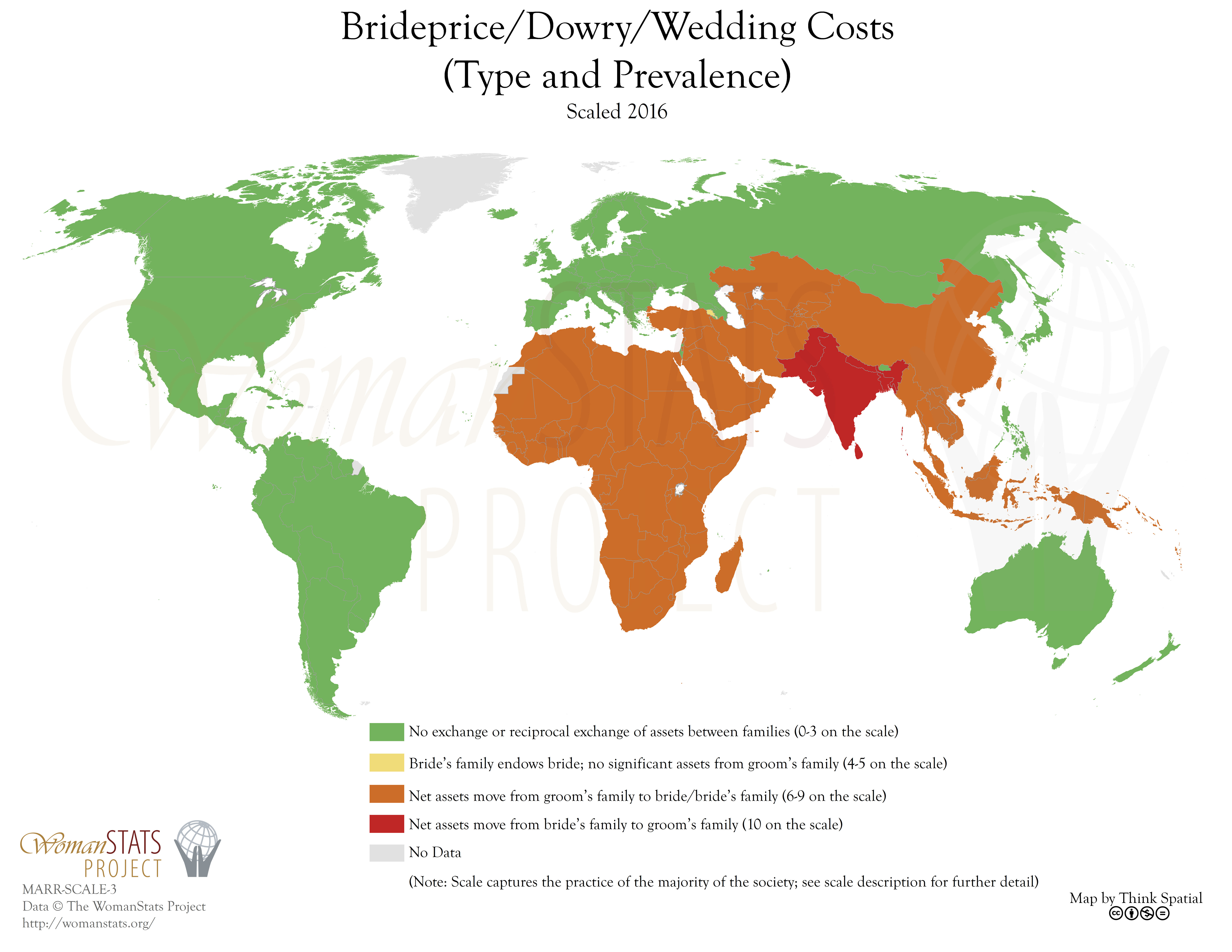
A brideprice is a payment (monetary or non-monetary) from the family of the groom to the family of the bride, on the occasion of their wedding. It is the norm throughout Africa, and most of Asia (excepting South Asia), as the following map shows (though note that sub-national heterogeneity is not shown, and there are areas in Africa where brideprice is not the norm):


In a recent article published in the journal International Security (ungated version here), Valerie Hudson (Texas A&M University) and Hilary Matfess (Yale) explain the economics of brideprice, and there is a lot of good economics in the article (so forgive the number of quotes, but the story is interesting):
The status of males in patrilineal societies is strongly linked to marriage. Not only does marriage mark the transition to manhood in patrilineal societies, but it establishes the male as a source of lineage and inheritance within the larger patriline. The marriage imperative is thus deeply felt among males in such cultures. And yet, marriage is unobtainable without assets...
Marriage in patrilineal societies is accompanied by asset exchange, wherein brideprice offsets the cost to the natal family of raising the bride... In addition to patrilocal marriage and the lack of female property rights mentioned above, these societies are characterized
by arranged marriage in the patriline’s interest; a relatively low age of marriage for girls; profound underinvestment in female human capital; intense son preference, resulting in passive neglect of girl children or active female infanticide/sex-selective abortion; highly inequitable family and personal status law favoring men; and chronically high levels of violence against women as a means to enforce the imposition of the patrilineal system on often recalcitrant women...
In patrilineal systems, brideprice is essentially an obligatory tax on young men, payable to older men...
...men pay for their sons’ brideprices by first collecting the brideprice for their daughters. Such transactions are another force pushing down the age of marriage among girls in brideprice societies, in addition to the desire to stop providing for daughters who, socially, will become the responsibility of another family. Unless a family is very wealthy, daughters in general must be married off first, so that the family can accumulate enough assets to pay the sons’ brideprices... If brideprice were not standardized within the society, families could not count on the brideprices brought in by their daughters being sufficient to cover the costs of their sons’ marriages. Thus, over time, a fairly consistent brideprice emerges for the community at any given time, though the actual cost may vary somewhat over time depending on local conditions...
Given the tendency toward brideprice inflation, an unequal distribution of wealth will amplify market distortions by facilitating polygyny...
Given both low investments in women’s health and the early age of marriage for girls in these societies, maternal mortality rates in most patrilineal societies tend to be egregiously high...
Thus, both polygyny and higher rates of post-marriage female mortality increase the ratio of marriageable males to marriageable females. Sometimes this scarcity produces extreme downward pressure on the marriage age of girls in a given society, with some marrying off girls as young as eight...
The patrilineal syndrome, therefore, is primed to produce chronic marriage market obstruction because (1) brideprice acts as a flat tax on young men that they cannot refuse to pay without suffering profoundly adverse social consequences; (2) brideprice catalyzes polygyny among the wealthier segments of society; and (3) the devaluation of women’s lives leads to high female mortality...
Marriage market obstruction, in turn, can be an important factor driving young men to join violent groups. The flat and inflationary nature of brideprice guarantees that poor young men will be hard-pressed to marry... These young men are not taking up arms against the institution of brideprice. Rather, at the individual level, a young man engages in violence to become more successful within the patrilineal system...
Furthermore, if a family has many sons, it may strive mightily to get the first son married, but then the younger, higher birth-order sons (such as the third, fourth and fifth sons) are typically expected to find their own sources of funding to pay brideprice...
Being unemployed is never good, but being unemployed in a society where you can only become an adult man by marrying and in which marriage requires significant financial resources produces a clear intensification of vexation and desperation...
High levels of grievance open up an opportunity for anti-establishment groups to exploit young men attempting to gain the status and the assets needed to marry. Delayed marriage and, importantly, the threat that one may never father a son in a culture defined by patrilineality are common elements exploited by groups seeking young adult men interested in redressing the injustice they feel on a personal level, by force if necessary.
Hudson and Matfess illustrate their article with examples of Boko Haram in the Lake Chad Basin and northern Nigeria, and militia groups in South Sudan. In both cases, brideprice inflation has led armed groups to offer incentives in the form of wives to militants willing to sign up. Hudson and Matfess also offer the counter-example of Saudi Arabia, where the government has capped brideprice and also acted to reduce the cost of weddings.

The article argues that polygyny increases the scarcity of potential brides, and prices increase when 'resources' are scarcer, and this pushes up the brideprice. That puts brides out of reach of low-income men, particularly second and later sons who can't rely on their family to be able to pay the brideprice for them. This is not just a flat tax. Because the brideprice is the same regardless of income (it's not an example of the 'law of one price' I would have considered), it is a regressive tax (it takes up a higher proportion of the income of a lower income man than a higher income man). This regressive tax incentivises low income men to: (1) take up arms in order to have the insurgent group find them a wife (e.g. Boko Haram); or (2) to engage in cattle raiding with armed groups (e.g. South Sudan). Either way, their inclusion in the armed group is a way for the young men to get a wife that they otherwise could not afford.

Finally, economists usually frown on the use of price controls, since they tend to lower economic welfare (they create a deadweight loss). As the case of Saudi Arabia shows, this might be one of the few exceptions. Without controls on the brideprice, Saudi Arabia might have faced a whole lot more problems.

[HT: Marginal Revolution]

Saturday, 21 July 2018

The ancestral characteristics of modern populations

Economic development is remarkably persistent. There is plenty of research that demonstrates that historical patterns of development are predictive of current patterns of development (for example, refer to the research by Daron Acemoglu and James Robinson, as detailed in their book Why Nations Fail (which is on my long list of books-waiting-to-be-read).

Paola Giuliano (UCLA) and Nathan Nunn (Harvard) have a new dataset that, as far as I can see, has enormous potential for looking at a wide range of questions in development, as well as providing a host of candidate variables for use as instruments in otherwise-unrelated analyses. The development of the dataset is described in an article published earlier this year in the journal Economic History of the Developing Regions (ungated version here). The dataset itself is available from Nathan Nunn's website here.

The journal article by Giuliano and Nunn explains:
We contribute to this line of research by providing a publicly accessible database that measures the economic, cultural, political, and environmental characteristics of the ancestors of current population groups... Specifically, we construct measures of the average pre-industrial characteristics of the ancestors of the populations in each country of the world. The database is constructed by combining preindustrial ethnographic information for approximately 1,300 ethnic groups with information on the current distribution of approximately 7,500 language groups measured at the grid-cell level.
Giuliano and Nunn then go on to describe the dataset, as well as providing illustrations of the data. What particularly caught my eye was a brief analysis they did of the relationship between their historical geographic characteristics (meaning the average ancestral characteristics of populations living in current countries) and current GDP. They find that:
Not surprisingly, being further from the equator is positively associated with real per capita GDP. However, what is more surprising is that the ancestral measure appears to be much more strongly correlated than the contemporary measure. This is particularly striking since we would expect the ancestral measure to be more imprecisely measured than the contemporary measure.
They find similar results for ancestral ruggedness of the land, and ancestral distance from the coastline. The reason these results caught my eye was that it suggests to me that these variables might be suitable instruments for GDP in other analyses (such as when GDP would be endogenous in the particular model you are trying to run. If that was a bit too pointy-headed for you, don't worry. It just suggests that these variables have a lot of potentially cool uses for economists.

[HT: Marginal Revolution]

Tuesday, 9 January 2018

Households' fuel mix choices in Pakistan, and why policy change is necessary

As I mentioned in a post last June, indoor air pollution is a serious problem that kills an estimated 70,000 people annually in Pakistan, and about 1.6 million people globally each year (see here). Indoor air pollution is a serious problem for developing countries, so understanding why households (or more accurately, the people making decisions who live in households) choose to use fuels that lead to high levels of indoor air pollution (solid fuels such as firewood, animal dung, and crop residues) is important.

To date, most studies of fuel use have treated fuel selection as independent. That is, those studies make the assumption is that each household decides whether or not to use a fuel independent of their choices of whether the household also uses other fuels or not. The worst of those studies only consider the fuel that households use the most, and ignore the other fuels that make up the mix of fuels the household uses. Some better studies do look at fuel mixes, but the mixes that are investigated are pre-determined by the researchers, and therefore might not reflect the on-the-ground fuel mix selections of actual households.

In a new working paper, Muhammad Irfan, Gazi Hassan and I use household data from the 2013-14 Pakistan Living Standards Measurement Survey to look at the actual fuel mix selections of households and the non-price factors associated with fuel mix use. One important aspect of the paper is that we use cluster analysis to determine the fuel mixes that are used by households, and we identify seven fuel mix clusters, made up of different proportions of solid fuels (firewood, animal dung, and crop residues) and modern fuels (natural gas and LPG). Three of the fuel mixes use exclusively solid fuels (in different proportions), while the other four use a mixture of solid and modern fuels. For one of the latter four fuel mixes, households use on average 82% natural gas, 9.8% firewood, and small proportions of other fuels - we label this fuel mix as a 'clean' fuel mix, as it contains the highest proportion of the cleaner modern fuels.

We then look at the factors associated with choosing each fuel mix in preference over the other six options. There are many comparisons, so I won't go through them in detail. To summarise though, households that have higher income and education, and those that are in urban areas, are more likely to choose the clean fuel mix, while agricultural households and larger households (those with more people) are more likely to choose the fuel mixes that are predominantly solid fuels.

Given that income is one of the determinants of clean fuel mix selection, it is reasonable to ask whether Pakistan (as a middle-income country) could simply grow out of using solid fuels. We look at this question directly and find that this is unlikely, especially in rural areas. The most feasible way for Pakistan to shift households to cleaner fuel mix use is to promote the take-up of piped natural gas connections, especially outside large urban areas. In other words, it requires a clear policy change to drive a shift away from solid fuel use and the indoor air pollution it generates.

Saturday, 3 June 2017

Pakistan should subsidise LPG for heating and cooking

Indoor air pollution is a serious problem in many (or most) developing and middle-income countries. The main source of indoor air pollution is the burning of solid fuels (such as firewood, animal dung, or crop residues) for heating and cooking purposes. In Pakistan alone, the World Health Organization estimates that over 70,000 deaths annually can be attributed to indoor air pollution (see here), with the global total being around 1.6 million deaths annually.

When we think about demerit goods (goods that society would prefer there was less consumption of), there are typically two solutions. The first option is a command-and-control policy that prohibits or limits the consumption of the good. In this case, governments could ban the use of firewood. However, it is unlikely that such a ban is feasible. The second option is to tax the good, but again in this case taxing is not feasible as firewood, animal dung, and crop residues can be obtained at low (or no) cost by rural households direct from the source.

In a new working paper, Muhammad Irfan, Gazi Hassan and I use household data from Pakistan to estimate the price and fuel expenditure elasticities of demand for various fuels used for heating and cooking. Specifically, we pooled data from three waves of the Pakistan Social and Living Standard Measurement Survey (2007-08, 2010-11 and 2013-14), and used Deaton and Muellbauer's LA-AIDS (Linear Approximate Almost Ideal Demand System) model. That sounds complicated and fancy (and it is), but the output is pretty simple - it estimates all of the price and fuel expenditure elasticities for the different fuels (natural gas, LPG, firewood, agricultural waste/crop residues, animal dung, and kerosene). We were also able to estimate different elasticities for rural and urban households.

We found that all fuel types except natural gas were price inelastic at the national level and for urban households. In rural areas, natural gas and LPG were found to be more price elastic compared with urban areas. Fuel expenditures elasticities for all fuels were found to be positive and between zero and one.

Finally, we ran a fairly simple policy simulation to test how much solid fuel use could be reduced by subsidising the cleaner-burning fuels (LPG and natural gas). We found that subsidizing LPG dominates a subsidy of natural gas, producing a greater reduction in solid fuel use at a lower total cost to the government. If the government wants to subsidise only one clean fuel, they should subsidise LPG instead of natural gas. So, while it may be unusual for an economist to advocate in favour of a subsidy, in this case it probably makes a lot of sense, if you want to reduce the burden of disease from indoor air pollution.

Finally, this paper is also the first research paper from Muhammad's PhD thesis, so congratulations to him on that achievement, and I look forward to reporting on his future work in later posts.

Tuesday, 10 November 2015

What is a developing country, anyway?

I've always thought it problematic that we define "developing countries" (or "less-developed countries" or "low income countries" if you prefer) purely on the basis of income (or GDP per capita). There are many aspects of development that are not captured by income (although they may be correlated with income), such as health, education, good institutions, individual freedoms, and so on. The focus on income is one of the main reasons why we conflate under-development with poverty. While they may be related, they are not the same thing.

The Human Development Index (HDI) goes some way towards improving the categorisation of countries, but isn't really used when the big multilateral agencies consider categorising the countries that are most in need of assistance. Moreover, by its very nature as an index, it is uni-dimensional. What we need is a more multi-dimensional way of categorising the level of development of countries.

So, I was quite excited to recently read this 2014 CGD Working Paper by Andy Sumner (King's College London) and Sergio Tezanoz Vazquez (University of Cantabria). It builds on some earlier work of theirs that was published in the Journal of Development Studies in 2013 (sorry I don't see an ungated version online), and looks at a taxonomy of developing countries constructed in an explicitly multidimensional way.

The authors use cluster analysis to categorise countries, using variables across four main dimensions of development:

  1. Development as structural transformation - GDP in non-agricultural sectors (as a % of GDP), exports of primary commodities (as a % of GDP), GDP per worker (in constant 2005 PPP dollars, as a measure of productivity), number of scientific articles (per million people), and external finance (overseas development assistance, foreign direct investment, foreign portfolio investment, and remittances, as a share of GDP);
  2. Development as human development - poverty headcount (using a $2 per day poverty line), Gini coefficient (a measure of inequality), and malnutrition prevalence (low weight-for-age among those aged under five years);
  3. Development as democratic participation and improved governance - World Governance Indicators index, and POLITY 2 index; and
  4. Development as environmental sustainability - CO2 emissions (in metric tons per capita).
Cluster analysis is a really useful way of identifying observations (in this case, countries) that are similar across many dimensions. The important thing is that, unlike the HDI, the multi-dimensionality of the data is preserved. That means that you don't have a dichotomy (poor/non-poor countries), nor do you necessarily have a single development trajectory (from low income to high income). The authors note:
hierarchical cluster analysis allows one to build a taxonomy of countries with heterogeneous levels of development in order to divide them into a number of groups so that: i) each country belongs to one – and only one – group; ii) all countries are classified; iii) countries of the same group are, to some extent, internally ‘homogeneous’; and iv) countries of different groups are noticeably dissimilar. The advantage of this procedure is that it allows one to discern the ‘association structure’ between countries, which – in our analysis – facilitates the identification of the key development characteristics of each cluster.
Moreover, one of the great things about this working paper is that they look at two points in time (1995-2000, and 2005-2010), which allows them to:
...this analysis allows us to... analyse the dynamics of the development process of a single country in comparative terms (that is, in terms of the average development indicators of the "peer" countries belonging to the same cluster.
In both time periods, the authors identify five clusters of developing countries. The three variables in order with the greatest discriminating power (the variables that make countries in each country most different from each other) are poverty, quality of democracy, and productivity in the 1995-2000 data, and poverty, productivity, and quality of democracy in the 2005-2010 data. The consistency is reassuring.

The five clusters in 1995-2000 (in order from lowest average Gross National Income per capita to highest) were:
  1. Very poor countries with largely 'traditional' economies - 31 countries, including Democratic Republic of Congo, Rwanda, Pakistan, and Swaziland;
  2. Poor countries with democratic regimes but poor governance - 18 countries, including Ethiopia, India, Indonesia, and the Philippines;
  3. Countries with democratic regimes but high levels of inequality and dependency on external flows - 18 countries, including Moldova, Honduras, Colombia, and the Dominican Republic;
  4. "Emerging economies" that were primary product exporting with low inequality but high environmental pollution and severely constrained political freedoms - 11 countries, including Azerbaijan, China, Egypt, and Gabon; and
  5. Highly polluting and unequal emerging economies - 21 countries, including Ukraine, Thailand, Mexico, and Argentina.
In 2005-2010, four of the clusters maintain a similar definition, but Cluster 2 becomes "Countries with high poverty and malnutrition rates that are primary product exporting and have limited political freedoms".

To a large extent, the most interesting aspects of the paper are the dynamics, i.e. which countries move from one cluster to another over the period, and which countries remain in the same cluster. There is a lot of movement between clusters - too much to effectively summarise here. Some notable (to me!) movements though include Vietnam moving from Cluster 1 to the new Cluster 2, India (and Nigeria, Ethiopia, and Papua New Guinea) moving from Cluster 2 to Cluster 1, Indonesia (and Sri Lanka) moving from Cluster 2 to Cluster 3, Thailand (and Ukraine) moving from Cluster 5 to Cluster 3, and Iran moving from Cluster 5 to Cluster 4. All countries in Clusters 3 and 4 in the first period were still in the same clusters in the second period, which is also interesting.

Obviously, some improvements can be made in terms of which variables should be included in developing the clusters (the authors make this point themselves). However, I can see a lot of mileage in further exploring not only the results in this paper, but the approach to categorising developing countries and their development paths more generally.

Tuesday, 13 October 2015

Nobel Prize for Angus Deaton

The 2015 Sveriges Riksbank Prize in Economic Sciences in Memory of Alfred Nobel (aka Nobel Prize in Economics) has been awarded to Angus Deaton. I won't write too much here, but if you want to know a good deal about Deaton and his work see the links in this post by Tyler Cowen, this one by Alex Tabarrok, and additional links here.

Chris Blattman has an excellent piece, which I will largely echo. My own intersection with Deaton's work was during my PhD, where I undertook a fairly large (~680 households) household survey in Northeast Thailand. The Analysis of Household Surveys was one of many guidebooks that helped greatly with setting up the survey (along with several World Bank publications on the survey methods for the Living Standards Measurement Surveys which Deaton was also involved in), and the book was invaluable in the analysis phase (as you would expect from the title). In reading Deaton's work, I have come to realise just how much of his thinking had already been indirectly a part of my development economics training, even if my lecturers were not always explicit about their sources.

As others have mentioned, this is a very well deserved award for a wide body of work that has greatly enhanced our understanding of poverty, inequality, consumption, and development economics more generally. His contributions span both the theoretical, the empirical, and the analytical. Deaton's name had no doubt been on the shortlist for a number of years.

Friday, 7 August 2015

Bride price and the returns to education for women

Continuing the development economics theme this week, one of the most important and most studied development projects is the massive school building program in Indonesia in the 1970s, the Sekolah Dasar INPRES. Over 61,000 primary schools were constructed - about one for every 500 children aged 5-14, which roughly doubled the number of primary schools in the country, and increased the enrolment rates of children aged 7 to 12 from 69 percent in 1973 to 83 percent in 1978.

The effects of this program on educational attainment and wages for men were evaluated by Esther Duflo in this AER paper (ungated here). She found:
The INPRES program led to an increase in educational attainment in Indonesia. On average, the estimates indicate that the program led to an increase of 0.25 to 0.40 years of education (0.12 to 0.19 years for each new school built per 1,000 children), and increased by 12 percent the probability that an affected child would complete primary school. The estimates also suggest that the program led to an increase of 3 to 5.4 percent in wages.
A subsequent NBER working paper by Lucia Breierova and Esther Duflo (ungated here) showed that the effects on women's education were much smaller. Both studies make use of the fact that date and region of birth determine each person's exposure to the increased schooling (which overcomes the identification problem that would usually arise - since family characteristics determine the choice of schooling, and subsequent labour market outcomes).

Which brings me to this new paper (PDF) by Navaa Ashraf, Natalie Bau, and Nathan Nunn (all from Harvard) and Alessandra Voena (University of Chicago). Using the same dataset and identification, they set out to investigate the effect of bride price on education attainment among women. Bride price is the custom of the groom's family making a payment to the wife's family at the time of the marriage (it is the opposite of dowry). It's not about buying a bride - it is typically interpreted as rewarding the parents of the bride for their years of investment in their daughter, and compensating them for her no longer contributing to their household (directly). Bride price is (still) a reasonably common practice in parts of Africa and Asia.

The paper's findings are interesting:
We show that among ethnic groups that practice bride price, the amount that the bride’s family receives as a bride price payment increases with the level of education of the bride. Completing primary school is associated with a 100% increase in the bride price payment, completing junior secondary is associated with a further 40% increase, and completing college with another 100% increase. These relationships are very robust and remain strong even when conditioning on a large set of observable characteristics, as well as potentially endogenous characteristics like the groom’s education.
Essentially, they find that the impact of the school building program in Indonesia was much greater for ethnic groups that practice bride price, and was virtually zero for other ethnic groups. Moreover, they show similar results for Zambia (which had a similar, albeit smaller, wide-scale school building program in the 1990s and early 2000s). The reason why bride price had such positive effects on educational attainment for girls is that:
...bride price provides a greater incentive for parents to invest in girls' education, and it is these parents that are more likely to take advantage of the increased supply of schools by educating their daughters.
Bride price often gets and unfair rap, but this is one situation where it appears to have had a positive impact - young girls would have had less schooling in Indonesia had it not been for the existence of the bride price custom.

[HT: Kevin Grier at Cherokee Gothic]

Tuesday, 4 August 2015

El Nino, climate change, and agriculture in the tropics

Following on from yesterday's post on developing countries, today I read an interesting article from the AER Papers and Proceedings issue earlier this year (ungated version here; PDF), by Solomon Hsiang (University of California, Berkeley) and Kyle Meng (University of California, Santa Barbara). In the article, the authors investigate the relationship between the El Nino Southern Oscillation (ENSO) and agriculture in tropical and temperate countries. ENSO has been shown to cause large and systematic changes in local climatic conditions around the world, but these effects have the greatest impact in tropical countries.

The authors use as a measure of ENSO an index of sea surface temperature in the eastern Pacific Ocean (a commonly used measure). They find:
that ENSO systematically affects country level temperature and rainfall in the tropics... A rise in the ENSO index by +1°C increases local temperatures in the tropics by +0.27°C and lowers rainfall by -4.6 cm on average (combined over two years). For temperate countries, temperatures actually fall due largely to changes in atmospheric and ocean circulations, but only by half as much, and there is a small but insignificant positive effect on rainfall.
More importantly though, they find:
A +1°C increase in the ENSO index lowers cereal yields -2%, total cereal production -3.5%, and agricultural income -1.8% on average across the tropics. These effects are highly statistically significant and suggest that rises in prices do not fully compensate countries for declines in agricultural output... crop yields increase in temperate countries when the tropical Pacific warms, albeit with a smaller magnitude that is less significant.
Given that some (but not all) research suggests that future climate change will be linked to stronger ENSO events (for a great review see here), these results suggest that poor countries (which are disproportionately located in the tropics) could face decreased agricultural output, decreased food security, and decreased economic growth in the future. Perhaps it also helps to explain in part the poor past growth trajectories of these countries as well.

Monday, 3 August 2015

How love conquered marriage

One of the key differences between developed and developing countries is the presence (or absence) of complete and functional markets. In my graduate development economics class, we spend a fair amount of time talking about the causes and implications of incomplete labour markets, credit markets, and insurance markets. The absence of functional insurance markets is a big problem for people in developing countries and as you would expect, they have developed various strategies to insure themselves (either individually, as a household/family, or as a community) against adverse shocks such as bad weather. These strategies include share-cropping (which shares the risk of weather shocks between the tenant farmer and the landowner), choosing low-yield but low-risk crop varieties, temporary rural-urban migration to diversity sources of income, or diversifying geographically through marriage of family members into families located in other villages (or regions, or even countries).

One of the ways that a family can ensure that they diversify geographically is for parents to arrange marriages for their children. Late last year, Marginal Revolution pointed me to this interesting paper (PDF) by Gabriela Rubio (University of California, Merced), and I've been meaning to write about it for a while. Rubio uses data from the Indonesian Family Life Survey (IFLS) to investigate whether improved agricultural outcomes have reduced the need for arranged-marriage-as-insurance, and have led to the observed decline in arranged marriage in Indonesia (and in many other countries, though Rubio notes that India, Pakistan and Bangladesh are exceptions). From the paper:
The goal of this paper is to understand the main driver(s) of the transition by proposing and testing empirically a model of marital choices. I first show that this transition away from arranged marriages in favor of self-choice or “love” marriages is correlated with increases in education, formal employment, urbanization, and declines in agriculture. These trends are common in all the countries where micro-data is available, suggesting that despite having different institutions at work, there is a fundamental economic explanation behind these changes in marriage institutions.
Based on these patterns, I build a simple model of marriage choice. I assume that arranged marriages serve as a form of informal insurance (as suggested in the literature of sociology, anthropology and economics, e.g. Rosenzweig and Stark (1989)) whereas other marriages (outside one’s networks) do not...
The model predicts that arranged marriages disappear when the net benefits of the insurance arrangement decrease relative to the (unconstrained) returns outside of the social network. When this is the case, parents invest in more education for the child, effectively increasing her outside option and, thus, the probability that she will reject the arranged marriage.
Rubio first demonstrates that arranged marriage acts as a form of (imperfect) insurance. She then uses the progressive introduction of the Green Revolution across Indonesia from the 1960s to the 1980s as a quasi-experiment, to test her theory about the impact on arranged marriage. She finds:
...that the Green Revolution increased returns to schooling by an additional 2.1% to 4.7% per additional year of schooling, it increased mean income of agricultural households, and importantly, it decreased their income variance by 8.1% and 8.3%, respectively.
Importantly, because the income variance decreased, that made insurance less necessary, which in turn led to the main results:
As predicted, the Green Revolution resulted in a decline of 9 to 20 percentage points in the probability of having an arranged marriages [sic] for the cohort exposed to the Green Revolution, and in an increase in education of 0.3 to 0.5 years of schooling for the same cohort.
The results are robust to various alternative specifications that Rubio tries. Which may lead us to conclude that the Green Revolution conquered arranged marriage, leaving love to take over.

However, it does leave one important question unanswered - what is so different about India, Pakistan and Bangladesh? They've had similar increases in agricultural incomes to Indonesia (and other countries that Rubio identifies as having declining rates of arranged marriage), and they've had a reduction in variability of incomes as well due to the Green Revolution. So the need for arranged-marriage-as-insurance is lower in these countries too, and yet arranged marriage persists. Are South Asians simply more intent on maintaining marriage traditions than Indonesians, do they use arranged marriage to signal their group affiliations and maintain social capital, or are they much more risk averse (such that insurance is still necessary even in the wake of improved incomes)? These are questions to be answered in future research.

Sunday, 19 January 2014

The implications of rural-urban migration for children left behind

Back on New Years Day, Tyler Cowen at Marginal Revolution posted this "China fact of the day":
More than 61 million children — about one-fifth of the kids in China — live in villages without their parents. Most are the offspring of peasants who have flocked to cities in one of the largest migrations in human history. For three decades, the migrants’ cheap labor has fueled China’s rise as an economic juggernaut. But the city workers are so squeezed by high costs and long hours that many send their children to live with elderly relatives in the countryside.
The Washington Post article which inspired Tyler's post makes for sobering reading. But was no surprise to me. One of the first things I noticed during my PhD fieldwork in Northeast Thailand in 2003, was the number of children who were being raised by grandparents. Just like Beibei in the article.

Even worse, many of the grandparents that I spoke to related a similar story: The grandchild (or often grandchildren, since unlike China, Thailand didn't have a one child policy) are left with them while the parents go to work in Bangkok. The parents start off by visiting and bringing money with them, then after a couple of years this becomes sending money without visiting, and before long the remittances start to dry up. Eventually, the grandparents are left caring for the grandchildren without assistance from the parents at all. Now, of course this does not happen in all cases. But it was frequent enough of a story for me to refine my data collection on the fly to allow me to also partially investigate the question of whether these children were being made worse off.

The result was this working paper, co-authored with Steven Lim. In the paper, we look at how migration changes Lux's traditional domestic cycle, and how children are faring (in terms of anthropometric measures) in households of different types. We found that, relative to nuclear families (where both of the child's parents are present), children in other family types have significantly lower weight-for-height (with insignificant differences in weight-for-age or height-for-age). The implication is that children living without their parents have worse outcomes. Surprisingly though, the worst outcomes of all were for those children in extended families with both parents present. We put that result down to nutritional resources being spread among more dependents in those households.

Of course, this study was purely cross-sectional so we are limited in what we can say about causality. We couldn't even control for how long each child had been in their 'current' household type, which was a big limitation. I've been meaning to go back to similar research questions using some of the excellent panel data series that are available for developing countries, which might help to resolve the question of whether the type of household really matters.