Showing posts with label Intellectual property. Show all posts

Thursday, 6 November 2025

The economics of maps

I have always liked maps. When I was growing up, one of my favourite books was my Rand McNally atlas. I may even still have it, tucked away with its spine held together by masking tape (after years of overuse by my primary-school-aged self). When I'm reading some fantasy novel that has a map on the inside cover, I can find myself lost in the map before even getting to read the book, and then flicking back to the map any time some new location is mentioned. Right next to my laptop while I'm writing this is a sepia-toned desk globe than, in truth, takes up too much space on the desk but will not be foregone.

Given my interest in maps, I've been planning to read this 2020 article by Abhishek Nagaraj (University of California at Berkeley) and Scott Stern (MIT), published in the Journal of Economic Perspectives (open access), for some time (like many articles that have sat in my digital to-be-read pile for a long time). Nagaraj and Stern explain the economics of maps. This isn't the economics that uses maps, such as in the field of economic geography, but two other aspects. First, they review the economic and social consequences of maps. Second, they review the economics of mapmaking. Most of the article is devoted to the latter, and that's what I want to focus on as well.

First though, what is a map? In my classes, I use maps as an example of a model - an abstraction or simplification of reality. Nagaraj and Stern note that maps are composed of two elements: (1) spatial data; and (2) a design. As they explain:

At its core, a map takes selected attributes attached to a specific positional indicator (spatial data) and pairs it with a graphical illustration or visualization (design)...

Having separated a map into its constituent elements, Nagaraj and Stern then look at the economics of spatial data, and the economics of design. On data, they note that:

...mapping data is in many respects a classical public good. Almost by definition, mapping data is non-rival insofar as the use of data for a map by any one person does not preclude its use by others; moreover, the information underlying a given database is non-excludable because copyright law does not protect the copying of factual information. While the precise expression included within a database can be protected through copyright, the underlying geographical facts reflected in the database cannot be protected.

And just like most other public goods:

The combination of non-rivalry and non-excludability of mapping data makes its production prone to private underinvestment, providing a rationale for government support. Indeed, many of the most widely used maps rely on publicly funded geospatial data, including US Geological Survey topographical maps, Census demographic information, and local land-use and zoning maps.

On the other hand:

...there are important cases where mapping data is in fact excludable, either through secrecy or contract... Mapping data that allows for excludability exhibits properties more akin to a club good than a traditional public good. Specifically, the significant fixed costs of data collection combined with relatively cheap reproducibility creates entry barriers that supports natural monopolies or oligopolistic competition. It may be efficient for only a single firm to engage in data collection and for the industry to simply license these data (under agreed-upon contractual terms) from this monopoly provider.

Now, even when spatial data is protected and excludable:

...in the absence of perfect price discrimination, private entities may only provide mapping data at a high price (relative to near-zero marginal cost), reducing efficient access. Beyond pricing, the private provision of mapping data may additionally be concentrated in locations with high demand (such as urban areas) to the exclusion of less concentrated regions.

And that all accords with what we see. There are free sources of spatial data, which are public goods supported by governments or universities, alongside proprietary spatial databases that are club goods and only available at relatively high cost (to the dismay of researchers such as me!).

Turning to map designs, Nagaraj and Stern note that:

Like data, designs are also a knowledge good in that multiple individuals can use a particular map design (and so a design is non-rival) and the degree of excludability for a given design may vary with the institutional and intellectual property environment. With that said, a striking feature of a map design is that, almost by construction, a map is created for the purpose of visual inspection, and it is much easier to copy than a database (which might be protected by secrecy or contract). One consequence of this is that there may be underinvestment in high-quality and distinct designs for a given body of geospatial data.

They use this to explain why there is a lot of competition in the provision of map designs, which is why so many maps for particular purposes look the same. As Nagaraj and Stern explain:

A potential consequence of the non-excludability of mapping data and designs is inefficient overproduction of mapping products that compete with each other. Once a given map is produced for a particular location and application (say, a city-level tourist map), copycat maps can be produced at a lower sunk cost; because demand for maps of a given quality and granularity is largely fixed, free entry based on a given map involves significant business-stealing...

Taking both spatial data and map designs together, the role of intellectual property protection is important:

On the one hand, an absence of formal intellectual property protection leads to underinvestment in mapping data and high-quality map design, but inefficient entry by copycat mapmakers. On the other hand, a high level of formal intellectual property protection can shift the basis of competition away from imitation and towards duplicative investment. For example, over the past two decades, no less than four different organizations—including Google Street View, Microsoft StreetSide, OpenStreetCam project, and TomTom—have undertaken comprehensive and qualitatively similar initiatives to gather street-level imagery and mapping coordinates for the entire US surface road system.

So that explains why there are multiple Street View clones available. The firms are over-investing in goods that are protected by intellectual property. Do we really need multiple copycats of Google Street View? Also, in terms of intellectual property protection, I found this interesting:

In addition to employing copyright, firms often invest in additional strategies to protect their intellectual property. In particular, mapmakers have devised the idea of inserting fictional “paper towns” or “trap streets” in maps... This strategy allows them to detect rivals who might copy their data (rather than collecting similar data through an original survey) and thereby protect costly investment in original data collection. Such strategies are commonly deployed by mapmakers to this day for factual data...

Does that help to explain why people have been caught out following roads that don't exist, or trying to find towns that are misplaced? I guess that 'trap streets' or 'paper towns' are a good idea on a paper map, which requires a certain amount of attention to follow, but less suitable for digital maps that people follow blindly.

Nagaraj and Stern's article opens our eyes to the economics of maps, as well as their consequences. And now, I'm going to search my garage for my beloved Rand McNally atlas. If only I had a map to guide me as to where it is hiding!

Wednesday, 16 October 2024

The economic welfare gains from the introduction of generic weight-loss drugs

The Financial Times reported this week (paywalled):

India’s powerful copycat pharmaceutical industry is set to roll out generic weight-loss drugs in the UK within weeks, with one leading producer forecasting a “huge price war” that could widen access to the popular medicines.

Bengaluru-based Biocon is the first company to win UK authorisation to offer a generic version of Novo Nordisk’s Saxenda weight treatment and is ready to launch sales by November.

Saxenda is an older drug of the same GLP-1 drug class as the Danish company’s popular Ozempic diabetes treatment and Wegovy weight-loss medication.

In an interview with the Financial Times, Biocon chief executive Siddharth Mittal declined to comment on his pricing strategy for generic Saxenda, but predicted his company’s sales of the drug would reach £18mn annually in the UK after the expiry of its patent protection there next month. Mittal said he expected Biocon’s generic version of Saxenda to be approved by the EU this year and in the US by 2025.

“When the generics come in there will be a huge price war,” he said. “There is a huge demand for these drugs at the right price.”

To see how the introduction of generic medicines affects the market, consider the diagram of the market for Saxenda below. When the active ingredient in Saxenda is protected by a patent, the market is effectively a natural monopoly. That means that the average cost curve (AC in the diagram) is downward sloping for all levels of output. This is because, as the quantity sold increases, the large up-front cost of developing Saxenda (see here for example) will be spread over more and more sales, lowering the cost on average. If Novo Nordisk (the producer of Saxenda) is maximising its profits, it will operate at the quantity where marginal revenue meets marginal cost, i.e. at QM, which it can obtain by setting a price of PM (this is because at the price PM, consumers will demand the profit-maximising quantity QM). Novo Nordisk makes a profit from Saxenda that is equal to the area PMBKL. [*]


Now consider what happens in this market when the patent expires and generic versions of Saxenda enter the market. We end up with a market that is more competitive, which would operate at the point where supply (MC) meets demand. This is at a price of PC, and the quantity of QC. Notice that the price of Saxenda falls dramatically - this is how the price war that Mittal mentions will play out.

Now consider what happens to the other areas of economic welfare. Before the patent expires, the consumer surplus is equal to the area GBPM. After the patent expires, the consumer surplus increases to the area GEPC. Consumers are made much better off by the patent expiry, because they can buy Saxenda at a much lower price, and they respond by buying much more of it. The producer surplus, which was PMBHPC, becomes zero. [**] The competition between the producers drives this producer surplus down. Total welfare (the sum of consumer and producer surplus) increases from GBHPC to GEPC. So, society is better off after the patent expiry.

Now, you could argue based on this that expiring the patent earlier would be even better, given the economic welfare gain that would result. And while I have some sympathy for that view, governments should be a little cautious here. The large producer surplus from having the patent in place creates an incentive for the big pharmaceutical firms to develop these pharmaceuticals in the first place. So, an appropriate balance between patent protection and incentives for pharmaceutical development needs to be found. Nevertheless, it is clear that once patents expire, there is a large welfare gain to society at that point.

*****

[*] This is different from the producer surplus, which is the area PMBHPC. The difference between producer surplus and profits arises because of the fixed cost - in this case, the cost of development of Saxenda.

[**] If we treat this as continuing to be a natural monopoly after the patent expiry, the market makes a negative profit of -JFEPC (because the price PC is less than the average cost of production ACC). However, you could argue that because the firms producing the generic version didn't face the up-front cost of development, this is no longer a natural monopoly once the patent has expired.

Saturday, 15 May 2021

The case for waiving patent protection for coronavirus vaccines is weak

The week before last, my ECONS102 class covered intellectual property rights. So, the unfolding story of the US announcing the waiving of patent protection for coronavirus vaccines is timely. As the New Zealand Herald reported:

The United States is throwing its support behind efforts to waive intellectual property protections for Covid-19 vaccines in an effort to speed the end of the pandemic.

US trade representative Katherine Tai announced the Government's position amid World Trade Organisation talks over easing rules to enable more countries to produce more of the life-saving vaccines.

"The Administration believes strongly in intellectual property protections, but in service of ending this pandemic, supports the waiver of those protections for Covid-19 vaccines," Tai said.

But she cautioned that it would take time to reach the required global "consensus" to waive the protections under WTO rules, and US officials said it would not have an immediate effect on the global supply of Covid-19 shots.

The announcement has generated a lot of debate. Before we get to that though, let's review the arguments for and against strong protection of intellectual property rights. The 2018 Nobel Prize winner William Nordhaus outlined the trade-off inherent in intellectual property rights. Strong protection of intellectual property rights provides an incentive for investment in the creation or development of new intellectual property, but this also provides a limited monopoly to the holder of the intellectual property rights (patents are one example, but so are trademarks, which I discussed in this 2018 post). The monopoly that the strong intellectual property rights creates leads to a higher price for the goods or services derived from the intellectual property, and under-consumption (relative to the welfare-maximising quantity of consumption). Weak protection of intellectual property rights allows anyone to make use of the intellectual property, but reduces the incentive to create it in the first place. This is the trade-off: strong protection of intellectual property rights leads to under-consumption, but weak protection leads to under-investment.

By waiving the intellectual property rights on patented coronavirus vaccines, the US would move the needle from strong protection to weak protection. In theory, that would lower the price of vaccines and increase the quantity consumed. However, that assumes that the pharmaceutical firms are deriving monopoly profits from the vaccines. Despite Pfizer reportedly making billions of dollars from vaccine sales, and no doubt the other pharmaceutical firms are doing likewise, are they really profit maximising here? Remember that coronavirus vaccine sales are being made in response to advance market commitments - governments lined up to guarantee future vaccine purchases at an agreed price before any vaccine had even been approved. Although the pharmaceutical firms had a lot of market power, it seems unlikely that they were really exploiting that power in the face of a high degree of public scrutiny (they're not all being run by Martin Shkreli, after all).

However, as most commentators on the announcement have noted, the assumption that pharmaceutical firms are restricting the supply of vaccines in order to raise the price (which is what a monopoly firm would do in order to maximise profits) doesn't stand up to scrutiny. As Alex Tabarrok noted:

Patents are not the problem. All of the vaccine manufacturers are trying to increase supply as quickly as possible. Billions of doses are being produced–more than ever before in the history of the world. Licenses are widely available. AstraZeneca have licensed their vaccine for production with manufactures around the world, including in India, Brazil, Mexico, Argentina, China and South Africa. J&J’s vaccine has been licensed for production by multiple firms in the United States as well as with firms in Spain, South Africa and France. Sputnik has been licensed for production by firms in India, China, South Korea, Brazil and pending EMA approval with firms in Germany and France. Sinopharm has been licensed in the UAE, Egypt and Bangladesh. Novavax has licensed its vaccine for production in South Korea, India, and Japan and it is desperate to find other licensees...

That doesn't sound like firms that are trying to restrict supply. At least, that's the outward impression one gets. The vaccine supply chain is complicated, and has lots of moving parts. Derek Lowe has written about where the bottlenecks in the vaccine supply chain really are. He is worth quoting at length:

I’ve gone over these other problems before, but here’s a brief summary of those – not in any order, because it’s difficult to rank them and those ranks change. An obvious first problem is hardware: you need specific sorts of cell culture tanks for the adenovirus vaccines, and the right kind of filtration apparatus for both the mRNA and adenovirus ones. You also need specialized mixing equipment for the formation of the mRNA lipid nanoparticles. A good proportion of the world’s supply of such hardware is already producing the vaccines, to the best of my knowledge. Second, you need some key consumable equipment to go along with the hardware. Cell culture bags have been a limiting step for the Novavax subunit vaccine, as have the actual filtration membranes needed for it and others. These are not in short supply because of patents, and waiving vaccine patents will not make them appear. Third, you need some key reagents. Among others, there’s an “end-capping” enzyme that has been a supply constraint, and there are the lipids needed for the mRNA nanoparticles, for those two vaccines. Those lipids are indeed proprietary, but their synthesis is also subject to physical constraints that have nothing to do with patent rights, such as the availability of the ultimate starting materials. Supplies have been increasing via the tried and true method of offering people money to make more, but switching over equipment and getting the synthesis to work within acceptable QC is not as fast a process as you might imagine. Fourth, for all these processes, there is a shortage of actual people to make the tech transfer work. For most reasonably complicated processes, it helps a great deal to have experienced people come out and troubleshoot, because the number of tiny things that can go wrong is not easy to quantify. Moderna, for one, has said that a limiting factor in their tech-transfer efforts is that they simply do not have enough trained people to go around. And keep in mind that these all have to do with producing a stream of liquid vaccine solution – but you need what the industry calls “fill-and-finish” capacity to deal with it after that. Filling and capping sterile vials for injection is a specialized business and the great majority of large-scale capacity is already being used for the existing vaccines. Time and money will fix that, and has been, but waiving vaccine patents won’t.

Eric Crampton made some related points here. I'm not a huge defender of patents. I talk at length in my ECONS102 class about the problems they generate. But, for once at least, it is likely that patents are not the problem here. Similarly, pharmaceutical firms have a lot to answer for. Unlike their early approach to AIDS drugs though, it doesn't seem like they are the problem either. In fact, for once the pharmaceutical firms may actually be primarily focusing on providing social good (no doubt with a selfish eye on the good publicity that comes from being a successful vaccine manufacturer that 'saved the world').

We should also be considering the long-term incentives here. If governments squash intellectual property rights early following this pandemic, then that reduces the incentive for pharmaceutical firms to generate vaccines in the advent of future pandemics (remember the trade-off between strong protection and weak protection of intellectual property). If governments are intent on this path, then they really need to consider some alternative way of maintaining the incentive to innovate. Perhaps creating a fund like the Health Impact Fund, but for contingencies such as future pandemics. The WHO (or some other body) could administer the fund, which would be built up by contributions from governments. In the advent of a pandemic, pharmaceutical firms could be paid out of the fund, in exchange for making their vaccines available in the public domain. The challenge of course is determining the right amount to pay out of the fund. Perhaps the fund could be combined with a predetermined advance market commitment that would apply to any pandemic. It's a difficult question, with many aspects to be worked through, but definitely worth considering.

[Update:] The Economist also raises some good points (which I have also seen elsewhere):

We believe that Mr Biden is wrong. A waiver may signal that his administration cares about the world, but it is at best an empty gesture and at worst a cynical one.

A waiver will do nothing to fill the urgent shortfall of doses in 2021. The head of the World Trade Organisation, the forum where it will be thrashed out, warns there may be no vote until December. Technology transfer would take six months or so to complete even if it started today. With the new mrna vaccines made by Pfizer and Moderna, it may take longer. Supposing the tech transfer was faster than that, experienced vaccine-makers would be unavailable for hire and makers could not obtain inputs from suppliers whose order books are already bursting. Pfizer’s vaccine requires 280 inputs from suppliers in 19 countries. No firm can recreate that in a hurry.

In any case, vaccine-makers do not appear to be hoarding their technology—otherwise output would not be increasing so fast. They have struck 214 technology-transfer agreements, an unprecedented number. They are not price-gouging: money is not the constraint on vaccination. Poor countries are not being priced out of the market: their vaccines are coming through covax, a global distribution scheme funded by donors.

Saturday, 24 November 2018

The debate over a well-cited article on online piracy

Recorded music on CDs and recorded music as digital files are substitute goods. So, when online music piracy was at its height in the 2000s, it is natural to expect that there would be some negative impact on recorded music sales. For many years, I discussed this with my ECON110 (now ECONS102) class. However, in the background, one of the most famous research articles on the topic actually found that there was essentially no statistically significant effect of online piracy on music sales.

That 2007 article was written by Felix Oberholzer-Gee (Harvard) and Koleman Strumpf (Kansas University), and published in the Journal of Political Economy (one of the Top Five journals I blogged about last week; ungated earlier version here). Oberholzer-Gee and Strumpf used 17 weeks of data from two file-sharing servers, matched to U.S. album sales. The key issue with any analysis like this is:
...the popularity of an album is likely to drive both file sharing and sales, implying that the parameter of interest Î³ will be estimated with a positive bias. The album fixed effects vi control for some aspects of popularity, but only imperfectly so because the popularity of many releases in our sample changes quite dramatically during the study period.
The standard approach for economists in this situation is to use instrumental variables (which I have discussed here). Essentially, this involves finding some variable that is expected to be related to U.S. file sharing, but shouldn’t plausibly have a direct effect on album sales in the U.S. Oberholzer-Gee and Strumpf use school holidays in Germany. Their argument is that:
German users provide about one out of every six U.S. downloads, making Germany the most important foreign supplier of songs... German school vacations produce an increase in the supply of files and make it easier for U.S. users to download music.
They then find that:
...file sharing has had only a limited effect on record sales. After we instrument for downloads, the estimated effect of file sharing on sales is not statistically distinguishable from zero. The economic effect of the point estimates is also small.... we can reject the hypothesis that file sharing cost the industry more than 24.1 million albums annually (3 percent of sales and less than one-third of the observed decline in 2002).
Surprisingly, this 2007 article has been a recent target for criticism (although, to be fair, it was also a target for criticism at the time it was published). Stan Liebowitz (University of Texas at Dallas) wrote a strongly worded critique, which was published in the open access Econ Journal Watch in September 2016. Liebowitz criticises the 2007 paper for a number of things, not least of which is the choice of instrument. It is worth quoting from Liebowitz's introduction at length:
First, I demonstrate that the OS measurement of piracy—derived from their never-released dataset—appears to be of dubious quality since the aggregated weekly numbers vary by implausibly large amounts not found in other measures of piracy and are inconsistent with consumer behavior in related markets. Second, the average value of NGSV (German K–12 students on vacation) reported by OS is shown to be mismeasured by a factor of four, making its use in the later econometrics highly suspicious. Relatedly, the coefficient on NGSV in their first-stage regression is shown to be too large to possibly be correct: Its size implies that American piracy is effectively dominated by German school holidays, which is a rather farfetched proposition. Then, I demonstrate that the aggregate relationship between German school holidays and American downloading (as measured by OS) has the opposite sign of the one hypothesized by OS and supposedly supported by their implausibly large first-stage regression results.
After pointing out these questionable results, I examine OS’s chosen method. A detailed factual analysis of the impact of German school holidays on German files available to Americans leads to the conclusion that the extra files available to Americans from German school holidays made up less than two-tenths of one percent of all files available to Americans. This result means that it is essentially impossible for the impact of German school holidays to rise above the background noise in any regression analysis of American piracy.
I leave it to you to read the full critique, if you are interested. Oberholzer-Gee and Strumpf were invited to reply in Econ Journal Watch. However, instead they published a response in the journal Information Economics and Policy (sorry, I don't see an ungated version online) the following year.  However, the response is a great example of how not to respond to a critique of your research. They essentially ignored the key elements of Liebowitz's critique, and he responded in Econ Journal Watch again in the May 2017 issue:
Comparing their IEP article to my original EJW article reveals that their IEP article often did not respond to my actual criticisms but instead responded, in a cursorily plausible manner, to straw men of their own creation. Further, they made numerous factual assertions that are clearly refuted by the data, when tested.
In the latest critique, Liebowitz notes an additional possible error in Oberholzer-Gee and Strumpf's data. It seems to me that the data error is unlikely (it is more likely that the figure that represents the data is wrong), but since they haven't made their data available to anyone, it is impossible to know either way.

Overall, this debate is a lesson in two things. First, it demonstrates how not to respond to reasonable criticism - that is, by avoiding the real questions and answering some straw man arguments instead. Related to that is making your data available. Restricting access to the data (except in cases where the data are protected by confidentiality requirements) makes it seem as if you have something to hide! In this case, the raw data might have been confidential, but the weekly data used in the analysis are derivative and may not be. Second, as Leibowitz notes in his first critique, most journal editors are simply not interested in publishing comments on articles published in their journal, where the comments might draw attention to flaws in the original articles. I've struck that myself with Applied Economics, and ended up writing a shortened version of a comment on this blog instead (see here). It isn't always the case though, and I had a comment published in Education Sciences a couple of months ago. The obstructiveness of authors and journal editors to debate on published articles is a serious flaw in the current peer reviewed research system.

In the case of Oberholzer-Gee and Strumpf's online piracy article, I think it needs to be seriously down-weighted. At least until they are willing to allow their data and results to be carefully scrutinised.

Friday, 19 October 2018

The economics of trademark protection

Last week, William Nordhaus won the Nobel Prize in economics and as I mentioned at the time, one of his contributions to economics was a recognition of the trade-offs inherent in the protection of intellectual property rights. Strong intellectual property rights provide an incentive for investment in creation or development of new intellectual property, but they also provided a limited monopoly to the holder of the intellectual property rights. The trade-off (as we'll see a little later in this post) is between under-creation of intellectual property if there is weak protection, and under-consumption of the intellectual property if there is strong protection.

Intellectual property rights can be protected through patents or copyright, or through trademarks as this article from last week notes:
Trademark protection is available to businesses of all sizes and there are very good reasons for traders to use that protection...
The registered owner is deemed to have the exclusive right to use the mark throughout New Zealand in relation to all the goods and services it covers; the owner's rights are on a publicly searchable register, which may have a deterrent effect on copy-cats; and it has the right to sue under the the [sic] Trade Marks Act 2002...
...the trademark system also has wider economic benefits.
Providing legal protection for brands incentivises businesses to invest in building goodwill and reputation by producing high quality goods and services.
Trademarks provide an incentive for Firm A to invest in building goodwill, because Firm A's goodwill can't be captured by other firms that are pretending to sell Firm A's goods. Consider the diagram below, which shows the market for a firm selling a trademarked product. The trademark makes the firm a monopoly (in this particular trademarked product). It gives the firm some market power. The trademark is costly to obtain (it involves the cost of the trademark itself, but also the cost of building consumer awareness of the brand the trademark protects), and that fixed cost leads to some economies of scale. This is why the average cost (AC) curve is downward sloping. If the firm is maximising its profits, it will operate at the point where marginal revenue meets marginal cost, i.e. at the quantity QM, which it can obtain by setting a price of PM (this is because at the price PM, consumers will demand the profit-maximising quantity QM). The firm makes a profit that is equal to the area PMBKL. [*]


Now consider what would happen if there was no trademark protecting the product. Other competing firms would realise that this product is quite profitable, and they would start to sell it (since there is no trademark stopping them from doing so). We end up with a market that is more competitive, which would operate at the point where supply (MC) meets demand. This is at a price of PC, and the quantity of QC. Notice that the price is now below average cost - the firm that developed the product sells at a loss (equal to the area JFEPC). [**]

So, if there is strong intellectual property rights protection (trademarks in this case, but a similar analysis applies to patents or copyright), there would be less consumption of intellectual property (because QM is much less than QC). But, if there is weak intellectual property rights protection, there would be less development of intellectual property in the first place (because the developer would face the costs of development, but could not easily profit from it).

Trademarks are clearly valuable for firms, but the article also argues that they are valuable for consumers:
Trademark protection also has a consumer welfare aspect. Trademarks are "badges of origin" for consumers, a sort of guarantee to indicate that a product or service comes from a trusted, reliable source.
Regulating their use (and misuse) helps to protect the buying public from confusion and, at worst, physical harm.
At the extreme end of the spectrum, counterfeit products can pose an active risk to health.
Last month, the BBC reported hundreds of thousands of pounds of counterfeit cosmetics had been seized in the UK, some of which contained chemicals such as highly toxic mercury and the illegal levels of the skin-whitening agent hydroquinone.
Intellectual property rights is an interesting topic that I cover in my ECONS102 class, particularly because it involves a difficult trade-off. It isn't clear how strong intellectual property rights protection should be, in order to balance under-consumption (relative to an economic-welfare-maximising point) against under-development (because of the lack of profits from developing intellectual property). Clearly, we still don't have the balance right if we are still facing drug pricing that works like this.

*****

[*] This is different from the producer surplus, which is the area PMBHPC. The difference between producer surplus and profits arises because of the fixed cost - in this case, the cost of the trademark and product development.

[**] The producer surplus in this case is zero. This is because the diagram shows a 'constant cost' firm, where marginal cost is constant (so every unit costs the same to produce), and the equilibrium price is equal to marginal cost. Also, more realistically if you don't create the trademark in the first place, the fixed cost is eliminated. So there is no loss, but there is also no profit because every unit is sold at its marginal cost.

Sunday, 5 November 2017

Book Review: The Knockoff Economy

Intellectual property rights face a significant trade off, identified by the economist William Nordhaus. The trade-off is between having weaker (or shorter) intellectual property rights, which would lead to under-investment in intellectual property development, or having stronger (or longer) intellectual property rights, which would lead to under-consumption of intellectual property. For instance, if the government strongly protects intellectual property (through longer periods of copyright or patent protection), then that increases the incentives for inventors or artists to invest the time and effort necessary to create new inventions, write new books, create new artworks and so on. This is because the strong intellectual property rights create limited natural monopolies for the rights holders, allowing them to raise the price and increase their profits. However, those higher prices reduce the consumption of the intellectual property relative to the case where intellectual property rights were weaker (or less long-lasting).

However, is it always the case that stronger intellectual property rights foster innovation, and weaker intellectual property rights deter inventors or creators from inventing or creating? This is the question that is addressed in a 2012 book by Kal Raustiala and Christopher Sprigman, entitled The Knockoff Economy: How Imitation Sparks Innovation. In the book, the authors look mainly at three industries (fashion, cuisine, and stand-up comedy) and show that substantial innovation occurs in each case in spite of a lack of strong enforcement of intellectual property rights. Indeed, in the examples discussed in the book, copyright and patents are either not used, or are not available. And yet, in all cases there is a great deal of ongoing innovation. This narrative provides a strong counter-argument to the seemingly-constant increases in the strength and length of intellectual property rights protection being granted in many western countries, especially the U.S.

As I was reading through the book, I made a large number of notes of things I wanted to discuss in my review, but there is really no way I could address them all and keep this post manageable. Because in each of the three cases that make up the first three chapters of the book (fashion, cuisine, and stand-up comedy), the reasons why innovation remains high are quite different. On fashion, the authors note that:
...the apparel industry is not just surviving - it is thriving. Extensive and legal copying accelerates the fashion cycle, banishing once-desired designs to the dustbin of apparel history (perhaps later to the dusted off and reintroduced) and sending the fashion-conscious off in search of the new, new thing.
In the fashion industry, the act of copying drives innovation because there are customers who really want something new, but they are only driven to something new once many others have started wearing the old, new fashions. Cuisine, though, is different. It is robust to copying because you aren't really buying just the meal but an experience, which is difficult to copy:
The dish you crave must be purchased as part of a larger, multifaceted transaction, replete with various courses, beverages, and side dishes. There are ambience, service, energy, and other intangibles in the mix. All of these factors work together. Copying one aspect - the main dish - may be easy. Copying the experience in full is virtually impossible. The experience is less one of buying a product and more that of enjoying a performance.
Chefs may copy each others' dishes, but they also care about their reputation, which is even more the case for stand-up comics. It is social norms that keeps copying of stand-up jokes in check. The authors write that:
...comedians' norm system includes informal but powerful punishments. These start with simple bad-mouthing and ostracism. If that doesn't work, punishments may escalate to a refusal to work with the offending comedian. Occasionally, comedians threaten joke thieves and even beat them up. None of these sanctions depend on legal rules - indeed, when comedians resort to threatening or beating up other comics, that's obviously against the law. Yet these tactics work.
That last point reminded me of Elinor Ostrom's work on informal agreements to deal with common resource problems, and it would have been good if the authors had also noted this parallel. The idea of the fashion cycle made me think about viral smartphone apps - could a case be made for removing copyright protection from smartphone apps, in order to drive more innovation (if indeed, we want more innovation in that space)?

The book looks also in less detail at a number of other areas of innovation including football (of the American variety), fonts, finance, and databases. In these cases, the authors draw the important distinction between 'pioneers' (those who first invent something) and 'tweakers' (those who take the original invention and improve it). This process of pioneer innovation followed by tweaking has been a driver of improved quality in many cases, and the authors essentially argue that this is likely to be true in many more domains. It is an attractive argument, particularly when you consider an area like pharmaceuticals, where monopoly pricing is problematic.

Overall, I really enjoyed this book. If you're interested in intellectual property or innovation, then this is definitely a good read.

Saturday, 8 July 2017

Rockonomics: The economics of popular music

I really enjoyed my time in Seattle, and especially the Museum of Pop Culture. The plane trip from Seattle to Portland (which we also visited before returning to New Zealand) seemed an opportune time then to read this 2006 chapter (with the same title as this post) from the Handbook of the Economics of Art and Culture (ungated earlier versions here and here), by Marie Connolly and Alan Krueger (both Princeton).

That chapter had been sitting in my must-read pile for about ten years (!), but for whatever reason consistently kept getting bumped a little lower down the pile. It is important to me because the economics of popular music provides a lot of good illustrations of the things we teach in first year microeconomics. So given that ECON100 and ECON110 both start B Semester lectures next week, in this post I'm going to take some brief quotes (taken from the NBER working paper version of the chapter) from the chapter to illustrate some of the things we will cover in those papers.

Besides that, the chapter includes a lot of interesting detail on the structure of the music economy. Consider these bits, which relate to the ECON110 topic on media economics:
...it is clear that concerts provide a larger source of income for performers than record sales or publishing royalties. Only four of the top 35 income-earners made more money from recordings than from live concerts, and much of the record revenue for these artists probably represented an advance on a new album, not on-going royalties from CD sales... 
If a band composed its own music, it will also contract with a publisher to copyright the music... The publisher usually takes half the royalties, and the composer receives the other half (some of which goes to the manager).
...bands receive relatively little of their income from recording companies. Indeed, only the very top bands are likely to receive any income other than the advance they receive from the company, because expenses – and there are many – are charged against the bands advance before royalties are paid out...
Record companies tend to sign long-term agreements with bands that specify an advance on royalties and a royalty rate. The typical new band has very little negotiating power with record labels, and the advance rarely covers the recording and promotion costs, which are usually charged to the band. Because fixed recording costs vary little with band quality, only the most popular artists earn substantial revenue from record sales...
[Quoting Jacob Slichter, the drummer for Semisonic]: If our CD was sold in stores for fifteen dollars, the band’s share of the revenue might be something between fifty cents and a dollar per CD.
We cover moral hazard in both ECON100 and ECON110. Moral hazard occurs when one of the parties to an agreement has an incentive, after the agreement is made, to act in a way that brings additional benefits to themselves at the expense of the other party. In relation to that Connolly and Krueger write:
Caves prosaically notes that, “From the artist’s viewpoint, a problem of moral hazard arises because the label keeps the books that determine the earnings remitted to the artist.”
So, the recording label engages in moral hazard because it provides additional benefits to the label, and because the artists cannot easily monitor what the label is doing when it estimates earnings and costs and what should be paid to the artist. There are also a number of points that Connolly and Krueger write in relation to pricing (which we cover in ECON100), including:
As an economic good, concerts are distinguished by five important characteristics: (1) although not as extreme as movies or records, from a production standpoint concerts have high fixed costs and low marginal costs; (2) concerts are an experience good, whose quality is only known after it is consumed; (3) the value of a concert ticket is zero after the concert is performed; (4) concert seats vary in quality; (5) bands sell complementary products, such as merchandise and records...
The price of a concert ticket is set lower than it would be in the absence of complementary goods, because a larger audience increases sales of complements and raises revenue.
Firms that sell complementary products need not necessarily profit maximise for any of those products individually, if they can profit maximise across the whole range of their products. And in terms of price elasticity (covered in ECON100):
...despite flat or declining tickets sales, total revenues (in 2003 dollars) trended upwards until 2000 because of price increases. Other things equal, these trends suggest the elasticity of demand was less than 1 before 2000. Since 2000, however, there has been a 10 percent drop in ticket revenue for these artists, suggesting that prices increases have been offset by a larger than proportional demand response.
When demand is relatively inelastic, a given percentage increase in price is associated with a smaller percentage decrease in quantity demanded, so total revenues (price x quantity) increases. This is what happened prior to 2000, but after 2000 demand appears to have been elastic, so that the percentage increase in price was more than offset by a larger percentage decrease in quantity demanded, meaning that total revenues (price x quantity) decreased.

Connolly and Krueger cover inequality as well (as we will in ECON110):
...concert revenues became markedly more skewed in the 1980s and 1990s. In 1982, the top 1% of artists took in 26% of concert revenue; in 2003 that figure was 56%. By contrast, the top 1% of income tax filers in the U.S. garnered “just” 14.6% of adjusted gross income in 1998 (see Piketty and Saez, 2003). The top 5% of revenue generators took in 62% of concert revenue in 1982 and 84% in 2003.
And on intellectual property rights (which we cover in ECON110):
How far does intellectual protection go? Are rights strong enough to encourage the optimal amount of innovation? The problem stems from the fact that musical compositions are nonrival goods, whose property rights, as laid out by Nordhaus (1969), generate a trade-off between under-provision of the nonrival good (with weak rights) on the one hand and monopoly distortions (when the property rights are strong) on the other. 
Nordhaus's characterisation of the trade-offs inherent in intellectual property is one of the key pillars of the ECON110 topic on intellectual property rights. There are other bits of interest, including ticket scalping (which we cover in both ECON100 and ECON110), signalling (also both ECON100 and ECON110), and superstar effects (which we discuss in ECON110). A few parts of the chapter are a little technical, but all of it is interesting, and there are lots of gems to take away. Some parts of the chapter are getting a little dated, but mostly it has aged well and if you like to see economics in action, I encourage you to read it.

Saturday, 3 September 2016

The Epipen price increase explained

I had been holding off posting about the increase in the price of EpiPens (400% over the last several years), waiting for my ECON100 and ECON110 classes to cover monopoly, market power, and intellectual property. However, Alex Tabarrok at Marginal Revolution pointed to this excellent Slate Star Codex post, which breaks it down nicely and saves me the trouble:
EpiPens, useful medical devices which reverse potentially fatal allergic reactions, have recently quadrupled in price, putting pressure on allergy sufferers and those who care for them...
...when was the last time that America’s chair industry hiked the price of chairs 400% and suddenly nobody in the country could afford to sit down? When was the last time that the mug industry decided to charge $300 per cup, and everyone had to drink coffee straight from the pot or face bankruptcy? When was the last time greedy shoe executives forced most Americans to go barefoot? And why do you think that is?
The problem with the pharmaceutical industry isn’t that they’re unregulated just like chairs and mugs. The problem with the pharmaceutical industry is that they’re part of a highly-regulated cronyist system that works completely differently from chairs and mugs.
If a chair company decided to charge $300 for their chairs, somebody else would set up a woodshop, sell their chairs for $250, and make a killing – and so on until chairs cost normal-chair-prices again. When Mylan decided to sell EpiPens for $300, in any normal system somebody would have made their own EpiPens and sold them for less. It wouldn’t have been hard. Its active ingredient, epinephrine, is off-patent, was being synthesized as early as 1906, and costs about ten cents per EpiPen-load...
Why can't generics compete? It's our old favourite, rent-seeking behaviour in the form of lobbying, at work:
So why is the government having so much trouble permitting a usable form of a common medication?
There are a lot of different factors, but let me focus on the most annoying one. EpiPen manufacturer Mylan Inc spends about a million dollars on lobbying per year...
Imagine that the government creates the Furniture and Desk Association, an agency which declares that only IKEA is allowed to sell chairs. IKEA responds by charging $300 per chair. Other companies try to sell stools or sofas, but get bogged down for years in litigation over whether these technically count as “chairs”. When a few of them win their court cases, the FDA shoots them down anyway for vague reasons it refuses to share, or because they haven’t done studies showing that their chairs will not break, or because the studies that showed their chairs will not break didn’t include a high enough number of morbidly obese people so we can’t be sure they won’t break. Finally, Target spends tens of millions of dollars on lawyers and gets the okay to compete with IKEA, but people can only get Target chairs if they have a note signed by a professional interior designer saying that their room needs a “comfort-producing seating implement” and which absolutely definitely does not mention “chairs” anywhere, because otherwise a child who was used to sitting on IKEA chairs might sit down on a Target chair the wrong way, get confused, fall off, and break her head.
(You’re going to say this is an unfair comparison because drugs are potentially dangerous and chairs aren’t – but 50 people die each year from falling off chairs in Britain alone and as far as I know nobody has ever died from an EpiPen malfunction.)
Imagine that this whole system is going on at the same time that IKEA spends millions of dollars lobbying senators about chair-related issues, and that these same senators vote down a bill preventing IKEA from paying off other companies to stay out of the chair industry. Also, suppose that a bunch of people are dying each year of exhaustion from having to stand up all the time because chairs are too expensive unless you’ve got really good furniture insurance, which is totally a thing and which everybody is legally required to have.
Nicely said. Give a firm market power, grant it even a limited monopoly, and it has incentives to raise price to maximise profits. Which we see again and again in the pharmaceutical industry.

Read more:

Thursday, 9 June 2016

Don't expect new antibiotics anytime soon

The most read post on my blog is this one from 2014 on the economics of drug development and pricing. Maybe it's time for a follow-up, but this time with a more specific focus, on antibiotics.

The Economist had an excellent (albeit somewhat scary) article last month about antibiotic resistance:
A thorn scratch today seems a minor irritant, not a potential killer. But that may be too sanguine. A study by America’s Centres for Disease Control (CDC) found that the number of cases of sepsis rose from 621,000 to 1,141,000 between 2000 and 2008, with deaths rising from 154,000 to 207,000. One reason for that is the emergence of MRSA (pictured being attacked by a white blood cell)—a variety of Staphylococcus aureus that cannot be killed with methicillin, one of penicillin’s most effective descendants. This could just be a taste of things to come. Three years ago the CDC produced a list of 18 antibiotic-resistant microbes that threaten the health of Americans (see table). Five of them (including MRSA) cause sepsis.
Microbes are increasingly exhibiting antibiotic resistance, not only to first-line antibiotics but to their alternatives as well. Without effective antibiotics, infections that were previously treatable become potentially life-threatening. That makes the development of new antibiotics important and increasingly urgent. However, as I noted in my 2014 post, the cost of developing new pharmaceutical drugs is very large. While pharmaceutical companies hope to recoup that cost through holding a natural monopoly over the drug and charging a relatively high price for it, in the case of antibiotics that is not necessarily assured, because there are already antibiotics that are effective in most cases, which means new antibiotics would only need to be used (hopefully) rarely. The Economist notes:
There are reasons for drug firms not to invest in antibiotics. Such companies increasingly prefer treatments for chronic diseases, not acute ones; the customers stick around longer. And despite the growing problem of resistance, most antibiotics still work for most things most of the time. Given that the incumbents are also cheap, because they are off-patent, new drugs cannot earn back their development costs. Even if they could, it would be poor public policy to let them; much better for new drugs to be used only sparingly, to forestall the development of further resistance. That further puts the kibosh on sales.
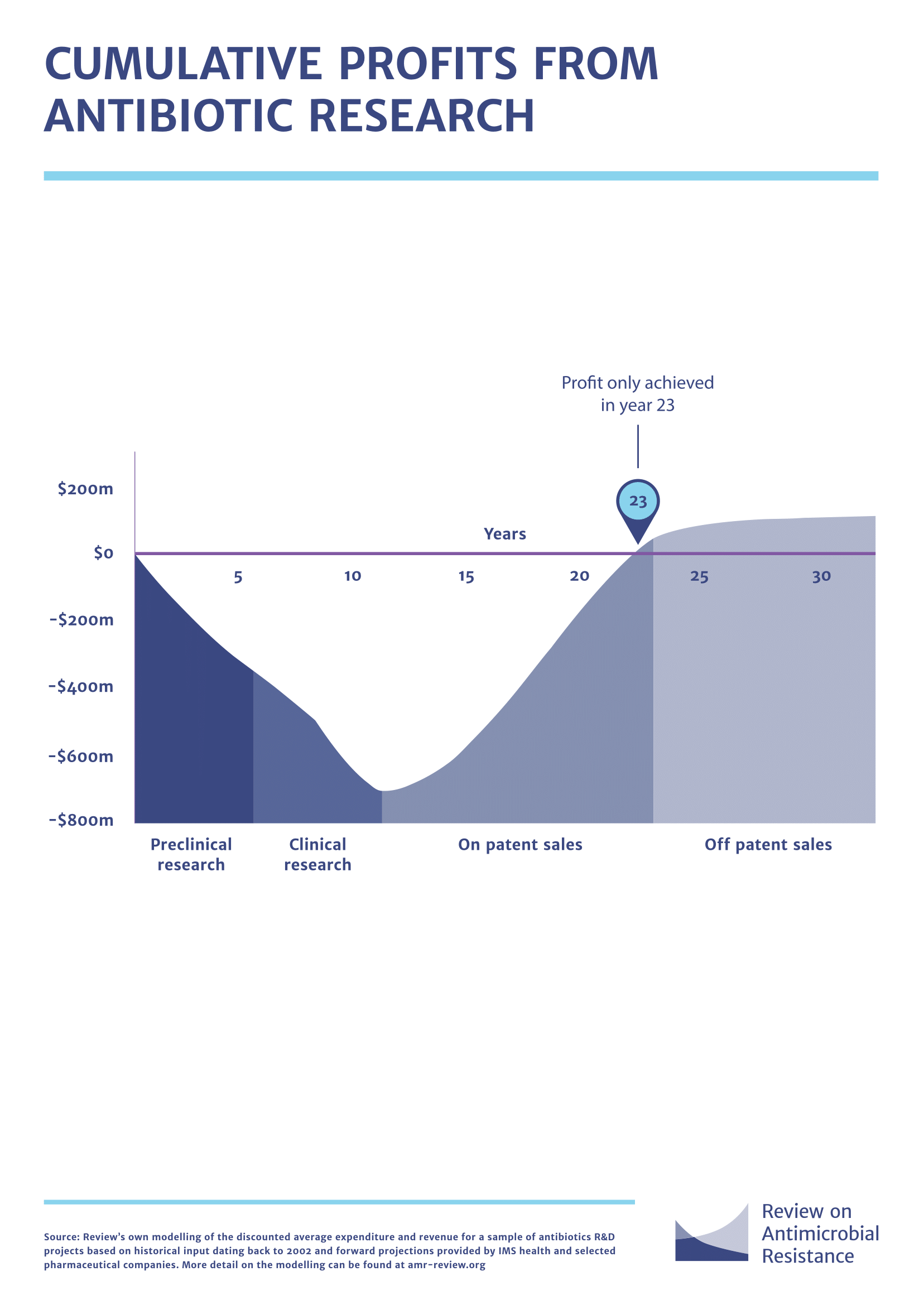
This figure (source here) also effectively demonstrates the case against developing new antibiotics:


It takes 23 years for a new antibiotic to break even. By then, the patent has almost expired and the drug will soon need to compete with generic competitors, which severely limits the profits available to the pharmaceutical firm. Most pharmaceutical firms are looking to invest in research that leads to quicker payoffs than that, and they have plenty of other research opportunities that they can invest in.

There are alternatives to the 'traditional' development-patent-monopoly approach. This is what I wrote in 2014, and it still stands:
A better option was laid out several years ago by Nobel Prize winner Joseph Stiglitz. Stiglitz argues convincingly that an alternative to the current intellectual property (patent) based regime is to offer prizes for firms that develop medicines, cures or vaccines for diseases that affect the poorest countries. Stiglitz says:
"A solution to both high prices and misdirected research is to replace the current model with a government-supported prize fund. With a prize system, innovators are rewarded for new knowledge, but they do not retain a monopoly on its use. That way, the power of competitive markets can ensure that, once a drug is developed, it is made available at the lowest possible price - not at an inflated monopoly price."
The trade-off for firms collecting the prize money (which would be contributed to mainly by developed country governments), is that their drug would have to be made available in the public domain (i.e. not patented). Then, generic drug manufacturers would be able to produce the drugs at low cost to provide to poor countries and rich countries alike. One promising example of this approach is the Health Impact FundAdvance market commitments are a similar idea.
Unless we apply some of these alternatives, the low incentive for pharmaceutical companies to develop new antibiotics will remain. So, don't expect new antibiotics anytime soon. It might be best to try and avoid infections.

Thursday, 7 August 2014

The Economics of Drug Development and Pricing

The week before last I spent a few days at the XXth International AIDS Conference in Melbourne. I couldn't be there for the whole conference because of my teaching commitments, which was a little disappointing because I appeared to miss a lot of the action. By action, I mean the inevitable protests that are a frequent sideline to these conferences.

However, I was at this session on "The Future of HIV and HCV Treatment - Patents, Pricing and Pharma" which was subject to a protest against the pharmaceutical company Gilead (see footage of the end of the protest here). The protesters were angry about the drug pricing for a new treatment for Hepatitis C, which costs around US$84,000 for a 12-week course of treatment in the U.S. You can see more about the pricing strategies of Gilead in this presentation from the same session. Gilead has negotiated a much lower price for the treatment in Egypt - US$900. However, in both cases (U.S. at $84,000 and Egypt at $900) the treatment is severely unaffordable for the majority of people with Hepatitis C. The protesters argue that this pricing strategy is costing lives.

What is Gilead doing? How can they justify such a wide variation in prices between the U.S. and Egypt? There are two key points here that relate to the economics of drug development and pricing.

First, drug development is very expensive (US$1.8 billion according to this source). Why so much? There are a lot of regulatory hurdles for drugs to overcome before they can be certified as safe and made available for patients, on top of the costs of research and development of the drugs themselves. Pharmaceutical companies have to be sure that they can recover the cost of development - otherwise it would make no sense for them to begin the drug development process. In fact, it's been argued that's the reason why there has been little in the way of development of new antibiotics in recent years - there's more money for pharmaceutical companies in researching drugs for orphan diseases than in developing new antibiotics. And this in spite of the impending doom of a "post-antibiotic era, in which common infections and minor injuries, which have been treatable for decades, can once again kill".

Once a new drug is developed, there is little in the way of ongoing costs and the marginal costs of producing the drug are fairly low. This means that pharmaceutical products are a form of natural monopoly - there are economies of scale, because the more that the company produces, the lower their average costs of production because the development costs can be spread over a greater quantity of production. Their natural monopoly is protected by the patents they are granted for the drugs. The protesters are effectively arguing that the pharmaceutical companies should be pricing at average cost, or even at marginal cost (or at least closer to those costs). In either case, this makes it much harder for the company to recoup their investment in development costs, much less any return on capital invested in the development process (see here for more on the problems of natural monopolies). So, the protesters are missing the point - if the pharmaceutical firms are forced to price their drugs low, they won't develop them in the first place.

The second point relates to the "variable pricing" scheme that the pharmaceutical companies use, where they price the drugs at low prices in developing countries and at much higher prices in developed countries. On the surface, this seems pretty unfair, but it is a straightforward application of price discrimination - where different consumers (or groups of consumers) are charged different prices for the same good or service, and where the difference in price does not arise because of a difference in cost (and which I've previously written on here). In price discrimination, the firm charges a higher price to groups of consumers that are willing to pay more for the good or service. For price discrimination to be effective, there must be different groups with different willingness-to-pay for the good or service, the firm must be able to determine which consumers belong to which group, and there must be no transfers between the sub-markets. It seems to me that patients (or health ministries, or health insurers) in developed countries are willing to pay more than those in developing countries, it's easy for the pharmaceutical company to tell the groups apart, and provided the firm negotiates a tight contract with developing country governments specifying no on-selling there will be little in the way of transfers between the sub-markets. So price discrimination is not only feasible, but likely, in this situation and should come as no surprise to us.

Drug development has also been in the news and blogosphere lately because of the Ebola outbreak in West Africa (see here and here and here). Two U.S. doctors received an untested (in humans) treatment, which is unlikely to be made widely available to public health authorities. Why? It hasn't gone through clinical trials yet, and as this news story notes:
Developing, trialling and licensing vaccines or treatments would cost significant amounts of money, and drugs companies argue there is not enough demand to justify the outlay.
“These outbreaks affect the poorest communities on the planet. Although they do create incredible upheaval, they are relatively rare events,” said Daniel Bausch, a medical researcher in the US who works on Ebola and other infectious diseases.
“So if you look at the interest of pharmaceutical companies, there is not huge enthusiasm to take an Ebola drug through phase one, two, and three of a trial and make an Ebola vaccine that maybe a few tens of thousands or hundreds of thousands of people will use.”
So, it seems unlikely that there will be a widely-available treatment or vaccine for Ebola in the near-term (see also here), because the costs of development outweigh the benefits of producing it for pharmaceutical firms. Of course, that ignores the substantial social benefits associated with saving lives (unless you are willing to argue that those benefits are captured in the willingness-to-pay for the treatment).

How do we get pharmaceutical companies to develop treatments, vaccines, or cures for diseases that mostly affect the developing world? It's stupid to wait until drugs are developed, and then protest and demand that pharmaceutical companies lower their prices - that reduces the incentives to develop the drugs in the first place.

A better option was laid out several years ago by Nobel Prize winner Joseph Stiglitz. Stiglitz argues convincingly that an alternative to the current intellectual property (patent) based regime is to offer prizes for firms that develop medicines, cures or vaccines for diseases that affect the poorest countries. Stiglitz says:
A solution to both high prices and misdirected research is to replace the current model with a government-supported prize fund. With a prize system, innovators are rewarded for new knowledge, but they do not retain a monopoly on its use. That way, the power of competitive markets can ensure that, once a drug is developed, it is made available at the lowest possible price - not at an inflated monopoly price.
The trade-off for firms collecting the prize money (which would be contributed to mainly by developed country governments), is that their drug would have to be made available in the public domain (i.e. not patented). Then, generic drug manufacturers would be able to produce the drugs at low cost to provide to poor countries and rich countries alike. One promising example of this approach is the Health Impact Fund. Advance market commitments are a similar idea.

So, perhaps the protesters' efforts are misguided - instead of banging on the doors of pharmaceutical firms, they should be joining with them to bang on the doors of government and potential donors, to generate funds for new drug development that would avoid the patent and monopoly pricing problems for all.