Showing posts with label Black markets. Show all posts

Thursday, 23 June 2022

Why price controls likely make things worse, not better

Phil Lewis wrote a good article on The Conversation today, about price controls:

Australian shoppers are facing a crisis in the fresh-food aisles.

Iceberg lettuces that cost $2.80 a year ago have doubled, or tripled, in price. Brussel sprouts that cost $4 to $6 a kilogram are now $7 to $14. Beans that cost $5 to $6 a kilogram are now more than double – and five times as much in remote areas...

The price hikes have led to calls for supermarkets to impose price caps to ensure shoppers can still afford to feed their families healthy food.

But price ceilings on goods or services rarely, if ever, work. Prices play an important role in allocating resources efficiently. They send a signal to both customers and suppliers. To arbitrarily reduce prices would only increase shortages – both now and in the longer term...

Higher prices provide a signal both to consumers and producers. They tell consumers to buy less and switch to alternatives. They provide an incentive for producers to grow more – though this process is fairly slow given the time needed to grow and harvest fruit and vegetables.

But eventually, if the market is left to its own devices, prices will eventually return to “normal”, consistent with historical prices.

Capping the price, on the other hand, will benefit those lucky enough to grab supplies when they available. But it will likely reduce supply even further, by affecting the decision of producers unwilling to supply at below-market prices.

It could also lead to a “black market”, with some customers sourcing supplies by other means at higher uncapped prices...

So generally price caps are to be avoided.

Now, if anything, Lewis understates the case against price controls (specifically, price ceilings - a legal maximum price which the market price is not allowed to exceed). Price ceilings are effective in lowering the price, but with a lower price, consumers want to buy more (this is the 'Law of Demand'). However, there isn't more to go around (if anything, the lower price reduces the incentive for sellers to supply the good. So, you have more consumers wanted to buy a restricted quantity of the good - it creates a shortage.

Shortages mean that the limited quantity available must be rationed in some way among the many consumers who want to buy at the low price. Usually, price is the main rationing mechanism in the market (only consumers who are willing and able to pay the market price will buy the good). However, when there is a price ceiling keeping the price artificially low, then some form of non-price rationing, is going to have to occur. Perhaps this rationing is based on who can get to the store first in the morning when the new stock is available, or is lucky enough to be at the store when shelves are re-stocked. Perhaps consumers have to queue in order to avoid missing out. Perhaps retailers have a lottery. Perhaps there is a rationing system where consumers are limited in the quantity they are allowed to buy. Perhaps interested consumers sign up and receive tickets that guarantee them a small amount of the good.

Notice how all of these non-price rationing alternatives do one of two things: (1) they impose a direct (non-monetary) cost on consumers (such as the time cost of queueing); or (2) they involve an element of luck. Higher non-monetary costs simply undo a lot of the good that the price ceiling was intended to create. Getting a good that you want only because you were lucky in a lottery, or happened to be in-store when shelves were re-stocked, is in my view not a particularly fair allocation system.

These non-price rationing schemes are also open to abuse, by consumers who are lucky (or who are happy to face the non-monetary cost) on-selling the goods to other consumers who are willing to pay more. This is the black market that Lewis refers to. And higher black market prices than the controlled price provide an incentive for unscrupulous sellers to ensure that their friends receive the goods in the lottery, or just happen to be in store at the right time. This sort of corruption is simply not worthwhile if there is no price ceiling in place.

For some graphic examples of how price ceilings can go wrong, look no further than rent controls (see some of my posts on that here, here, here, and here). The short version is that rent controls reduce economic welfare, they reduce the quality of housing available to rent, and they may even increase inequality. And, their effects get worse over time. In a famous quote, the Swedish economist Assar Lindbeck (who passed away in 2020) wrote that “Rent control appears to be the most efficient technique presently known to destroy a city - except for bombing.”

So, even though some consumers will certainly benefit from the lower prices that price controls create, we must never lose sight of the fact that they don't come with significant negative consequences as well. 

Monday, 6 December 2021

The supply of black market vaccine passes

I was interested to read this article from The Spinoff earlier this week:

New Zealand’s traffic light system comes into play today, and perhaps inevitably, it’s being accompanied by a new black market for stolen, shared and faked vaccine passes...

A Telegram seller who, when I last spoke to them, was selling fake vaccine record cards recently made a big pivot to buying and selling official My Vaccine Passes.

The seller, “Vax Card NZ”, told me via Telegram private message on Wednesday that they were diversifying: “Just transitioning to cover the digital passes, but we still are selling the cards.”

They went on to explain that they’re trying to build up a stock of official passes with a variety of names and birth dates. “We ideally need a variety of cards to cover the base demographics,” they said, in order to be able to offer suitable options to buyers. But so far they’ve not had much luck getting official cards, and have been raising the price they’re offering to buy the passes. “We started at $50 and are now offering $125, and will continue to raise prices until we are able to purchase enough stock,” they continued.

Clear evidence that the supply curve for vaccine passes starts from a point above the x-axis (nobody is willing to sell their vaccine pass even at a price of $50), and is expected to be upward sloping ('Vax Card NZ' will continue to raise prices until they are able to purchase enough stock'). I wonder how high the price will need to go before they have enough variety of passes to re-sell?

This bit is worrying though:

As of Wednesday, Vax Card NZ reported that they hadn’t been able to buy any cards, but they were expecting that to change. “This will likely happen when the passes start to be used as people will be able to photograph other people’s passes and then sell them,” they explained, pointing out that all they needed was an image of the official QR code in order to recreate the pass for sale.

This functionally creates a market for stolen vaccine passes, incentivising people to capture images of strangers’ vaccine passes; a process Vax Card NZ has called “mining” in their online advertisements. 

I guess that, just like your credit card, you want to be careful who is scanning your My Vaccine Pass, and what they are doing with it. To be safe, perhaps each of us should be looking at the screen of the scanner, to make sure that the person doing the scanning is using the official app, and not simply taking a photo of our QR code to resell?

The only way to effectively thwart this behaviour would be for every business that is required to scan vaccine passes, to be routinely checking every pass against a photo ID. That way, it would be more difficult to pass off a fake vaccine pass as genuine. Unfortunately, there doesn't appear to be much of an incentive for businesses to have a robust process in place.

Requiring photo ID then creates problems for the small minority of people who don't have photo ID. To solve that problem, perhaps the government could subsidise people to get Kiwi Access cards? They currently cost $55 each, but they don't require a test (like a driver's licence) or citizenship (like a passport). Perhaps when a person registers with My Vaccine Pass, they could get sent a one-time voucher for a Kiwi Access card.

None of this is rocket science. We could have a vaccine pass system that works for everyone, eliminates the bulk of the black market (although those who are seriously enthusiastic about avoiding vaccination will still find a way, like getting a fake driver's licence to go with their fake vaccine pass), and doesn't meaningfully exclude sections of the population.

Monday, 24 August 2020

The rise of speakeasy gyms during the coronavirus lockdown

In my ECONS102 class, several of the examples I use to illustrate the supply and demand model involve trading of illegal goods and services (like illicit drugs). It is important to realise that prohibition (making certain goods and services illegal to trade) doesn't eliminate the market, it just pushes the market underground. So, I found this recent NPR Planet Money story interesting:

My friend Evelyn is an immigration lawyer, and she recently had a meeting at a foreign consulate in downtown San Francisco. (Her work makes it hard for her to talk to reporters, so we're not using her last name). As she walked toward the building's metal detectors, the security guards told her she couldn't bring her backpack in, so she had to leave. She worried this would make her late, so she frantically began searching for a safe place to stash it. She walked down the street, and her eyes caught a gym storefront with one of those garage-style, roll-down metal doors. It was slightly open...

"Oh, we're not open," said one of the trainers.

What Evelyn uncovered can only be described as a speakeasy gym. You know, illegal, hush hush, like the underground bars during the Prohibition era. These underground gyms appear to be popping up everywhere, from LA to New Jersey.

One fitness freak in Ann Arbor, Michigan, turned to Reddit to get their fix. "Anybody want a home gym partner or know of a speakeasy gym?" they asked — assuring readers in a follow-up post, "not a cop." "That is exactly what a cop would say," responded someone in the thread.

Welcome to the COVID-19 Prohibition era, when gym rats have gone underground.

Governments can legislate all they want, but prohibiting stuff with eager buyers and sellers is super hard, says Jeffrey Miron, an economist at Harvard University who has spent three decades studying prohibitions. Miron, who these days is legally working out in his basement, says there's a simple lesson that emerges from his studies: "Prohibitions don't eliminate things. They drive them underground." And that comes with a whole host of unintended consequences...

This a textbook example of a classic unintended consequence of prohibition, Miron says. When markets get pushed underground, quality control tends to go down. In the case of drugs, this means potentially finding rat poison in your weed. When it comes to gyms in the COVID-19 era, it means potentially creating fitness environments that are even more likely to spread the virus than if they were legal and regulated. "When you drive something underground, your ability to regulate it goes away," Miron says...

Higher prices are another classic unintended consequence of prohibition. With less competition and higher risks in black markets, entrepreneurs can charge extra. The money-making opportunities of black markets lead to other classic side effects of prohibition: violence and corruption. "Disputes tend to be resolved violently because the participants in an underground market can't sue each other in state or federal courts," Miron says. Mobs and gangs function as quasi-governments that use violence to keep order and enforce property rights. But it's hard to imagine illegal gym operators turning to Tommy Guns and gang warfare to resolve their business disputes.

Putting aside the issue of gang warfare between rival illegal gym operators, let's consider the effects of prohibition on the market for gym services. First, let's assume that there are stiff penalties for gym operators who open during a lockdown, but no penalties for gym members who attend the illegal gym. This situation is illustrated in the market diagram below. Without the lockdown, the market operates in equilibrium with a price of P0, and there are Q0 gym memberships. Penalties for gym owners who operate during the lockdown increases the costs of gym operation, shifting the supply curve up from S0 to S1. This increases the equilibrium price of gym services to P1 (the higher prices noted in the quote above), and the number of operative gym memberships decreases to Q1.

Now consider an alternative, where there are penalties for gym owners (as shown above), but also penalties on gym members who flout physical distancing rules by attending the gym. In this case, not only is there a decrease in supply (from S0 to S1), but there is also a decrease in demand (from D0 to D2), because gym members face the risk of being penalised if they are caught. Assuming that the penalties on gym members are smaller than the penalties on gym owners, then the shift in demand would be much smaller than the shift in supply (as shown below). The equilibrium price of gym services increases to P2, and the number of operative gym memberships decreases to Q2. [*]

It would be interesting to see if this point from the article happens:

The longer gym shutdowns last during the COVID-19 prohibition era, the more likely people will evade them. And keep in mind it's summer. Come this fall and winter, millions of workout fiends in cold climates could have fewer legal options to exercise. Speakeasy gyms could have an even greater demand.

That would raise the price of speakeasy gym services even further. Prohibition doesn't eliminate markets - it just pushes them underground.

[HT: Marginal Revolution]

*****

[*] If the decrease in demand was larger than the decrease in supply, then the net effect on the equilibrium price would be a decrease. However, either way, we can be sure that the number of operative gym memberships will decrease.

Thursday, 23 June 2016

This couldn't backfire, could it?... Stockpiled ivory sales edition

I've written a number of posts about the problems associated with trying to save endangered species (see herehereherehere, here, and here). One solution that has been suggested is to sell government stockpiles of legally obtained ivory (such as ivory from dead elephants that were not killed as a result of poaching), or stockpiles of confiscated illegal ivory. In both cases, this should increase the supply of ivory in the market, and lower the market price. Alternatively, since legitimate ivory and black market ivory are close substitutes, making more legitimate ivory available should lower the demand for black market ivory, which lowers its price. Either way, the lower price for ivory should reduce the incentives for poachers to kill elephants, decreasing the number of elephants that are killed by poachers.

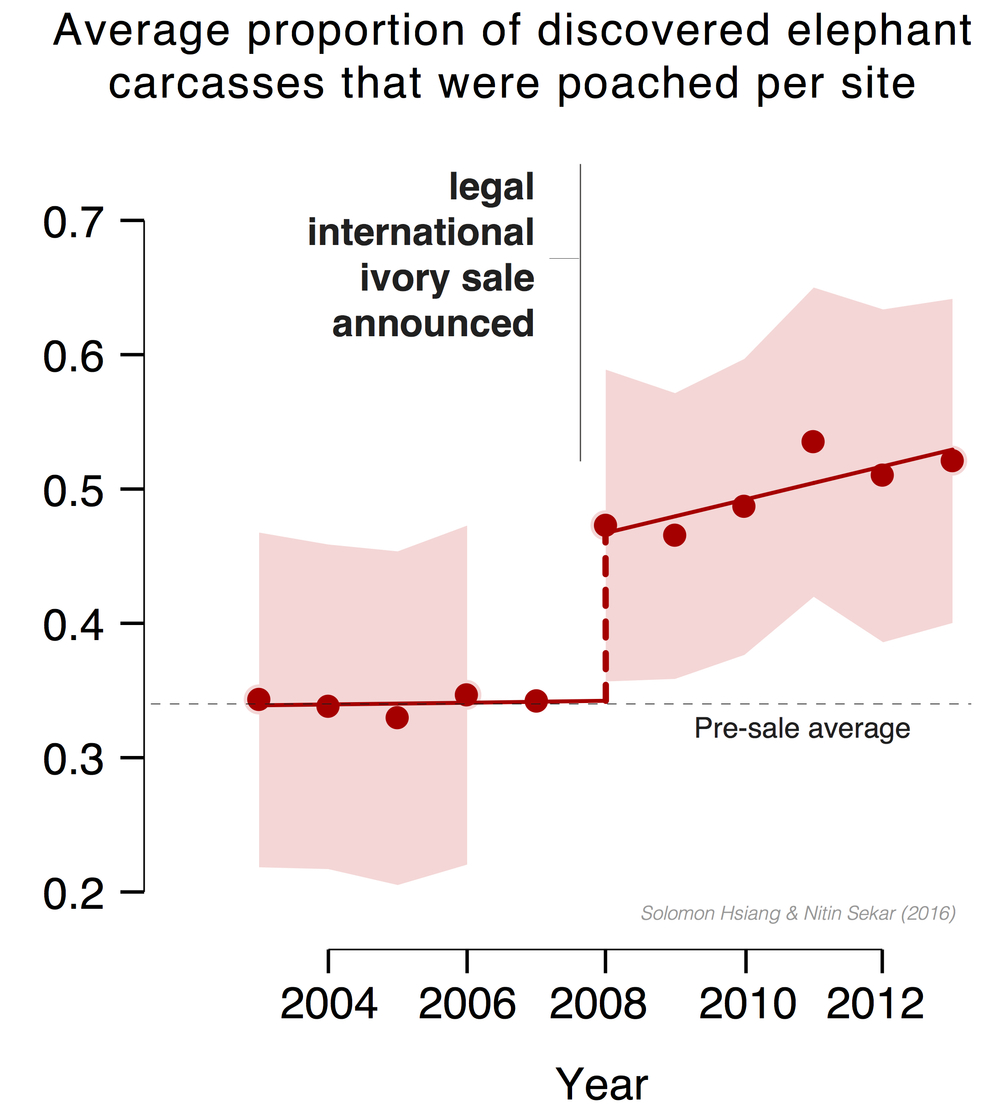
Chris Blattman points to this new NBER Working Paper (sorry I don't see an ungated version anywhere) by Solomon Hsiang (UC Berkeley) and Nitin Sekar (Princeton). They clearly show that a one-time legal sale of stockpiled ivory that happened in 2008 led to a significant increase in elephant poaching. Here is the key figure from the paper:


The break in the time series is very clear - poaching increased substantially after the sale (and shows an upwards trend that wasn't apparent before the sale). So, what's going on here? Maybe the sale of the stockpiled ivory led to a legitimisation of the trade in ivory, such that potential consumers became desensitised to the negative impacts of the ivory trade? This would lead to a long run increase in the demand for ivory. So, once the one-off sale of the stockpiled ivory had passed and supply returned to 'normal', the increased demand led to an increase in the price of ivory. The higher price creates incentives for more poaching. Indeed, Hsiang and Sekar conclude:
Our results are most consistent with the theory that the legal sale of ivory triggered an increase in black market ivory production by increasing consumer demand and/or reducing the cost of supplying black market ivory, and these effects dominated any competitive displacement that occurred. In markets where supply and demand interact directly with legalization, price data are relatively uninformative as to the effects of legalization. The data indicate illegal ivory suppliers anticipate opportunities to sell and/or smuggle illegal ivory, consistent with qualitative reports...
Our findings demonstrate that partial legalization of a banned good can increase illegal production of the good because the existence of white markets may influence the nature of black markets. 
It's probably fair to say that the ivory sale was a colossal failure. There are better ways of dealing with poaching. See my other posts (linked below) for some examples.

[HT: David McKenzie at Development Impact]

Update: Development Impact covers the subsequent debate about the results of the Hsiang and Sekar paper.

Read more:


Thursday, 24 December 2015

The black market in WINZ payment cards

One of the common examples I use in illustrating the role of incentives for my ECON110 class is the black market in WWII Great Britain. In short, many products (e.g. meat) were rationed. Essentially each household registered with their local shops, and the shops were provided with only the amount of meat for their registered customers. However, some households would prefer less meat and more sugar, so a complex system of black market trades started to occur, whereby households could obtain the goods they actually wanted, rather than those the authorities deemed they should have (you can read more here).

Black markets tend to arise whenever the government limits what citizens are allowed to spend their money on. For instance, in the U.S. food stamp programme (a.k.a. Supplemental Nutrition Assistance Program, or SNAP) many recipients sell their SNAP vouchers for cash, often with the complicity of shopkeepers (see here and here for example).

And now we have a local example, with payment cards from Work and Income New Zealand (WINZ) showing up for sale on Facebook. The New Zealand Herald reports:
Work and Income payment cards are showing up for sale on Facebook trading groups.
In a screenshot provided to the Herald, one person offers a $100 payment card for sale for $40 on the "Buy and Sell Hamilton" Facebook group.
And this is in spite of WINZ attempts to make it difficult for this sort of abuse:
When a card is issued, the recipient must sign it and payments are verified by matching the signature on the receipt to the back of the card.
Grants for food and hardship must be used within three days. 
Of course, setting rules on what payment cards can be used for makes them less valuable to the recipients than cash. It also increases the costs to the government because of the need to enforce the rules. And there needs to be some form of sanctions for recipients who break the rules. Having sanctions increases the cost of abuse for the payment card recipients, by making abuse more difficult (increasing the change of being caught). Presumably there are also penalties for the person who buys and tries to use a payment card in the name of someone else (under fraud laws I expect).

The payment card will only be able to be sold for less than face value, partly because the recipient (seller) probably wants cash fast (so is willing to give up some of the face value of the payment card for cash in hand now), and partly to compensate the buyer for the risk they face (of penalties for fraudulently using a payment card in the name of someone else).

The more urgent the sale (within less than three days), or the more costly the penalties for the buyer, the greater the difference will be between the face value of the payment card and the price it will be sold for. And so, we end up with the situation where a $100 WINZ payment card is being sold for $40.