Showing posts with label Natural monopoly. Show all posts

Wednesday, 16 October 2024

The economic welfare gains from the introduction of generic weight-loss drugs

The Financial Times reported this week (paywalled):

India’s powerful copycat pharmaceutical industry is set to roll out generic weight-loss drugs in the UK within weeks, with one leading producer forecasting a “huge price war” that could widen access to the popular medicines.

Bengaluru-based Biocon is the first company to win UK authorisation to offer a generic version of Novo Nordisk’s Saxenda weight treatment and is ready to launch sales by November.

Saxenda is an older drug of the same GLP-1 drug class as the Danish company’s popular Ozempic diabetes treatment and Wegovy weight-loss medication.

In an interview with the Financial Times, Biocon chief executive Siddharth Mittal declined to comment on his pricing strategy for generic Saxenda, but predicted his company’s sales of the drug would reach £18mn annually in the UK after the expiry of its patent protection there next month. Mittal said he expected Biocon’s generic version of Saxenda to be approved by the EU this year and in the US by 2025.

“When the generics come in there will be a huge price war,” he said. “There is a huge demand for these drugs at the right price.”

To see how the introduction of generic medicines affects the market, consider the diagram of the market for Saxenda below. When the active ingredient in Saxenda is protected by a patent, the market is effectively a natural monopoly. That means that the average cost curve (AC in the diagram) is downward sloping for all levels of output. This is because, as the quantity sold increases, the large up-front cost of developing Saxenda (see here for example) will be spread over more and more sales, lowering the cost on average. If Novo Nordisk (the producer of Saxenda) is maximising its profits, it will operate at the quantity where marginal revenue meets marginal cost, i.e. at QM, which it can obtain by setting a price of PM (this is because at the price PM, consumers will demand the profit-maximising quantity QM). Novo Nordisk makes a profit from Saxenda that is equal to the area PMBKL. [*]


Now consider what happens in this market when the patent expires and generic versions of Saxenda enter the market. We end up with a market that is more competitive, which would operate at the point where supply (MC) meets demand. This is at a price of PC, and the quantity of QC. Notice that the price of Saxenda falls dramatically - this is how the price war that Mittal mentions will play out.

Now consider what happens to the other areas of economic welfare. Before the patent expires, the consumer surplus is equal to the area GBPM. After the patent expires, the consumer surplus increases to the area GEPC. Consumers are made much better off by the patent expiry, because they can buy Saxenda at a much lower price, and they respond by buying much more of it. The producer surplus, which was PMBHPC, becomes zero. [**] The competition between the producers drives this producer surplus down. Total welfare (the sum of consumer and producer surplus) increases from GBHPC to GEPC. So, society is better off after the patent expiry.

Now, you could argue based on this that expiring the patent earlier would be even better, given the economic welfare gain that would result. And while I have some sympathy for that view, governments should be a little cautious here. The large producer surplus from having the patent in place creates an incentive for the big pharmaceutical firms to develop these pharmaceuticals in the first place. So, an appropriate balance between patent protection and incentives for pharmaceutical development needs to be found. Nevertheless, it is clear that once patents expire, there is a large welfare gain to society at that point.

*****

[*] This is different from the producer surplus, which is the area PMBHPC. The difference between producer surplus and profits arises because of the fixed cost - in this case, the cost of development of Saxenda.

[**] If we treat this as continuing to be a natural monopoly after the patent expiry, the market makes a negative profit of -JFEPC (because the price PC is less than the average cost of production ACC). However, you could argue that because the firms producing the generic version didn't face the up-front cost of development, this is no longer a natural monopoly once the patent has expired.

Friday, 25 March 2022

Supermarkets are not natural monopolies, and should NOT be regulated as public utilities

In The Conversation last week, Robert Hamlin (University of Otago) wrote:

The Commerce Commission’s report into New Zealand’s supermarket sector has been criticised for not going far enough to reduce food prices, but the answer to the current duopoly might lie in treating the sector as a public utility instead of a private industry...

This fairer supermarket sector could be achieved if the industry power players were governed as regulated public utilities, much like power and water. But such an approach would need to be legislated and has to combine simplicity with easy and effective enforcement.

To do this, the government should implement some key regulatory principles.

New regulations would need to ensure supermarkets do not engage in wholesale or manufacturing activity. The key to supermarket power is their control of the retail point of sale. If supermarkets are to be regulated as public utilities, then it is essential they are restricted solely to this activity.

The problem with Hamlin's argument is that he equates supermarkets with other utilities like power and water. However, supermarkets and public utilities like power and water differ in two fundamental ways. First, power and water are natural monopolies. They have large up-front costs, and then the marginal costs of production and distribution are fairly low. Natural monopolies are a tricky problem for governments, because as I noted in this earlier post, if the government regulates them such that total welfare is maximised, the natural monopolies make a loss and reduce investment and service quality, and may even shut down entirely. The second-best solution here is to regulate the natural monopoly, but not to such an extent that it makes economic losses. That is essentially what Hamlin is arguing for, when he writes:

As public utilities, individual supermarket sites should only be allowed to charge a single fixed and publicly stated margin on the goods they sell. This is a novel requirement, but it is core to the process of regulating a supermarket as a utility.

Supermarkets act as a middleman between consumers and producers. The mutual ignorance of what is happening on the other side of the retail barrier allows the supermarkets to manipulate consumers and suppliers at will. It is the key process that converts supermarket power to profit.

The requirement that supermarkets must apply a single, publicly posted margin to all the products in their store sets this capacity to zero, and promptly makes the retailer a fully transparent channel for suppliers and consumers.

This 'publicly-posted margin' is essentially what economists refer to as 'cost-plus' regulation. As Eric Crampton noted earlier this week, that solution is totally impractical, because of the second difference between public utilities and supermarkets: supermarkets sell many products. Public utilities typically sell one product, e.g. water, or electricity. That makes it relatively straightforward to impose a 'cost-plus' pricing regulation, since there is only one product to calculate this cost-plus margin for. working out the costs is not straightforward because of the mixed of fixed and variable costs, depreciation and other things. But that process is even more difficult when a firm sells many products. As Crampton wrote:

 A big part of the fight at ComCom was around calculating rates of return. How capital costs get treated matters. How land costs under the supermarkets are counted matters. There are piles of complex lease agreements around those that need to be worked through, and would themselves be endogenous to whatever stupid rule you set to regulate rates of return. 

It isn't straightforward. 

And then this guy wants to run it product-by-product as some kind of mark-up regulation with a fixed mark-up on each good? How's that going to work? Different goods have different turnover. A foot of shelf-space that turns over three times a day pays for itself differently than a foot of shelf-space that turns over once every three days. 

The policing of this kind of thing would be impossible. If you force a single markup on all products based on the price at which the retailer bought it, you force slow-moving goods off the shelves. If you allow some measure of the cost of shelf-space to enter in, you're going to be chasing your tail forever in policing it. It's just so impossibly stupid.

However, it's not just heterogeneity of products that make this proposal unworkable. It's the heterogeneity of supermarkets as well. Public utilities are easy to regulate, because there is few of them (they are natural monopolies, after all). But supermarkets are actually quite diverse. There is about a hundred-fold difference in turnover between a corner dairy and a large urban supermarket. Even within the supermarket category (i.e. excluding dairies), I wouldn't be surprised if there was a fifty-fold difference in turnover between supermarkets in small urban areas like Te Kauwhata and large cities like Hamilton. Should the government impose the same cost-plus regulation on all supermarkets, regardless of size? This could easily make small supermarkets unviable, leaving consumers with less choice and ultimately worse off.

Then, there are the incentive effects. When firms have to worry about their profits and margins, then they have an incentive to keep costs low as it keeps their profits high. However, if a firm has a cost-plus regulation in place, then they can earn the regulated margin regardless of their costs. There is less incentive for keeping costs low. This proposal could easily have the unintended consequence of higher prices for consumers in the long run, more waste and less efficiency in the supermarket sector.

Finally, the supermarket firms are not just retailers, but wholesalers. By itself, this proposal on retail prices would need to be carefully designed. Otherwise, the supermarkets will simply route around it by separating out their wholesale operations into a different business, which sets the wholesale prices, upon which the retail prices (cost-plus wholesale) will be based. Then the supermarket profits will simply back up one step as wholesale, rather than retail, profits. [*] This might be one way that the supermarkets will respond to the Commerce Commission's recommendation that the supermarkets be required to offer wholesale supply to other grocery retailers (see here) anyway.

All in all, regulating supermarkets as public utilities is thoroughly impractical, and possibly counter-productive. The Commerce Commission has made its recommendations. In general, they seem a sensible way of opening the retail grocery market (if not the wholesale market) to more competition. We should see whether those changes work before we open the door to crazy ideas.

*****

[*] This would work for Countdown, which owns all the retail stores, but possibly not so well for Foodstuffs, where the stores are owner-operated. However, I'm sure Foodstuffs could find some way to make a flavour of this work.

Saturday, 8 May 2021

Splitting Kiwirail into two entities makes sense

Every year it seems, Kiwirail is in the news for the losses that it makes. However, that need not be a bad thing, as I wrote in this 2014 post:

Having the natural monopoly make a loss (and this is an economic loss, so it includes opportunity costs, and would be greater than any accounting loss) may be a good thing because it increases total welfare. However, relative to profit maximisation, it entails a transfer of welfare from taxpayers (who ultimately end up paying the loss) to consumers of rail services (and ultimately, to consumers of stuff that is transported by rail).

It was interesting to see Kiwirail in the news this week for something slightly different, as the NBR reported (gated):

A proposal to split KiwiRail into two is still on the table but is not a pressing priority for the government.

Treasury made the suggestion in late 2017 after the Auditor-General’s office had raised concerns about the state-owned rail company’s financial reporting...

Under the specific proposal put forward by the Treasury in late 2017 and early 2018, one entity would be responsible for the tracks and be publicly funded, while the other would have a commercial State-owned enterprise responsible for all the above rail services. The SOE might get some government money but largely would be expected to fund its capital investment itself.

In a paper dated February 2018, and obtained by NBR under the Official Information Act, the Treasury said KiwiRail had an uncomfortable mix of profit-oriented assets and services and public-benefit oriented assets and services.

“This mix distorts KiwiRail’s investment decisions, operating and financial performance, and the Crown’s funding model and level of influence and control,” it said.

The Treasury said the “above rail” aspects of KiwiRail – its locomotives, rolling stock, ferries and commercial work with customers – were profit oriented and properly belonged in an SOE. But the “below rail” network assets – the rails, rail formation, bridges, tunnels, signalling and power infrastructure – were public benefit infrastructure.

The key problem with Kiwirail is, as I noted in that earlier post, that Kiwirail is a natural monopoly. It has a very large up-front (fixed) cost of production, which is the cost of the rail infrastructure, and the marginal costs (the cost of transporting an additional unit of freight) are very low. A privately-owned natural monopoly would profit-maximise, decreasing the quantity of its services and raising the price. A government-owned natural monopoly could do that too, but if government wanted to increase economic welfare, it would prefer the monopoly to set a lower price. And if it sets the price at the welfare-maximising level, the natural monopoly makes a loss (see my 2014 post for details).

Treasury's proposal is to split Kiwirail into two entities. The natural monopoly would remain a government-controlled public-benefit entity, in charge of the infrastructure. The for-profit entity would run its services on the lines owned by the public-benefit entity. The infrastructure could then be government-funded using a pure subsidy, like roads. The for-profit entity would (presumably) no longer make a loss, and look a lot better for the government (controlling the loss-making Kiwirail is not a good look, which is why it is in the media every year).

The parallel with the funding of roads is important here. Separating the infrastructure funding from the operators using that infrastructure seems to me to be an improvement. It would make the funding applied to rail infrastructure wholly transparent to the taxpayer, and allow us to have a better sense of the relative government spending on roads and rail. With the infrastructure coordinated centrally and separately from the commercial rail services, rail services could be opened to competition, with other rail service companies allowed to use the same rail lines (with signalling and scheduling handled through some centralised process). That could lower the costs of rail services further, and allow allegedly 'uneconomic' lines like the rail line from Gisborne to the Hawkes Bay to attract alternative providers if they can be made profitable. Competition could be good for rail passengers as well, with potentially lower fares and more on-time services. Although, care would need to be taken that we don't simply swap one set of problems for another, such as we are seeing with Wellington buses at the moment.

There are also parallels with how airports are run. They aren't owned by the airlines that use the airport infrastructure. Presumably the public-benefit entity will receive fees from Kiwirail (and any other rail service operators on the network), but it could also develop the stations and receive commercial rents from retail firms, hospitality, and so on. This could reduce the subsidy required from the government, and if successful enough, perhaps no subsidy would even be required (although I think this unlikely).

Finally, it would be interesting to know if Treasury has similar views about other state-owned or privately-owned natural monopolies. We have Transpower, which runs electricity transmission lines on a similar model. But what about telecommunications infrastructure? Or water supply infrastructure? In each case public or private firms could deliver services over those networks, paying a fee to a public-benefit entity for the use of the infrastructure under their control. Given the recently compounding issues with Wellington's water infrastructure, an alternative model is definitely worth considering. But first, Kiwirail.

Friday, 19 October 2018

The economics of trademark protection

Last week, William Nordhaus won the Nobel Prize in economics and as I mentioned at the time, one of his contributions to economics was a recognition of the trade-offs inherent in the protection of intellectual property rights. Strong intellectual property rights provide an incentive for investment in creation or development of new intellectual property, but they also provided a limited monopoly to the holder of the intellectual property rights. The trade-off (as we'll see a little later in this post) is between under-creation of intellectual property if there is weak protection, and under-consumption of the intellectual property if there is strong protection.

Intellectual property rights can be protected through patents or copyright, or through trademarks as this article from last week notes:
Trademark protection is available to businesses of all sizes and there are very good reasons for traders to use that protection...
The registered owner is deemed to have the exclusive right to use the mark throughout New Zealand in relation to all the goods and services it covers; the owner's rights are on a publicly searchable register, which may have a deterrent effect on copy-cats; and it has the right to sue under the the [sic] Trade Marks Act 2002...
...the trademark system also has wider economic benefits.
Providing legal protection for brands incentivises businesses to invest in building goodwill and reputation by producing high quality goods and services.
Trademarks provide an incentive for Firm A to invest in building goodwill, because Firm A's goodwill can't be captured by other firms that are pretending to sell Firm A's goods. Consider the diagram below, which shows the market for a firm selling a trademarked product. The trademark makes the firm a monopoly (in this particular trademarked product). It gives the firm some market power. The trademark is costly to obtain (it involves the cost of the trademark itself, but also the cost of building consumer awareness of the brand the trademark protects), and that fixed cost leads to some economies of scale. This is why the average cost (AC) curve is downward sloping. If the firm is maximising its profits, it will operate at the point where marginal revenue meets marginal cost, i.e. at the quantity QM, which it can obtain by setting a price of PM (this is because at the price PM, consumers will demand the profit-maximising quantity QM). The firm makes a profit that is equal to the area PMBKL. [*]


Now consider what would happen if there was no trademark protecting the product. Other competing firms would realise that this product is quite profitable, and they would start to sell it (since there is no trademark stopping them from doing so). We end up with a market that is more competitive, which would operate at the point where supply (MC) meets demand. This is at a price of PC, and the quantity of QC. Notice that the price is now below average cost - the firm that developed the product sells at a loss (equal to the area JFEPC). [**]

So, if there is strong intellectual property rights protection (trademarks in this case, but a similar analysis applies to patents or copyright), there would be less consumption of intellectual property (because QM is much less than QC). But, if there is weak intellectual property rights protection, there would be less development of intellectual property in the first place (because the developer would face the costs of development, but could not easily profit from it).

Trademarks are clearly valuable for firms, but the article also argues that they are valuable for consumers:
Trademark protection also has a consumer welfare aspect. Trademarks are "badges of origin" for consumers, a sort of guarantee to indicate that a product or service comes from a trusted, reliable source.
Regulating their use (and misuse) helps to protect the buying public from confusion and, at worst, physical harm.
At the extreme end of the spectrum, counterfeit products can pose an active risk to health.
Last month, the BBC reported hundreds of thousands of pounds of counterfeit cosmetics had been seized in the UK, some of which contained chemicals such as highly toxic mercury and the illegal levels of the skin-whitening agent hydroquinone.
Intellectual property rights is an interesting topic that I cover in my ECONS102 class, particularly because it involves a difficult trade-off. It isn't clear how strong intellectual property rights protection should be, in order to balance under-consumption (relative to an economic-welfare-maximising point) against under-development (because of the lack of profits from developing intellectual property). Clearly, we still don't have the balance right if we are still facing drug pricing that works like this.

*****

[*] This is different from the producer surplus, which is the area PMBHPC. The difference between producer surplus and profits arises because of the fixed cost - in this case, the cost of the trademark and product development.

[**] The producer surplus in this case is zero. This is because the diagram shows a 'constant cost' firm, where marginal cost is constant (so every unit costs the same to produce), and the equilibrium price is equal to marginal cost. Also, more realistically if you don't create the trademark in the first place, the fixed cost is eliminated. So there is no loss, but there is also no profit because every unit is sold at its marginal cost.

Saturday, 5 May 2018

Floating plug-in power stations are finally here

When I was an undergraduate student, one of the examples that one of my economics lecturers (perhaps John Tressler?) used in class was that of a plug-in power station floating on a barge. This example was used to illustrate how 'specific capital' creates a barrier to entry, especially for natural monopoly firms. Or at least, that's what I remember (who knows? It was a long time ago. It might have been an example used to illustrate a totally different point).

Specific capital is capital that is specific to that particular market (as with many concepts in economics, there's no mystery to the naming of it). If the firm later leaves the market, they lose all of that capital (because it was specific to that market). Some types of capital can be moved or used in other markets, but specific capital cannot. So, if a firm needs to invest in specific capital in order to enter a market, then that will make the firm nervous. What will they do if there is a sudden decrease in demand and they start making a loss in the market, if they can't easily move their capital elsewhere? The nervous firm might decide that it is better not to enter the market if there is a chance that they will waste their specific capital.

Specific capital can be a serious problem for a natural monopoly firm. A natural monopoly firm has economies of scale, and those economies of scale usually arise because there is some large up-front cost that the firm faces (and so, as they produce more or service more customers, that large up-front cost can be spread over a larger market, lowering the firm's average costs - what economists refer to as economies of scale). If the large up-front cost is specific capital (which it often is), it is easy to see that firms will be nervous about making the investment. This is why it is not always a good idea for governments to heavily regulate natural monopolies - it reduces the incentive for the up-front investment.

Aside from the threat of regulation, specific capital is also a problem if the firm is worried that the government might expropriate their specific capital (and especially a problem for natural monopolies). This is a serious problem in many developing countries, where an autocratic leadership might expropriate foreign-owned assets at any time. This makes foreign firms, which have a lot of financial capital, reluctant to invest in large assets in developing countries. An example of a large asset conducive to natural monopoly that foreign firms would be unlikely to want to invest in is a power station. Once the foreign firm has made the investment, the government could simply expropriate the power station, and there is little the foreign firm could do about it. Given this risk, there is less foreign investment in natural monopolies (e.g. large infrastructure projects) in developing countries than would be optimal.

A solution to the problem of specific capital, at least in the case of power stations, is to put the power station on a barge and float it from country to country, simply plugging it into the electricity network. Then, the firm can move it elsewhere if it feels that the political climate becomes too risky. It's still a large up-front cost, so still a natural monopoly, but at least the capital is not specific to the market that the barge is parked in, because it can be relocated. In the past, this solution was almost purely theoretical. But no more, as the New Zealand Herald reported on Wednesday:
If a Russian state-owned company has its way, remote regions of the world will soon see giant, floating nuclear reactors pumping power to port cities and drilling platforms.
It would be a real-life version of the Soviet reversal joke: In Russia, 70-megawatt nuclear reactor comes to you.
The reactor in question is called Akademic Lomonosov. Once the barge is wired into the electrical grid in the Arctic town of Pevek in 2019, it will be the world's northernmost nuclear reactor, capable of powering a town of 100,000 people with what its manufacturer, Rosatom, calls "a great margin of safety" that is "invincible for tsunamis and natural disaster."...
By 2019, the first-of-its-kind rig will provide power for the port town and for oil rigs.
For Rosatom, it is buoyant proof of concept that a floating sea-based reactor can work. Rosatom is already in talks with potential buyers in Southeast Asia, Latin America and Africa, according to Russian television station RT, which estimates that 15 countries have shown interest in the floating plants.
Critics are focused on the potential environmental downside to a floating nuclear reactor, but there is an upside. This could be exactly what is needed to encourage investment in at least some of the infrastructure needs of developing countries.

Wednesday, 16 November 2016

Scale vs. scope economies and the AT&T-Time Warner merger deal

I've been watching with interest the unfolding news on the proposed merger between AT&T and Time Warner. The Washington Post has a useful primer Q&A here:
AT&T, the nation's second-largest wireless carrier, is buying Time Warner, the storied media titan that owns HBO, CNN and TBS. In an unprecedented step, the deal is going to combine a gigantic telecom operator — which also happens to be the largest pay-TV company — and a massive producer of entertainment content.
In ECON110, one of the topics we cover includes media economics. The economics of media companies is of interest because it illustrates a bunch of economic concepts, and because their interaction leads to some seemingly-counterintuitive real-world outcomes.

For instance, media content (e.g. movies, television shows, music albums) is subject to substantial economies of scale - the average production cost per consumer of media content falls dramatically as you provide the content to more consumers. This is because the cost of producing content is relatively high, while the cost of distributing that content (especially in the digital age) is extremely low. Large economies of scale (in distribution) tend to favour large media companies over small media companies, since the large media company can distribute to a larger audience at lower cost per-audience-member. In other words, each item of media content gives rise to a natural monopoly.

However, consumers demand a variety of media content, and variety is difficult (and costly) to produce. Every different item of content requires additional scarce inputs (e.g. quality actors, sets, scripts, etc.), and the more novel the item of content the more expensive it will generally be to create. This leads to what is termed diseconomies of scope - the more different items of content that a media company produces, the higher their average costs. Diseconomies of scope (in production) tend to favour smaller media companies that focus on specific content niches.

So, the combination of these (economies of scale and diseconomies of scope) leads to an industry that is characterised by several large media companies producing 'mainstream' content (and usually formed by mergers of previously smaller media companies), as well as many smaller niche providers. If we focused only on the economies of scale, we would be left wondering why the smaller providers continue to survive alongside their larger rivals. It also explains why the offerings of the large media companies are often pretty bland when compared to the offerings of the smaller players - producing something that isn't bland is too costly.

Which brings me to the AT&T-Time Warner merger. This introduces a new element into play. Time Warner is a content provider, and a distributor through traditional media channels (television, etc.). AT&T is not a media company (at least, not yet), but would greatly enhance the potential distribution of Time Warner content. That in itself isn't problematic, and would simply follow previous media mergers focusing on increasing the gains from economies of scale.

The main problem is that AT&T is a gateway to consumers (and a gateway from consumers to content), and that means that the merged entity could significantly reduce competition in the media market. Media consumers value variety (as I noted above), but this merger might make it more difficult (or costly) for AT&T consumers to access that variety. The WaPo article linked above notes:
Here's where it starts to get really interesting. AT&T could charge other companies for the rights to air, say, "Inception" on their networks, or for the use of the Superman brand. Left unchecked, AT&T could abuse this power and force other Web companies, other cable companies, other content companies or even consumers to accept terms they otherwise would never agree to.
One of the things that AT&T might also do is make it costlier for their subscribers to access other content. Of course, they wouldn't frame it that way - they would instead offer a discount on accessing Time Warner content (which effectively makes other content more expensive and shifts consumers towards the Time Warner content).

What happens next? Federal regulators are looking into the deal, and depending on who you read, President-Elect Trump will either block the deal (which markets are anticipating and which he noted during the campaign) or not (based on the makeup of staff within the administration). From the consumers' perspective, let's hope that Trump follows through (this may be the only Trump campaign promise I would make that statement for!).

Thursday, 9 June 2016

Don't expect new antibiotics anytime soon

The most read post on my blog is this one from 2014 on the economics of drug development and pricing. Maybe it's time for a follow-up, but this time with a more specific focus, on antibiotics.

The Economist had an excellent (albeit somewhat scary) article last month about antibiotic resistance:
A thorn scratch today seems a minor irritant, not a potential killer. But that may be too sanguine. A study by America’s Centres for Disease Control (CDC) found that the number of cases of sepsis rose from 621,000 to 1,141,000 between 2000 and 2008, with deaths rising from 154,000 to 207,000. One reason for that is the emergence of MRSA (pictured being attacked by a white blood cell)—a variety of Staphylococcus aureus that cannot be killed with methicillin, one of penicillin’s most effective descendants. This could just be a taste of things to come. Three years ago the CDC produced a list of 18 antibiotic-resistant microbes that threaten the health of Americans (see table). Five of them (including MRSA) cause sepsis.
Microbes are increasingly exhibiting antibiotic resistance, not only to first-line antibiotics but to their alternatives as well. Without effective antibiotics, infections that were previously treatable become potentially life-threatening. That makes the development of new antibiotics important and increasingly urgent. However, as I noted in my 2014 post, the cost of developing new pharmaceutical drugs is very large. While pharmaceutical companies hope to recoup that cost through holding a natural monopoly over the drug and charging a relatively high price for it, in the case of antibiotics that is not necessarily assured, because there are already antibiotics that are effective in most cases, which means new antibiotics would only need to be used (hopefully) rarely. The Economist notes:
There are reasons for drug firms not to invest in antibiotics. Such companies increasingly prefer treatments for chronic diseases, not acute ones; the customers stick around longer. And despite the growing problem of resistance, most antibiotics still work for most things most of the time. Given that the incumbents are also cheap, because they are off-patent, new drugs cannot earn back their development costs. Even if they could, it would be poor public policy to let them; much better for new drugs to be used only sparingly, to forestall the development of further resistance. That further puts the kibosh on sales.
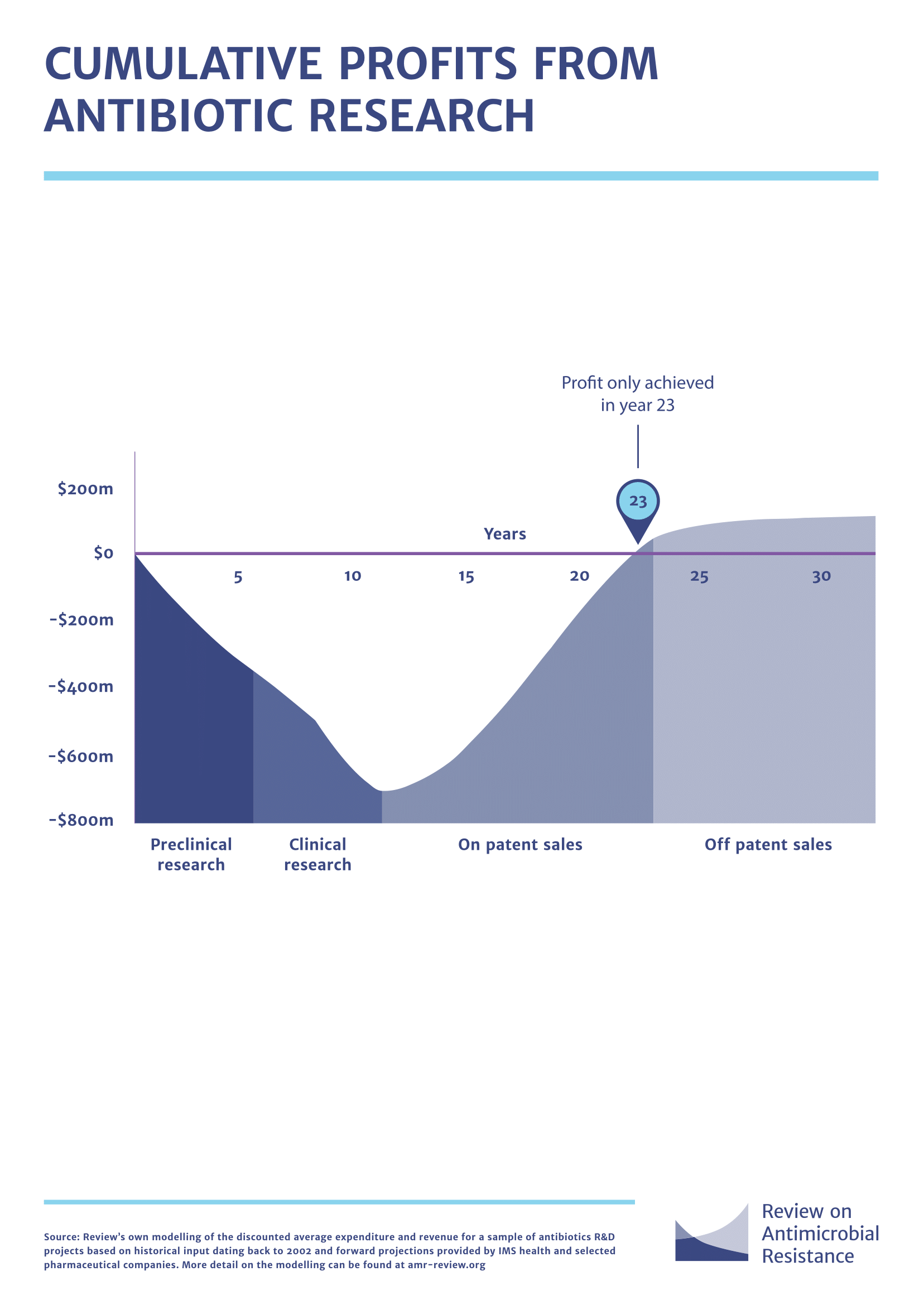
This figure (source here) also effectively demonstrates the case against developing new antibiotics:


It takes 23 years for a new antibiotic to break even. By then, the patent has almost expired and the drug will soon need to compete with generic competitors, which severely limits the profits available to the pharmaceutical firm. Most pharmaceutical firms are looking to invest in research that leads to quicker payoffs than that, and they have plenty of other research opportunities that they can invest in.

There are alternatives to the 'traditional' development-patent-monopoly approach. This is what I wrote in 2014, and it still stands:
A better option was laid out several years ago by Nobel Prize winner Joseph Stiglitz. Stiglitz argues convincingly that an alternative to the current intellectual property (patent) based regime is to offer prizes for firms that develop medicines, cures or vaccines for diseases that affect the poorest countries. Stiglitz says:
"A solution to both high prices and misdirected research is to replace the current model with a government-supported prize fund. With a prize system, innovators are rewarded for new knowledge, but they do not retain a monopoly on its use. That way, the power of competitive markets can ensure that, once a drug is developed, it is made available at the lowest possible price - not at an inflated monopoly price."
The trade-off for firms collecting the prize money (which would be contributed to mainly by developed country governments), is that their drug would have to be made available in the public domain (i.e. not patented). Then, generic drug manufacturers would be able to produce the drugs at low cost to provide to poor countries and rich countries alike. One promising example of this approach is the Health Impact FundAdvance market commitments are a similar idea.
Unless we apply some of these alternatives, the low incentive for pharmaceutical companies to develop new antibiotics will remain. So, don't expect new antibiotics anytime soon. It might be best to try and avoid infections.

Monday, 6 June 2016

Why Aucklanders should pay more for their electricity

Brian Fallow wrote an interesting piece in the New Zealand Herald a couple of weeks back, about the draft changes in the way the costs of the national electricity grid are allocated. Fallow wrote:
Unwinding a cross-subsidy is never popular among those who have been on the bludger's end of one.
But Aucklanders grumpy about the prospect of having to pay about $1 a week more per household for their power need to get over it.
The draft changes to the way the costs of the national grid are allocated, which the Electricity Authority released this week, are intended to make the system fairer and more efficient, by getting a better alignment between those who benefit from upgrades to the grid and those who pay for them.
Transpower has spent billions in recent years on the grid, mainly to serve Auckland's growing population.
Under the draft changes, Aucklanders face the prospect of paying an additional $58 per year per household for their electricity. Households in other parts of the country (especially in the South Island) will face lower electricity charges.

How can this be? Electricity is not transmitted from where it is generated to where it is used without cost. The further the electricity needs to be transmitted, the higher the costs of transmission. So, it is only natural that the customers who impose a higher cost on the supplier face higher prices. To be clear, the total cost of electricity transmission will not have changed - only the way those costs are distributed among consumers of electricity will change. The previous (current) system, which did not take proper account of the differences in transmission costs, was essentially subsidising Auckland electricity users (who did not face the full cost of their electricity use) at the expense of South Island electricity users (who paid too much for their electricity, relative to its cost). I can't see any argument for why such a cross-subsidy would be worthwhile or necessary.

As an aside, usually when different consumers face different prices for the same product, we consider this to be price discrimination. However in this case, this is not an example of price discrimination because the price differences are related to underlying cost differences. It is simply a case of the lines companies (and electricity generators/retailers) using their market power to pass additional costs (in the case of Auckland, or lower costs in the case of the South Island) onto consumers.

As a result, this change in the distribution of costs should (at the margin) encourage more modest electricity use in the north, and more electricity use in the south (perhaps as a winter heating source, reducing the smog problems in Christchurch and Timaru).

Tuesday, 23 September 2014

Why KiwiRail losses might be a good thing

Last week in ECON110 we covered natural monopoly. One of the interesting aspects of natural monopoly is what might happen when the government owns one. Such is the case with KiwiRail, which the government purchased back from Toll Holdings in 2008, after it was originally privatised in 1993.

KiwiRail was in the news again last month, having made a loss of $248 million in the year to June 30, 2014. That follows a loss of nearly $175 million in the previous year (PDF). Now, some of those losses are writedowns and impairments, but that aside, should we really be worried about big losses from a government-owned natural monopoly?

I previously blogged about natural monopolies earlier in the year, but didn't talk specifically about government-owned natural monopolies. First some background theory - a natural monopoly arises where one producer of a product is so much more efficient (by efficient I mean they produce at lower cost) than many suppliers that new entrants into the market would find it difficult, if not impossible, to compete with them. It is this cost advantage that creates a barrier to entry for other firms, and leads to a monopoly. Natural monopolies typically arise where there are large economies of scale (when, as a firm produces more of a product, their average costs of production fall). Economies of scale are common when there is a very large up-front (fixed) cost of production, and the marginal costs (the cost of supplying an additional unit of the product) are small (the cost structure is shown in the figure below, with a simplifying assumption that the marginal cost of production is low and constant). The markets for utilities, where the up-front cost includes the cost of having all of the infrastructure in place, are good examples. Rail is another example, since you need the tracks, the rolling stock, and the associated stations and other buildings in place before you can start to provide rail services.


Now natural monopolies, like other firms, are assumed to be profit maximisers. That is, they will operate at the point where marginal revenue is equal to marginal cost. That is, they will operate at the price PM and the quantity QM in the diagram above. At that point, the producer surplus is the area PMBHPS, while the firm's profit is the area PMBKL (the difference between profit and producer surplus arises because of the large up-front fixed costs, which are subtracted from profits, but not from producer surplus). However, consumer surplus in this market is GBPM, and total welfare is GBHPS. This leaves a deadweight loss equal to the area BEH.

Now, if the government owned the natural monopoly, it doesn't necessarily have to profit maximise if it doesn't want to. Government could choose to maximise total welfare instead. It would do this by setting the price at the point where marginal social benefit is equal to marginal social cost. That is, the market will operate at the price PS and the quantity QS. At that point, producer surplus is zero (since every unit is sold for marginal cost), but the profit is negative (JDEPS) because price is below average cost. On the other hand, consumer surplus is GEPS, and total welfare is maximised at GEPS.

Having the natural monopoly make a loss (and this is an economic loss, so it includes opportunity costs, and would be greater than any accounting loss) may be a good thing because it increases total welfare. However, relative to profit maximisation, it entails a transfer of welfare from taxpayers (who ultimately end up paying the loss) to consumers of rail services (and ultimately, to consumers of stuff that is transported by rail).

Thursday, 7 August 2014

The Economics of Drug Development and Pricing

The week before last I spent a few days at the XXth International AIDS Conference in Melbourne. I couldn't be there for the whole conference because of my teaching commitments, which was a little disappointing because I appeared to miss a lot of the action. By action, I mean the inevitable protests that are a frequent sideline to these conferences.

However, I was at this session on "The Future of HIV and HCV Treatment - Patents, Pricing and Pharma" which was subject to a protest against the pharmaceutical company Gilead (see footage of the end of the protest here). The protesters were angry about the drug pricing for a new treatment for Hepatitis C, which costs around US$84,000 for a 12-week course of treatment in the U.S. You can see more about the pricing strategies of Gilead in this presentation from the same session. Gilead has negotiated a much lower price for the treatment in Egypt - US$900. However, in both cases (U.S. at $84,000 and Egypt at $900) the treatment is severely unaffordable for the majority of people with Hepatitis C. The protesters argue that this pricing strategy is costing lives.

What is Gilead doing? How can they justify such a wide variation in prices between the U.S. and Egypt? There are two key points here that relate to the economics of drug development and pricing.

First, drug development is very expensive (US$1.8 billion according to this source). Why so much? There are a lot of regulatory hurdles for drugs to overcome before they can be certified as safe and made available for patients, on top of the costs of research and development of the drugs themselves. Pharmaceutical companies have to be sure that they can recover the cost of development - otherwise it would make no sense for them to begin the drug development process. In fact, it's been argued that's the reason why there has been little in the way of development of new antibiotics in recent years - there's more money for pharmaceutical companies in researching drugs for orphan diseases than in developing new antibiotics. And this in spite of the impending doom of a "post-antibiotic era, in which common infections and minor injuries, which have been treatable for decades, can once again kill".

Once a new drug is developed, there is little in the way of ongoing costs and the marginal costs of producing the drug are fairly low. This means that pharmaceutical products are a form of natural monopoly - there are economies of scale, because the more that the company produces, the lower their average costs of production because the development costs can be spread over a greater quantity of production. Their natural monopoly is protected by the patents they are granted for the drugs. The protesters are effectively arguing that the pharmaceutical companies should be pricing at average cost, or even at marginal cost (or at least closer to those costs). In either case, this makes it much harder for the company to recoup their investment in development costs, much less any return on capital invested in the development process (see here for more on the problems of natural monopolies). So, the protesters are missing the point - if the pharmaceutical firms are forced to price their drugs low, they won't develop them in the first place.

The second point relates to the "variable pricing" scheme that the pharmaceutical companies use, where they price the drugs at low prices in developing countries and at much higher prices in developed countries. On the surface, this seems pretty unfair, but it is a straightforward application of price discrimination - where different consumers (or groups of consumers) are charged different prices for the same good or service, and where the difference in price does not arise because of a difference in cost (and which I've previously written on here). In price discrimination, the firm charges a higher price to groups of consumers that are willing to pay more for the good or service. For price discrimination to be effective, there must be different groups with different willingness-to-pay for the good or service, the firm must be able to determine which consumers belong to which group, and there must be no transfers between the sub-markets. It seems to me that patients (or health ministries, or health insurers) in developed countries are willing to pay more than those in developing countries, it's easy for the pharmaceutical company to tell the groups apart, and provided the firm negotiates a tight contract with developing country governments specifying no on-selling there will be little in the way of transfers between the sub-markets. So price discrimination is not only feasible, but likely, in this situation and should come as no surprise to us.

Drug development has also been in the news and blogosphere lately because of the Ebola outbreak in West Africa (see here and here and here). Two U.S. doctors received an untested (in humans) treatment, which is unlikely to be made widely available to public health authorities. Why? It hasn't gone through clinical trials yet, and as this news story notes:
Developing, trialling and licensing vaccines or treatments would cost significant amounts of money, and drugs companies argue there is not enough demand to justify the outlay.
“These outbreaks affect the poorest communities on the planet. Although they do create incredible upheaval, they are relatively rare events,” said Daniel Bausch, a medical researcher in the US who works on Ebola and other infectious diseases.
“So if you look at the interest of pharmaceutical companies, there is not huge enthusiasm to take an Ebola drug through phase one, two, and three of a trial and make an Ebola vaccine that maybe a few tens of thousands or hundreds of thousands of people will use.”
So, it seems unlikely that there will be a widely-available treatment or vaccine for Ebola in the near-term (see also here), because the costs of development outweigh the benefits of producing it for pharmaceutical firms. Of course, that ignores the substantial social benefits associated with saving lives (unless you are willing to argue that those benefits are captured in the willingness-to-pay for the treatment).

How do we get pharmaceutical companies to develop treatments, vaccines, or cures for diseases that mostly affect the developing world? It's stupid to wait until drugs are developed, and then protest and demand that pharmaceutical companies lower their prices - that reduces the incentives to develop the drugs in the first place.

A better option was laid out several years ago by Nobel Prize winner Joseph Stiglitz. Stiglitz argues convincingly that an alternative to the current intellectual property (patent) based regime is to offer prizes for firms that develop medicines, cures or vaccines for diseases that affect the poorest countries. Stiglitz says:
A solution to both high prices and misdirected research is to replace the current model with a government-supported prize fund. With a prize system, innovators are rewarded for new knowledge, but they do not retain a monopoly on its use. That way, the power of competitive markets can ensure that, once a drug is developed, it is made available at the lowest possible price - not at an inflated monopoly price.
The trade-off for firms collecting the prize money (which would be contributed to mainly by developed country governments), is that their drug would have to be made available in the public domain (i.e. not patented). Then, generic drug manufacturers would be able to produce the drugs at low cost to provide to poor countries and rich countries alike. One promising example of this approach is the Health Impact Fund. Advance market commitments are a similar idea.

So, perhaps the protesters' efforts are misguided - instead of banging on the doors of pharmaceutical firms, they should be joining with them to bang on the doors of government and potential donors, to generate funds for new drug development that would avoid the patent and monopoly pricing problems for all.

Sunday, 4 May 2014

Getting around the problems of natural monopoly

This week in ECON100 we are covering monopoly markets and pricing with market power. As part of this, we talk about natural monopoly, which can be quite tricky so I thought I would blog on it.

Natural monopoly doesn't have anything to do with nature. A natural monopoly arises where one producer of a product is so much more efficient (by efficient I mean they produce at lower cost) than many suppliers that new entrants into the market would find it difficult, if not impossible, to compete with them. It is this cost advantage that creates a barrier to entry for other firms, and leads to a monopoly.

Natural monopolies typically arise where there are large economies of scale. Economies of scale occur when, as a firm produces more of a product, their average costs of production fall. Economies of scale aren't uncommon (here's a bunch of examples), but for natural monopoly to arise, the economies have to be large. This happens when there is a very large up-front (fixed) cost of production, and the marginal costs (the cost of supplying an additional unit of the product) are small. When this is the case, the average cost (AC) and marginal cost (MC) curves look something like this:


Examples of industries with this type of cost structure include anything with a large up-front infrastructure cost (water supply, electricity generation and supply, telecommunications, rail, roads, mail, etc.), but potentially lots of IT-based industries as well (search engines, instant messaging, social networks, etc.). This Ars Technica article from last month provides a good example from the U.S., in the form of Internet Service Providers (ISPs). According to the article:
A new fiber provider needs a slew of government permits and construction crews to bring fiber to homes and businesses. It needs to buy Internet capacity from transit providers to connect customers to the rest of the Internet. It probably needs investors who are willing to wait years for a profit because the up-front capital costs are huge. If the new entrant can't take a sizable chunk of customers away from the area's incumbent Internet provider, it may never recover the initial costs. And if the newcomer is a real threat to the incumbent, it might need an army of lawyers to fend off frivolous lawsuits designed to put it out of business.
So, here is the problem. There is a large up-front cost associated with setting up an ISP (or expanding your ISP into a new location), because the would-be ISP needs government permits (expensive) and needs to lay the cables necessary to connect their customers (very expensive - the article estimates that Google spent US$84 million to build a fibre network that went past 149,000 homes in Kansas City, without including the costs of actually connecting any of the homes, an average cost of around $560 per home if all of them connected). All of these costs need to be paid before even one customer can be connected to the ISP. Add onto that the cost of defending lawsuits, and that is a pretty big up-front (fixed) cost.

If the new entrant ISP has only a small subscriber base, this fixed cost is spread over only a small number of customers, meaning that their average costs will be very high. Compare that with an incumbent ISP which already has many subscribers, spreading their fixed cost over a large number of customers and leading to lower average costs. The incumbent ISP could easily keep prices at a point where the new entrant ISP would be making a loss, eventually running out of money and closing down.

Of course, you might note that predatory pricing is illegal (including in New Zealand). However, the incumbent ISP wouldn't need to engage in predatory pricing here. The price they set would not need to be artificially low (i.e. below cost), in order to force the new entrant out. The incumbent ISP could continue to make a profit (albeit a smaller profit than before) while the new entrant ISP makes losses.

So, we are probably left with a single (natural monopoly) firm serving the market. The main problems with monopoly providers are that they charge a high price (they are profit maximising, so they produce the quantity where MR=MC, i.e. QM on the diagram below, and sell it as the price PM), which limits quantity below the socially-efficient amount of the product (where AR=MC, i.e. at QS on the diagram below, with the price PS).


How can government solve the problem of natural monopoly then?

One potential solution is to regulate price. By introducing a price ceiling (a legal maximum price), you can force the monopoly to charge a lower price than they otherwise would (ultimately you could set the price ceiling at PS), which increases welfare. The first problem is that if you set the price ceiling at the price that maximises welfare (PS), then the natural monopoly will make a loss (since PS is less than the firm's average costs CS) and may choose to shut down (leaving you with no market for the good at all). An alternative is to set the price ceiling high enough that the firm makes no loss (price ceiling of at least CS) - this won't maximise welfare, but it will increase welfare above the monopoly pricing situation. However, even if the natural monopoly makes no profit or a small profit, there are still problems with regulating price. The main problem is that it is pretty inflexible and won't readily adjust to changes in the market. For instance, if demand increases substantially, we would expect price to increase but in this case it is held low by the price ceiling. This would lead to under-investment in new capacity by the monopoly, and decreases in service quality, etc.

A second solution is for the government to own the natural monopoly itself. Government ownership of natural monopolies is common in many countries (think about rail, telecommunications, water supply, electricity, etc.). That way, the government can charge whatever price it wants, and can ensure that economic welfare is increased (again, at the expense of profits). An advantage of government ownership is that the government can usually borrow more cheaply than private firms, which means that the costs of paying for the large infrastructure investment to set up the natural monopoly firm (in the case of utilities, for example) are lower. The government also doesn't need to worry about collateral - consider this bit from the Ars Technica article:
"One of the really terrible things about being in this business is the infrastructure you're building is very expensive, but it has no collateral value for the bank," Montgomery also said. "If I put $1 million of fiber in the ground and go to the bank, it'll say, 'ok I'm going to need a million dollars' worth of collateral. The fiber isn't worth anything to us, so you're going to have to cough up something else, gold bars, cash, something.'"
However, government ownership is generally less efficient that private ownership. Private firms must answer to shareholders, who expect profits. So private firms have incentives to seek gains in efficiency. Government-owned firms have weaker incentives to seek gains in efficiency (this is a type of X-inefficiency). So, in the long run government ownership may actually make society worse off, and the best option may be for government to set up the natural monopoly (and take advantage of the low borrowing costs), then privatise.

A third solution is to find some way of ensuring your market has the benefits of competition (so firms will compete on price, service quality, etc.), without the necessity of firms incurring multiple instances of the fixed costs. One way of achieving this (in the case of utilities) is to share the infrastructure between many firms. Essentially, you separate the competitive parts of the business (usually retail) from the natural monopoly parts (usually the infrastructure itself). For instance, with ISPs you have one set of fibre linking to all houses in an area but the fibre is not owned by any of the competing firms. Instead, the fibre network may be owned by the government, or by a single firm regulated by the government, and access to the network is provided to all ISPs on the same cost basis. This gives none of the firms a cost advantage over any other, and all contribute to the costs of network maintenance, etc.

Of course, this last solution is not without its problems. The natural monopoly still exists (in the form of the firm that owns the network infrastructure itself), and will need to be regulated using one of the previous two options). However, the consumers are to some extent insulated from the activities of the natural monopoly and have competition in the marketplace for the product, and benefit from the resulting lower prices, better service quality, etc. This last solution is essentially what we have in place in the electricity market in New Zealand, and in the roll-out of ultra-fast broadband.