Showing posts with label Coordination game. Show all posts

Tuesday, 21 March 2023

Spotify has artists playing chicken, but they can fight back if they can cooperate

The New Zealand Herald reported today:

Spotify has recently faced backlash over its newly-implemented Discovery Mode program.

The initiative, which gives artists greater exposure on the platform in exchange for a lower royalty rate, was announced during the company’s Stream On event in March 2021 and has continued to be criticised all the way up to its 2023 launch.

Under Discovery Mode, artists or their teams can submit tracks for consideration to be included on Spotify’s radio and autoplay features. In exchange for this greater algorithmic exposure, they agree to receive a lower royalty rate for streams of their music.

For some, it’s an inventive new way to link potential fans to new music, but others in the industry believe it to be yet another way to shave the pay cheque of hardworking musicians whose work is the lifeblood of an app that rakes in billions of dollars each year.

This is a smart ploy by Spotify. As noted by DJ Luca Lush on Twitter:

Ideally for spotify, EVERYONE opts in, they take 30% more revenue & no one gets more plays

It's not clear that every artist would opt into Discovery Mode though. To see why, consider the decision as part of a simultaneous game, played by some artist (Artist A) and all other artists. The game is laid out in the payoff table below, with the payoffs measured as a percentage of the 'normal' level of royalties. If all artists (including Artist A) choose no Discovery Mode, then they all continue to receive the normal level of royalties. If all artists (including Artist A) choose Discovery Mode, then they all lose 30 percent of their income (as Luca Lush noted). However, if Artist A chooses Discovery Mode and all others do not, Artist A benefits greatly (let's say that their royalties go up by 50 percent - in the New Zealand Herald article, Spotify says that "artists have seen an average 50 per cent increase in saves" when participating in Discovery Mode), and other artists are negatively affected, but only slightly (because even when Artist A's Spotify streams increase a lot, that doesn't much reduce every other artist's streams). On the other hand, if Artist A chooses not to participate in Discovery Mode and all other artists do, it is the other artists that benefit greatly, and Artist A is made worse off. [*]

To find the Nash equilibrium in this game, we use the 'best response method'. To do this, we track: for each player, for each strategy, what is the best response of the other player. Where both players are selecting a best response, they are doing the best they can, given the choice of the other player (this is the definition of Nash equilibrium). In this game, the best responses are:

  1. If Artist A chooses not to participate in Discovery Mode, the other artists' best response is to participate in Discovery Mode (since a payoff of 150 is better than a payoff of 100) [we track the best responses with ticks, and not-best-responses with crosses; Note: I'm also tracking which payoffs I am comparing with numbers corresponding to the numbers in this list];
  2. If Artist A chooses to participate in Discovery Mode, the other artists' best response is not to participate in Discovery Mode (since a payoff of 99 is better than a payoff of 70);
  3. If the other artists choose not to participate in Discovery Mode, Artist A's best response is to participate in Discovery Mode (since a payoff of 150 is better than a payoff of 100); and
  4. If the other artists choose to participate in Discovery Mode, Artist A's best response is not to participate in Discovery Mode (since a payoff of 95 is better than a payoff of 70).

Notice that there are two Nash equilibriums in this game - where Artist A chooses to participate in Discovery Mode, and every other artist does not, and where Artist A chooses not to participate in Discovery Mode, and every other artist does.

We could repeat this exercise for any number of additional artists, rather than Artist A. We would come out with the same outcome. We could even try this as a multi-player game. We would find something similar. The artists are all better off if they can participate in Discovery Mode, but not too many of the other artists do so. Every artist would want to be participating in Discovery Mode. However, if all (or a large proportion) of them choose to participate in Discovery Mode, then every participant is made worse off. This is an example of the game of chicken. Two drivers driving towards each other can choose to speed ahead, or swerve out of the way. Both prefer to speed ahead, because they are trying to win the game of chicken. However, if they both follow that strategy, it all ends in a fiery crash (for a more complete explanation, see this post).

Usually, in the game of chicken, a player can get the outcome that they prefer if they can make a credible commitment to their strategy. In the classic game of chicken, a driver could commit to speeding ahead by disabling their brakes and throwing the steering wheel out the window. That is a pretty showy way of demonstrating that the driver won't change their strategy of speeding ahead.

However, in the game that Spotify has set up, there are too many players for a credible commitment to scare others off. Most artists will instead be thinking, 'I'm sure that one more artist choosing Discovery Mode isn't going to be the one that destroys the payoffs for everyone, so why shouldn't I?'. That's the sort of thinking that ends in a fiery crash, with all artists earning 30 percent lower royalties.

A cynic would interpret this as Spotify's strategy all along. They are profit maximising by steering the artists into a game of chicken that leads to all participating artists receiving lower royalties. However, the artists can fight back. This is a repeated game. In a repeated game, the players can cooperate in order to obtain a better outcome for them all. By cooperating, and choosing not to participate in Discovery Mode, the artists would be made better off collectively. This is essentially what the artists who have spoken out against Discovery Mode are trying to do. They are trying to coordinate a cooperative response that sees all artists boycotting Discovery Mode, which would be for the betterment of them all.

This sort of cooperative outcome is only possible if the artists can trust each other. There is an incentive for any artist to cheat on the agreement. That's because, if Artist A (or any other artist) knows for sure that the other artists will not participate in Discovery Mode, then Artist A can participate and make themselves better off. Once that starts to happen, the cooperative agreement can quickly break down.

The questions now are, will the artists be able to agree not to participate, and if they do, will they be able to maintain trust and cooperation?

*****

Another way of thinking about the payoffs in this game is to recognise that Artist A is probably made wildly worse off by every other artist opting into Discovery Mode. The game with these new payoffs is shown below.

The best responses for the other artists are unchanged. However, for Artist A, the best responses are now:

  1. If the other artists choose not to participate in Discovery Mode, Artist A's best response is to participate in Discovery Mode (since a payoff of 150 is better than a payoff of 100);
  2. If the other artists choose to participate in Discovery Mode, Artist A's best response is to participate in Discovery Mode (since a payoff of 70 is better than a payoff of 25).

Notice that now, Artist A has a dominant strategy to participate in Discovery Mode. Participating in Discovery Mode is better for Artist A, no matter what the other artists do. They should always choose to participate in Discovery Mode. And this would apply to any other artist, if we replaced Artist A with them instead. This provides an even stronger incentive for artists to participate in Discovery Mode than in the chicken game shown earlier (it wouldn't be a chicken game any more, but much more like a prisoners' dilemma game with multiple players). However, the other points I make about the repeated game, cooperation and trust, all still apply to this version of the game as well.

Tuesday, 1 February 2022

The haggling coordination game

The TVHE blog had an interesting post about haggling earlier this week:

[Gulnara]

On a recent trip to my beautician – link to her website below – I started negotiating the price of my visit. However, I quickly caught myself doing so and stopped. She understood where I was coming from, as she is also from the former Soviet Union, where such haggling is a normal part of daily life. But that isn’t the case in a country like New Zealand – which is why we both put a stop to it.

So why is haggling culture so different in different countries, and what are the economic consequences of this?

[Matt]

That is really interesting Gulnara. Such bargaining does depend on the expectations of consumers and producers – so bargaining cultures will tend to support individuals bargaining while societies that do not do that will make it costly.

This strategic complementarity implies that both societies with bargaining and those without are “equilibrium” outcomes – where people’s incentive is to do what everyone else is doing. We call these bargaining and non-bargaining equilibrium “states of the world”...

Strategic complementarity implies that there is a coordination game here. We can show how it works, and how there are two equilibrium outcomes, using some simple game theory. Consider two players, the buyer and seller, decided whether to haggle over prices. The game is outlined in the payoff table below. If the seller expects to haggle, they set a relatively high price, which might put off buyers who do not haggle. Hence, the seller gets a lower profit and the buyer is worse off as well. If the seller expects to haggle and the buyer haggles, then both benefit from the sale. On the other hand, if the seller doesn't expect to haggle, they set a lower price. If the buyer haggles, the sale may go through, or the seller may get pissed off and choose not to proceed. Hence, the seller gets a lower average profit and the buyer is worse off as well (not just by the chance that the sale doesn't go through, but because of the possibility of social sanctions on them). As Matt notes in the TVHE post linked above:

The willingness to haggle on both the customer’s and the firm’s behalf depends on whether it is something they expect other people to do – it feels pretty stink to go and haggle just for the other person, and other customers, to look down their nose at you. However, this is more than just some concern about underlying social judgment – the act of haggling is something the firm would like to be prepared for, and the act of undertaking haggling puts pressure on these other customers to take on the cost of haggling themselves.

Finally, if the seller expects not to haggle, and the player doesn't haggle, then both benefit from the sale.

We can establish the locations of Nash equilibriums using the 'best response method'. To do this, we track: for each player, for each strategy, what is the best response of the other player. Where both players are selecting a best response, they are doing the best they can, given the choice of the other player (this is the textbook definition of Nash equilibrium). In this game, the best responses are:

  1. If the buyer chooses to haggle, the seller's best response is to expect to haggle (since 10 is a better payoff than 8) [we track the best responses with ticks, and not-best-responses with crosses; Note: I'm also tracking which payoffs I am comparing with numbers corresponding to the numbers in this list];
  2. If the buyer chooses not to haggle, the seller's best response is not to expect to haggle (since 10 is a better payoff than 8);
  3. If the seller chooses to expect to haggle, the buyer's best response is to haggle (since 10 is a better payoff than 5); and
  4. If the seller chooses to not expect to haggle, the buyer's best response is not to haggle (since 10 is a better payoff than 4).

Notice that there are two Nash equilibriums in this game: (1) where the seller expects to haggle and the buyer haggles; and (2) where the seller expects not to haggle and the buyer doesn't haggle. The problem now, as with all of these sorts of coordination games, is: in which equilibrium will we end up? Sometimes this can be solved through government enacting laws. Think about which side of the road we drive on. It is a coordination game, where you want everyone to drive on the same side of the road, but it doesn't really matter too much which side that is.

In the case of haggling though, the TVHE blog provides some discussion about the consequences of being in one equilibrium or the other (and is worth reading for that reason). They conclude that:

...with price discrimination and tacit collusion, we’ve outlined two of the possible mechanisms that may differentiate market outcomes in countries with active market bargaining and those without.  Both of these arguments appeared to show bargaining in a favourable light – however, they also did point to trade-offs that may reverse this, namely the cost of bargaining, the proliferation of excess product variety, and broader related distributional consequences.

Unfortunately, that doesn't really answer the question of how we end up in one equilibrium or the other. So, let me venture a hypothesis: trust. In countries with relatively high levels of trust between buyers and sellers, the buyers can trust that sellers are not setting high prices that require haggling. The sellers realise this, and recognise that it is in their best interest not to set such high prices. On the other hand, in a lower trust society, a seller setting a lower price would make themselves worse off as they have set a lower starting point for the haggling process.

The problem with this hypothesis is that, if true, it simply shifts the question of 'why' on step further back. Instead of wondering why we are in a haggling or non-haggling equilibrium, we are left wondering why we are in a low-trust or high-trust environment. Unfortunately, that's about as far as the theory can get us. To understand more, we would need to look at some data.

Wednesday, 10 February 2021

Game theory and the search for extraterrestrial intelligence

In game theory, a coordination game is a game where there is more than one Nash equilibrium. If the game is non-repeated (played just once), then it is difficult for the players to coordinate their actions to ensure that the equilibrium outcome is obtained. One example of a coordination game is the game of chicken (see here or here). This difficulty in coordination can even be an issue if the game is repeated (although the players may eventually be able to learn, develop trust in each other, and coordinate).

A famous example of a coordination problem (or game) was outlined by Thomas Schelling. If you needed to meet with a stranger in New York City, and you had no way of communicating with them, when and where would you try to meet them? This seems an extraordinary question to answer, as there are literally millions of possible location and time combinations you could choose. However, if you and the stranger are both thinking about the same problem, then some locations and times are more likely than others. You'd want to choose somewhere central, which is easy to find, and which many people would think about going. Similarly, you'd want to choose a time that is a pretty common time for meeting. Schelling argued that you should choose one of these 'focal points' (which we now refer to as Schelling Points), as being the most likely equilibrium. Schelling's solution to the New York City problem was that you should go to the information booth at Grand Central Station at 12 noon.

That brings me to this article from Phys.org last month:

New research from the University of Manchester suggests using a strategy linked to cooperative game playing known as 'game theory' in order to maximize the potential of finding intelligent alien life.

If advanced alien civilisations exist in our galaxy and are trying to communicate with us, what's the best way to find them? This is the grand challenge for astronomers engaged in the Search for Extraterrestrial Intelligence (SETI). A new paper published in The Astronomical Journal by Jodrell Bank astrophysicist, Dr. Eamonn Kerins, proposes a new strategy based on game theory that could tip the odds of finding them more in our favor.

Notice that this is similar to Schelling's New York City coordination problem. We want to look for extraterrestrial intelligence, but where should we look? To quote Tommy Lee Jones' character in the movie Armageddon, "beg'n your pardon sir, but it's a big-ass sky". And if some extraterrestrial intelligence is looking to broadcast their location, where should they direct their broadcasts? And to take things a step further, with two separate civilizations on different planets, which one should be the sender of the signal, and which should be the receiver? If everyone is listening but no one is sending a signal, then that is a coordination failure too. Kerins' solution is excellent:

Dr. Kerins dubs his idea "Mutual Detectability." It states that the best places to look for signals are planets from which we would be capable of determining that Earth itself may be inhabited.

"If we have evidence of a potentially inhabited planet, and civilisations there have similar evidence about our planet, both sides should be strongly incentivised to engage in SETI towards each other because both will be aware that the evidence is mutual."...

The new theory suggests examining transiting planets, planets that are on orbits that pass directly across the face of their host star, briefly making it appear dimmer. This dimming effect has been previously used to discover planets. In fact, transiting planets make up most of the planets we currently know about. For some, astronomers can determine if they are rocky planets like Earth, or if they have atmospheres that show evidence of water vapor.

"What if these planets are located in line with the plane of the Earth's orbit? They'll be able see Earth transit the Sun and they'll be able to access the same kind of information about us. Our planets will be mutually detectable." said Dr. Kerins. 

And in relation to being a sender or a receiver of a signal, there is a game theoretical solution there as well:

"It turns out that civilisations on a planet located in the Earth Transit Zone can know whether the basic evidence of their transiting planet is clearer to us or if our signal is clearer to them. We'll know this too. It makes sense that the civilisation that has the clearest view of the other's planet will be most tempted to send a signal. The other party will know this and so should observe and listen for a signal."

In the research paper Dr. Kerins shows that the vast majority of habitable planets in the Earth Transit Zone are expected to be in orbits around low-mass stars that are dimmer than the Sun. He shows that these civilisations would have a clearer view of us. Using the Mutual Detectability theory suggests that targeted SETI programs should therefore concentrate on looking for signals from potentially habitable planets around dim stars.

It appears that there is a Schelling Point in the search for extraterrestrial intelligence. Now, we have to hope that, if such intelligence exists, they have also developed an understanding of game theory. And if SETI suddenly becomes successful, it may have game theory to thank.

[HT: Marginal Revolution]

Tuesday, 2 June 2020

Rioting as a coordination game

There are many situations that require decision-makers to coordinate their decisions. These include situations where we are better off doing the same as everyone else, or better off doing something different to everyone else. Economists refer to these situations as coordination games (such as in this post about the panic buying of toilet paper). Earlier this week, the Scholar's Stage blog had a post about rioting that demonstrates a coordination game at work:
Let us say you are a man inclined towards a riot...
Yet you and all those like you have a problem. The man inclined towards a riot cannot simply wake up one day and begin one. The lone rioter is not a rioter at all. He is simply a common vandal. The system can handle that problem with ease. This is the sorrow of the would-be rioter: he cannot begin his riot until he is sure all the other would-be rioters will pound the streets besides him.
Up front I want to point out that people may have good reason to be angry (and in the case of recent events, justifiably so), and have good cause to have their voices heard. However, there is a difference between protest and rioting (which as the Scholar's Stage blog post notes, explains why riots have also occurred after good news like sports team victories). So, the analysis of rioting need not rely on consideration of any underlying anger.

Now, let's consider this situation using some simple game theory. To keep things simple, let's assume that there are just two potential rioters, Person A and Person B. There are two strategies: riot, and not riot. Assuming that this is a simultaneous game (both players' decisions about strategy are revealed at the same time), then we can lay out the game as a payoff table, like this:


The payoffs are measured in utility (satisfaction, or happiness), for the two players. If both players riot, they get to release their angry and smash some stuff up, and both players receive positive utility (utility = +5). If one player riots and the other doesn't, then the rioter is easily singled out by police as a vandal and subject to punishment (utility = -5), but the player not rioting is no better or worse off than before (utility = 0). If neither player riots, then both are no better or worse off than before (utility = 0).

Now, to find the Nash equilibriums in our game, we can use the 'best response method'. To do this, we track: for each player, for each strategy, what is the best response of the other player. Where both players are selecting a best response, they are doing the best they can, given the choice of the other player (this is the textbook definition of Nash equilibrium). In this game, the best responses are:
  1. If Person B chooses to riot, Person A's best response is to riot (since +5 is a better payoff than 0) [we track the best responses with ticks, and not-best-responses with crosses; Note: I'm also tracking which payoffs I am comparing with numbers corresponding to the numbers in this list];
  2. If Person B chooses not to riot, Person A's best response is not to riot (since 0 is a better payoff than -5);
  3. If Person A chooses to riot, Person B's best response is to riot (since +5 is a better payoff than 0); and
  4. If Person A chooses not to riot, Person B's best response is not to riot (since 0 is a better payoff than -5).
Notice that there are two Nash equilibriums in this game: (1) where both players choose to riot; and (2) where both players choose not to riot. Which of these two equilibriums will obtain depends on what each player thinks the other player will do. So, if there is good reason to believe that the other player is not going to riot, your best response is also not to riot (and vice versa for the other player). But, if there is good reason to believe that the other player is going to riot, your best response is to riot too (and vice versa for the other player).

How does each player work out what to do? Notice that both players in this game prefer to riot (they are better off both rioting, than both not rioting). However, you wouldn't riot if you couldn't be sure that the other player was going to as well. If one of the players can send a credible signal about their strategy to riot, then everyone knows that rioting is on the cards, and a riot develops. So, what makes a credible signal? The Scholar's Stage blog quotes David Haddock and Daniel Posby (Understanding Riots):
Certain kinds of high-profile events have become traditional “starting signals” for civil disorders. In fact, incidents can become signals simply because they have been signals before. What ignited the first English soccer riot has been lost in the mists of history; but they had become a troublesome problem sometime during the nineteenth century, as Bill Buford (1991) makes clear in quoting old newspaper accounts in his Among the Thugs. Today, there is a century’s weight of tradition behind soccer violence. People near a football ground on game day know that a certain amount of mischief, possibly of a quite violent kind, is apt to occur. Those who dislike that sort of thing had best take themselves elsewhere. Certain people, though, thrive on the action —relish getting drunk, fighting, smoking dope; enjoy the whiff of anarchy, harassing and beating respectable people and vandalizing their property. Such people—hooligans—make a point of being where the trouble is likely to start....  In Detroit in recent years, “Devils Night” (the night before Halloween) has become a springboard for multiple, independent, almost simultaneous acts of arson. These are examples, baleful ones, of how culture, habit, and tradition can overcome major organizational barriers to cooperative social endeavors and lower the cost of transacting business.
A credible signal has to be costly, and other players have to be sure that the signalling player will follow through on the strategy choice (in this case, rioting). Throwing the first stone (literally and figuratively) is a costly action, and demonstrates the willingness to riot. However, players need to know that it is 'safe' to be the person throwing that stone. Coordinating around certain 'trigger events', where rioting is 'expected' behaviour (or at least, not unexpected) provides the appearance of safety and therefore provides a way of overcoming the uncertainty inherent in this coordination game.

Based on this simple analysis, it is obvious that even something as chaotic as a riot requires some coordination.

[HT: Marginal Revolution]

Tuesday, 28 April 2020

CEOs playing games

Experimental economics is incredibly useful, because it allows economists to study decision-making in circumstances when basically all of the key parameters to the decision are controlled. However, one of the main problems with experimental economics is that the study population is often made up of students (see here and here for previous posts on this topic). So, it's particularly interesting when experimental economics makes us of samples made up of 'real people'.

For instance, in a new article (open access) published in the journal Experimental Economics, HÃ¥kan Holm (Lund University), Victor Nee (Cornell University), and Sonja Opper (Lund University), report on an experiment they conducted with Chinese CEOs and "comparable people in professional roles". Their sample size is quite large for this type of study - they have 200 CEOs and 200 other professionals.

Their experiment involves game theory - essentially, the research participants were asked to choose actions in three games: (1) the prisoners' dilemma (which I have written about before, most recently here); (2) a 'battle of the sexes' coordination game (I have written about coordination games too, see for example here); and (3) a chicken game (which I have also written about before, see here). They also asked the research participants about their beliefs about what the other research participants would choose.

Now, you might be thinking that CEOs have good strategic minds, and so they should be able to do well in game theoretic settings. You might also think that CEOs would be more selfish and more aggressive in these games. In those two hypotheses, you would only be partly correct. Holm et al. find that:
...substantial differences in behavior between the CEOs and the control group, but not in the way many would expect. The CEOs were not in general closer to the Nash equilibrium prediction (assuming selfish preferences). On the contrary, the average control group behavior was closer to the Nash equilibrium in the majority of the games and did not best respond less frequently to their beliefs. The most striking and consistent pattern was that the CEOs had higher expected earnings than the comparison group in all the games. The CEOs cooperated more and played less hawkishly compared to the control group, no matter how the game was framed (abstractly or with a narrative). Compared to the control group the CEOs’ also had significantly higher average beliefs that others would cooperate in the Prisoner’s Dilemma.
More specifically, the CEOs were between 13 and 25 percentage points more likely to choose the cooperative (prisoners' dilemma) or less aggressive (battle of the sexes, or chicken) option that the control group of professionals were. Because of (or perhaps in spite of) this, they earned more overall in the games. So, it appears that CEOs really do act differently than other (otherwise similar) people. Just not in the way that we might expect.

Holm et al. argue that this may be because less aggressive choices may be helpful because they allow the CEO "to mobilize support and loyalty from employees and business partners". I think we would need a lot more research before we can draw any conclusions about the mechanisms that explain these observed differences. Hopefully, there is more research on this to come.

[HT: Marginal Revolution, last year]

Wednesday, 18 March 2020

The Great Toilet Paper Crisis coordination game

This week in my ECONS101 class, we've been covering game theory. Which means I no longer have to hold back on blogging about this article in The Conversation from a couple of weeks ago, by Alfredo Paloyo (University of Wollongong):
Shoppers in Australia, Japan, Hong Kong and the United States have caught toilet paper fever on the back of the COVID-19 coronavirus. Shop shelves are being emptied as quickly as they can be stocked.
This panic buying is the result of the fear of missing out. It’s a phenomenon of consumer behaviour similar to what happens when there is a run on banks.
A bank run occurs when depositors of a bank withdraw cash because they believe it might collapse. What we’re seeing now is a toilet-paper run...
Both banking and the toilet-paper market can be thought of as a “coordination game”. There are two players – you and everyone else. There are two strategies – panic buy or act normally. Each strategy has an associated pay-off.
If everyone acts normally, we have an equilibrium: there will be toilet paper on the shop shelves, and people can relax and buy it as they need it.
But if others panic buy, the optimal strategy for you is to do the same, otherwise you’ll be left without toilet paper. Everyone is facing the same strategies and pay-offs, so others will panic buy if you do.
The result is another equilibrium – this one being where everyone panic buys.
Let's work through Paloyo's example systematically. In this game, there are two players: you, and everyone else. However, instead I'm going to use two named players (Sam and Chris) - the result would be the same if we used Paloyo's players, but I just find it easier to refer to named players. There are two strategies: panic buy, and act normally. Assuming that this is a simultaneous game (both players' decisions about strategy are revealed at the same time), then we can lay out the game as a payoff table, like this:


The payoffs are measured in utility (satisfaction, or happiness), for Sam and Chris. If both players act normally, then no one misses out on toilet paper, and both players receive 'normal' utility (utility = 0). If one player panic buys and the other doesn't, then the panic buyer is worse off by a little (they have to pay the costs of storing their panic purchases; utility = -2), but the player acting normally is much worse off (there is a good chance that the store runs out of stock and they have to search around for toilet paper; utility = -10). If both players panic buy, then both are worse off (costs of storing, and a good chance that the store runs out of stock, but at least they have some toilet paper once they find some that is available to buy; utility = -5).

Paloyo identifies two equilibriums in this game (everyone acts normally, and everyone panic buys). They are what we call Nash equilibriums, and to confirm that they are Nash equilibriums in our game, we can use the 'best response method'. To do this, we track: for each player, for each strategy, what is the best response of the other player. Where both players are selecting a best response, they are doing the best they can, given the choice of the other player (this is the textbook definition of Nash equilibrium). In this game, the best responses are:
  1. If Chris chooses to panic buy, Sam's best response is to panic buy (since -5 is a better payoff than -10) [we track the best responses with ticks, and not-best-responses with crosses; Note: I'm also tracking which payoffs I am comparing with numbers corresponding to the numbers in this list];
  2. If Chris chooses to act normally, Sam's best response is to act normally (since 0 is a better payoff than -2);
  3. If Sam chooses to panic buy, Chris's best response is to panic buy (since -5 is a better payoff than -10); and
  4. If Sam chooses to act normally, Chris's best response is to act normally (since 0 is a better payoff than -2).
Notice that, as Paloyo notes in his article, there are two Nash equilibriums in this game: (1) where both players choose to panic buy; and (2) where both players choose to act normally.

Which of these two equilibriums will obtain depends on what each player thinks the other player will do. So, if there is good reason to believe that the other player is acting normally, your best response is acting normally (and vice versa for the other player). But, if there is good reason to believe that the other player is panic buying, your best response is to panic buy too (and vice versa for the other player).

Notice that the acting normally equilibrium is better for both players than the panic buying equilibrium - everyone would be better off if everyone just acted normally. We refer to that as a Schelling Point (named after the Nobel Prize winner Thomas Schelling). In a coordination game (a game with more than one Nash equilibrium), a Schelling Point is the equilibrium that would be more likely to obtain - that's because everyone can see that the Schelling Point equilibrium is better for at least one player, and makes no player worse off (compared with any other Nash equilibrium). However, even though acting normally is a Schelling Point, and should be more likely (after all, it is the usual state of affairs), once people start panic buying, it suddenly becomes a better option for everyone to panic buy.

Which happens to be what we are seeing, with people desperately stockpiling toilet paper. Few people are stocking up on toilet paper because they think they need that much toilet paper. But no one wants to miss out on toilet paper because everyone else bought it up first. The outcome is everyone panic buying. Hopefully, some sanity will be restored by supermarkets, which are starting to impose limits on buyers. If acting normally is imposed on some buyers, and people can believe that others are being forced to act normally, then the Schelling Point equilibrium will be restored. And then the Great Toilet Paper Crisis will be over.

Tuesday, 28 May 2019

Autonomous cars, pedestrians, and the game of chicken

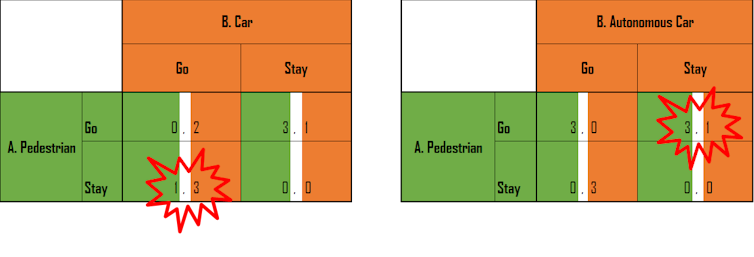
I was interested to read this article in The Conversation last month by Jason Thompson (University of Melbourne) and Gemma Read (University of the Sunshine Coast), about the interactions of humans and autonomous cars. In particular, they use some very simple game theory to represent the interaction between cars (autonomous or otherwise) and humans:
A simple example of how this might happen comes from game theory. Take two scenarios at an intersection where pedestrians and vehicles negotiate priority to cross first. Each receives known “pay-offs” for behaviour in the context of the other’s action. The higher the comparative pay-off for either party, the more likely the action.
In the left-hand scenario below, the Nash equilibrium (the optimum combined action of both parties) exists in the lower left quadrant where the pedestrian has a small incentive to “stay” to avoid being injured by the manually driven car, and the driver has a strong incentive to “go”.
However, in the scenario on the right, the autonomous vehicles has a desire to act flawlessly and pose no threat to the pedestrian at all. While this might be great for safety, the pedestrian can now adopt a strategy of “go” at all times, forcing the AV to stay put.
Here's their associated diagram. The red explosions show the Nash equilibrium in each case:

However, I think they have their analysis wrong. I don't think they've really considered the game theory implications here fully. In the game on the left, the car has a dominant strategy to "Go" - going provides a payoff that is always higher than staying. The car driver should never choose to stay, including if the pedestrian chooses to "Go" as well. But, if both pedestrian and driver choose to "Go", then the car runs over the pedestrian. It's hard to see how the car driver is better off going if the pedestrian goes (unless the disutility of washing the blood off their car really is less than the utility gained from getting through the intersection faster).

Similarly, in the game on the right, the pedestrian has a dominant strategy to "Go". But again, would they really choose to "Go" if the car is going too? Maybe in Thompson and Read's world, pedestrians aren't seriously injured or killed when they run into cars, but in the real world it seems like a pedestrian would be pretty stupid to go if a car is going.

A more realistic representation of the game is in the payoff table below. If both the car and the pedestrian go, then both lose. The loss to the car driver is pretty high (damage to their car; maybe jail time for running down a pedestrian), but not as high as the loss to the pedestrian (being injured or killed by a car is pretty serious). If car or pedestrian goes, and the other doesn't, then whichever one goes gets a larger positive payoff. If both car and pedestrian stay, then a standoff ensues, and both get a payoff of zero.


Where is the Nash equilibrium in this game? We can use the 'best response method' to find the equilibrium. To do this, we track: for each player, for each strategy, what is the best response of the other player. Where both players are selecting a best response, they are doing the best they can, given the choice of the other player (this is the textbook definition of Nash equilibrium). In this game, the best responses are:
  1. If the car chooses to go, the pedestrian's best response is to stay (since 1 is a better payoff than -5) [we track the best responses with ticks, and not-best-responses with crosses; Note: I'm also tracking which payoffs I am comparing with numbers corresponding to the numbers in this list];
  2. If the car chooses to stay, the pedestrian's best response is to go (since 3 is a better payoff than 0);
  3. If the pedestrian chooses to go, the car's best response is to stay (since 1 is a better payoff than -3); and
  4. If the pedestrian chooses to stay, the car's best response is to go (since 3 is a better payoff than 0).
There are two Nash equilibriums in this game: (1) where the car goes and the pedestrian stays; and (2) where the pedestrian goes and the car stays. Notice that both players in this game would be better off if they are the one to go, and worse off if they are the one to stay. But, if both choose to go, then they end up in the worst possible outcome! This is an example of the chicken game (which I have previously blogged about here).

A game with two Nash equilibriums doesn't really give us much guidance as to what the ultimate outcome will be. Both players want to go, but both want to avoid the situation where they are both trying to go at the same time. So, how do we solve this problem?

Currently, we solve the problem using a mixture of road rules and social norms. At pedestrian crossings, cars always stay and pedestrians can go. At traffic lights, cars and pedestrians stay or go depending on whether their light is red or green. At other places, pedestrians stay and cars go - that's why we learn as children to look both ways before crossing the road (a social norm).

However, autonomous cars create an interesting situation, as Thompson and Read highlight in their article. If autonomous cars are programmed to always give way to pedestrians (or, equivalently, to always avoid a collision with a pedestrian where possible), then that means the car will always stay. If the pedestrian knew (for sure) that the car was going to stay, they would choose to go. Every time. Suddenly, we end up in the top right box of the payoff table.

Why is this a problem? As Thompson and Read note:
Now imagine crossing a road or highway in a city saturated by autonomous cars where the threat of being run over disappears. You⁠ ⁠(⁠o⁠r⁠ ⁠a⁠n⁠y⁠ ⁠o⁠t⁠h⁠e⁠r⁠ ⁠mildly i⁠n⁠t⁠e⁠l⁠l⁠i⁠g⁠e⁠n⁠t⁠ ⁠a⁠n⁠i⁠m⁠a⁠l⁠)⁠ might quickly learn that ⁠⁠oncoming traffic poses no threat at all. Replicated thousands of times across a dense inner city, this could produce gridlock among safety-conscious autonomous vehicles, but virtual freedom of movement for humans – maybe even heralding a return to pedestrian rights of yesteryear.
Thompson and Read make the (obviously tongue-in-cheek) suggestion that a solution is for autonomous cars to occasionally, purposefully, run into pedestrians. That seems unlikely (though potentially effective).

Ultimately, this game of chicken is one that pedestrians are likely to win. So, while many are claiming that autonomous vehicles are the solution to traffic problems, they could actually end up making them worse.

Sunday, 23 September 2018

Is Trump vs. Xi a game of chicken, or a prisoners' dilemma?

There are several famous games that we use to teach game theory, one of which is the prisoners' dilemma (which I blogged on earlier in the week). Another is the game of chicken.

In the classic chicken game, two rivals line their cars up at opposite ends of the street. They then race directly towards each other. Each rival then has two options: (1) to swerve out of the way; or (2) to speed on. If one rival swerves and the other speeds on, the rival that sped on wins and the other driver looks foolish and loses some street cred. If both swerve, they both look a bit foolish. If both speed on, then there is a horrific accident and both may be severely injured or die. The game is presented in the payoff table below, for two drivers (Driver A and Driver B).


To find the Nash equilibrium in this game, we use the 'best response method'. To do this, we track: for each player, for each strategy, what is the best response of the other player. Where both players are selecting a best response, they are doing the best they can, given the choice of the other player (this is the definition of Nash equilibrium). In this game, the best responses are:
  1. If Driver A speeds ahead, Driver B's best response is to swerve (since a loss of face is better than dying in a fiery crash - maybe not immediately, but certainly in the long term) [we track the best responses with ticks, and not-best-responses with crosses; Note: I'm also tracking which payoffs I am comparing with numbers corresponding to the numbers in this list];
  2. If Driver A swerves, Driver B's best response is to speed ahead (since winning is better than looking a little foolish);
  3. If Driver B speeds ahead, Driver A's best response is to swerve (since, again, a loss of face is better than dying in a fiery crash);
  4. If Driver B swerves, Driver A's best response is to speed ahead (since winning is better than looking a little foolish).
Notice that there are two Nash equilibriums in this game - where one driver swerves and the other speeds ahead. Both drivers prefer the outcome where they are the one speeding ahead though, so if both try to get that outcome, we end up with both drivers dying in a fiery crash. The chicken game suggests that both players, acting in their own selfish best interest (or not considering the response of the other driver), leads to the worst possible outcome.

Which brings me to this article by Ambrose Evans-Pritchard in the Telegraph UK (gated, but there is an ungated version here):
The US and China are on a combustible escalation path that can end only when there is economic blood on the floor and the political pain threshold of one side or the other has been hit.
Both think they can withstand the longer siege. Neither can retreat easily...
China has in any case stated already that it will match each round of US tariffs with a riposte in kind.
Beijing must carry out this threat or lose face, and Trump has already vowed to escalate further when it does.
It is very hard to see how asset markets priced for perfection can ignore this deranged game of chicken for much longer. The mystery is that they have not crumbled yet.
Is this really a game of chicken? It turns out that it depends on how you define the payoffs. There are two players in the game (the U.S. and China), and two strategies (enact tariffs or hold off - the equivalents of speeding ahead or swerving). So, we can represent the game easily in a payoff table.

First, let's consider the payoffs to each country. If one country enacts tariffs and the other holds off, both countries are worse off than the status quo (they both lose some gains from trade), but the country that holds off probably loses less (their exporters are a bit worse off) [*]. We'll say that the payoff to the country enacting the tariffs is "bad", but for the other country the payoff is just "not so bad". If both countries enact tariffs then all of the bad stuff happens (exporters are a bit worse off, and there are lost gains from trade). We'll say that payoff is "very bad" for both countries. If both countries hold off, then the status quo prevails - the payoff is "OK" for both countries. The game is presented in the payoff table below.


Again solving for Nash equilibrium, the best responses are:
  1. If China enacts tariffs, the U.S.'s best response is to hold off (since "not so bad" is better than "very bad");
  2. If China holds off, the U.S.'s best response is to hold off (since "OK" is better than "bad");
  3. If the U.S. enacts tariffs, China's best response is to hold off (since "not so bad" is better than "very bad");
  4. If the U.S. holds off, China's best response is to hold off (since "OK" is better than "bad").
Notice that the best response for both countries is to hold off, regardless of what the other country does. Holding off is a dominant strategy. There is one Nash equilibrium here, which is for both countries to hold off (the status quo). It is also a dominant strategy equilibrium (because both countries have a dominant strategy). The equilibrium outcome of this game is the best outcome overall.

Clearly, that isn't the game that is playing out at the moment though, so how are things different? The current game is not a game about trade, it is a game about political posturing. The players are not the U.S. and China, but Donald Trump and Xi Jinping. They want to look strong, and not appear weak (to each other, or to their respective peoples). So, the payoffs and the players are different. The game that is actually being played looks more like the payoff table below. If both hold off, the status quo prevails (the payoff is "OK" for both. If one of them enacts tariffs and the other holds off, whichever of them enacted tariffs appears strong, and the other appears weak. If both enact tariffs, the payoff is costly to the economy.


Again solving for Nash equilibrium, the best responses are:
  1. If Xi enacts tariffs, Trump's best response is to enact tariffs (since "costly" is better than "weak");
  2. If Xi holds off, Trump's best response is to enact tariffs (since "strong" is better than "OK");
  3. If Trump enacts tariffs, Xi's best response is to enact tariffs (since "costly" is better than "weak");
  4. If Trump holds off, Xi's best response is to enact tariffs (since "strong" is better than "OK").
Notice that the best response for both leaders is to enact tariffs, regardless of what the other leader does! Enacting tariffs is a dominant strategy, and both leaders enacting tariffs is both the only Nash equilibrium and a dominant strategy equilibrium. The single equilibrium is also unambiguously worse than one of the other outcomes - this is an example of the prisoners' dilemma. Notice that it is not a chicken game.

How could this become a chicken game? If costing the economy was worse than appearing weak, then that would change things around. In that case, the best response to the other leader enacting tariffs would be to hold off. There would be two Nash equilibriums - where one leader enacts tariffs and the other holds off. However, both would prefer to be the leader enacting the tariffs rather than the one holding off.

So, whether this game is a chicken game or a prisoners' dilemma depends on how you think each leader feels about appearing weak. It seems to me that both want to avoid that at all costs. In my mind, this is a prisoners' dilemma, not a chicken game.

The repeated prisoners' dilemma can be solved for the optimal outcome (both holding off), but this requires cooperation between the two leaders. In order for this cooperation to arise, each leader must trust the other (because enacting tariffs is still a dominant strategy). If we want global trade to survive this showdown, somehow we need these leaders to develop a trusting relationship. It's a pity that Trump will not be at the APEC leaders meeting - it seems like a group hug is in order!

*****

[*] This might sound surprising. For the country imposing tariffs, tariffs lead to a deadweight loss (lost wellbeing). They make domestic sellers better off, but make domestic consumers worse off by more than the gain to domestic sellers. In contrast, the market in the country that holds off has no deadweight loss. The exporting firms in that country will be able to export a bit less, but that probably doesn't have as big of a negative impact as the tariffs do on the country that imposed them.

Wednesday, 15 February 2017

Brexit negotiations as a game of chicken

In a post last month, Tim Harford perceptively characterised the posturing between Britain and the European Union over Brexit as a game of chicken:
First: to be an effective negotiator often means accepting some risk of disaster. The simplest model of this is the game of “Chicken”, in which two leather-clad rebels get into their cars, and drive towards each other at a furious pace. The first one to veer off the road loses his dignity, unless neither of them swerve, in which case both of them will lose a lot more than that.
Chicken is an idiotic game, whose players have little to gain and much to lose. But Chicken teaches us that you can gain an advantage by limiting your own options. Imagine detaching your steering wheel and flamboyantly discarding it as you race headlong towards your opponent. Victory would be guaranteed. Nobody would drive straight at a car that cannot steer out of the way. But here’s a worrisome prospect: what if, as you hurl your own steering wheel out of the window, you notice that your rival has done exactly the same thing?
All this matters because both the UK and the EU are doing their best to give the impression that they’ve thrown their steering wheels away. Control of immigration is non-negotiable, says Theresa May. Fine, says the EU — in that case membership of the single market is out of the question. Fine, says May: we’re out. Don’t let the door hit you as you leave, says the EU.
It’s easy to see why both sides are behaving like this — it’s the logic of Chicken. But the eventual result may be something no sane person wants: a car crash. In May’s recent speech, she set out her willingness to risk such a crash by saying she might walk away without a deal. That does make some sense: it’s how you act if you want to win a game of Chicken. But there are games of Chicken that nobody wins.
The Brexit negotiations chicken game is laid out in the table below. The EU and the UK can choose to 'make concessions', or to 'play hardball'. If both make concessions, the outcome is essentially pretty neutral (a payoff of zero for both of them). However, if either the EU or the UK plays hardball while the other makes concessions, whichever of them plays hardball comes out better off (positive payoff) at the expense of the other (negative payoff).  Finally, if both play hardball, both will be much worse off (very negative payoffs).


Where are the Nash equilibriums in this game? To identify them, we can use the 'best response' method. To do this, we track: for each player, for each strategy, what is the best response of the other player. Where both players are selecting a best response, they are doing the best they can, given the choice of the other player (this is the definition of Nash equilibrium).

For our game outlined above:
  1. If the UK makes concessions, the EU's best response is to play hardball (since + is better than 0) [we track the best responses with ticks, and not-best-responses with crosses; Note: I'm also tracking which payoffs I am comparing with numbers corresponding to the numbers in this list];
  2. If the UK plays hardball, the EU's best response is to make concessions (since - is better than --);
  3. If the EU makes concessions, the UK's best response is to play hardball (since + is better than 0); and
  4. If the EU plays hardball, the UK's best response is to make concessions (since - is better than --).
Note that there are two Nash equilibriums, where one of the EU or the UK plays hardball, and the other makes concessions. However, both of them want to be the one playing hardball. This is a type of coordination game, and it is likely that both the EU and the UK will try to play hardball (but leading both to incur big losses!).

The solution to getting your preferred equilibrium outcome in the chicken game is to make a credible commitment (such as removing the steering wheel that Harford suggests for the classic chicken game). In the case of Brexit though, it isn't clear how either side can make a credible commitment to the hardball strategy, and both are already moving their feet towards the accelerator. But if neither are willing to make concessions, the outcome is clear.

Read more:


Saturday, 19 December 2015

China's zombie companies are playing chicken

Earlier this month, Andrew Batson wrote an interesting blog article about China's zombie companies:
One of the more interesting developments in official Chinese discussions about the economy has been the appearance of the term “zombie companies”... money-losing companies that seem to stay alive far longer than economic fundamentals warrant. This problem is particularly acute in the commodity sectors: a global supply glut has driven down prices of iron ore and coal to multi-year lows, levels where China’s relatively low-quality and high-cost mines have difficulty being competitive. And yet they continue operating despite losing money, because it is easier to keep producing than to completely shut down.
In ECON100 we no longer cover cost curves in detail, so we also don't talk about the section of the firm's marginal cost curve where it makes losses but prefers to continue trading because the losses from trading are smaller than the losses from shutting down. However, this is exactly the situation for China's zombie firms. As Batson notes:
An excellent story this week in the China Economic Times on the woes of the coal heartland of Shanxi quoted one executive saying, “If we produce a ton of coal, we lose a hundred yuan. If we don’t produce, we lose even more.”
Another aspect of the reluctance of China's zombie companies to shut down is strategic, and in this case it may be that the zombie companies continue to operate even if their losses would be smaller by shutting down. What the zombie companies are doing is playing a form of the 'chicken game'. In the classic version of the game of chicken, the two players are driving cars and line up at each end of the street. They accelerate towards each other, and if one of the drivers swerves out of the way, the other wins. If they both swerve, neither wins, and if neither of them swerve then both die horribly in a fiery car accident.

Now consider the game for zombie companies, as expressed in the payoff table below (assuming for simplicity that there are only two zombie firms, A and B). If either firm shuts down, they incur a small loss (including if both firms shut down). However, if either firm continues operating while the other firm shuts down, the remaining firm is able to survive and return to profitability. Finally, if both firms continue operating, both incur a big loss.


Where are the Nash equilibriums in this game? To identify them, we can use the 'best response' method. To do this, we track: for each player, for each strategy, what is the best response of the other player. Where both players are selecting a best response, they are doing the best they can, given the choice of the other player (this is the definition of Nash equilibrium).

For our game outlined above:
  1. If Zombie Company A continues operating, Zombie Company B's best response is to shut down (since a small loss is better than a big loss) [we track the best responses with ticks, and not-best-responses with crosses; Note: I'm also tracking which payoffs I am comparing with numbers corresponding to the numbers in this list];
  2. If Zombie Company A shuts down, Zombie Company B's best response is to continue operating (since survival and profits is better than a small loss);
  3. If Zombie Company B continues operating, Zombie Company A's best response is to shut down (since a small loss is better than a big loss); and
  4. If Zombie Company B shuts down, Zombie Company A's best response is to continue operating (since survival and profits is better than a small loss).
Note that there are two Nash equilibriums, where one of the companies shuts down, and the other continues operating. However, both firms want to be the firm that continues operating. This is a type of coordination game, and it is likely that both firms will try to continue operating, in the hopes of being the only one left (but leading both to incur big losses in the meantime!).

What's the solution? To avoid the social costs of the zombie companies continuing to operate and generating large losses, the government probably needs to intervene. Or, as noted at the bottom of the Batson blog article, mergers of these firms will remove (or mitigate) the strategic element, which is the real problem in this case.