Monday, 13 August 2018

Why taxing robots is infeasible, and an alternative proposal for a 'non-labour tax'

Back in March, I wrote a post using a simple production model to demonstrate how, as robots (and algorithms and other related technologies) became cheaper, they would increasingly displace human labour as robot-intensive technologies became the least-cost production technology for more firms and industries. An appealing fantasy is that we could tax robots and avert the coming labour crisis, but such a tax would only delay the inevitable. And, such a tax is likely to be infeasible in any case, as a recent article by Tim Harford explains:
What does a robot accountant look like? Not C-3PO with a pencil sharpener, that’s for sure. One might say that Microsoft Excel is a robot accounting clerk. A more plausible answer is that there is no such thing as a robot accountant. One day we may have androids sophisticated enough to do everything human accountants do now, but by then the very concept of an “accountant” will have changed beyond recognition.
So it is misleading of me to write of “robots” taking “jobs”. What actually happens is that specific tasks are automated, rather than the broad bundle of tasks that together constitute a human “job”. Automating tasks means reshaping jobs. The process can create jobs or destroy them, and will usually do both...
As any tax wonk can tell you, whatever we choose to tax — land, capital, profits, value-added, imports, wealth, greenhouse gas emissions — inevitably turns out to be a more ambiguous concept than it might appear, especially since ambiguity is often tax efficient.
But the category of “robot” is particularly difficult to define, and therefore to tax. We cannot tax the androids who march into our workplaces, stand by while we clear our desks, then sit down to replace us: they do not exist and it is hard to see why they ever would.
In a world of mass technological unemployment we are certainly going to need to tax something other than labour income alone. There are several plausible candidates. “Robots” is not one of them.
So, if we can't find specific robots to tax, it is difficult to tax robots effectively. What then? Give up and play Fortnite all day? An alternative proposal, which admittedly isn't fully formed in my mind yet, might be a 'non-labour tax'. The 'non-labour tax' would tax the difference between gross profit and net profit for each business, minus all labour costs that attract PAYE tax.

As any accountant will confirm, gross profits is basically what is left after the firm subtracts the cost of goods sold from total revenue. It is the gross profit that (manufacturing and retailing) firms use to pay the remainder of their costs, including the cost of labour [*]. Subtracting labour costs from gross profit, and taxing the difference between that and net profit, essentially places a tax on all non-labour expenses (which is why I dubbed it the 'non-labour tax'). Net profit is already taxed, so excluding net profit from the tax calculation avoids double-taxing.

My feeling is that such a proposal potentially creates a number of interesting outcomes. For instance, I believe that this tax proposal would:

  • incentivise firms to hire more labour at the margin, since it lowers the relative cost of labour (compared with 'robots' or whatever);
  • incentivise firms to hire labour in-house (since that labour would attract PAYE tax) rather than subcontracting out services like cleaning, since those subcontractor payments will now be taxed (so the relative 'price' of these services will be more in favour of in-house labour);
  • incentivise firms to categorise more of their workforce as employees (labour cost attracting PAYE tax) rather than as self-employed contractors (as above, the relative 'price' will be more in favour of labour); and
  • provide a means of taxing multinational firms that are profit-shifting to low-tax jurisdictions, since they would have to pay tax on international interest payments, intellectual property licensing fees and 'management services' fees, which are the main means that such firms use to shift profits overseas.
Of course, there are downsides to such a proposal, such as disincentives for research and development spending and innovation. Those disincentives might be able to be addressed through offsetting subsidies. There's probably plenty of other fishhooks I haven't considered (as I said above, it isn't a fully formed idea yet).

One of the main problems with taxes is all the activities that go on when people (or firms) try to avoid paying the tax (the unintended consequences that I often write about on this blog). In this case though, it should be clear enough to avoid such problems - if a payment attracts PAYE tax, then it is labour cost. And if not, it isn't. Labour costs are not a category that it would be easy for firms to shift other expenses into, in order to minimise their tax. Given that employers already need to report their payroll and PAYE tax payments regularly to the Inland Revenue Department, it seems straightforward that this could be used to calculate their tax liability (since they also have to report net profit and gross profit to IRD annually as well).

The pity here is that I've only recently started thinking about this, and it is now too late to make a submission to the government's Tax Working Group. I guess that just provides more time to think through the various consequences for the next time there is a working group (remembering past working groups on the same topic in 2009 and 2001).

*****

[*] Labour used in manufacturing might be subtracted from gross profit already, but we'll leave that aside for now because my recollections of accounting principles is a little shaky after many years out of the industry.

Saturday, 11 August 2018

Does brideprice explain why ISIS offered wives to its members?

You may have seen the stories, such as this one from CBS News in 2015:
The honeymoon was a brief moment for love, away from the front lines of Syria's war. In the capital of the Islamic State of Iraq and Syria's self-proclaimed "caliphate," Syrian fighter Abu Bilal al-Homsi was united with his Tunisian bride for the first time after months chatting online. They married, then passed the days dining on grilled meats in Raqqa's restaurants, strolling along the Euphrates River and eating ice cream.
It was all made possible by the marriage bonus he received from the Islamic State of Iraq and Syria (ISIS): $1,500 for him and his wife to get started on a new home, a family - and a honeymoon.
I thought it was interesting at the time, but mostly put it down to an organisation that is short on money finding non-monetary ways to incentivise new membership. Indeed, it appears that is exactly what was going on, but brideprice has a key role as the source of the incentive.

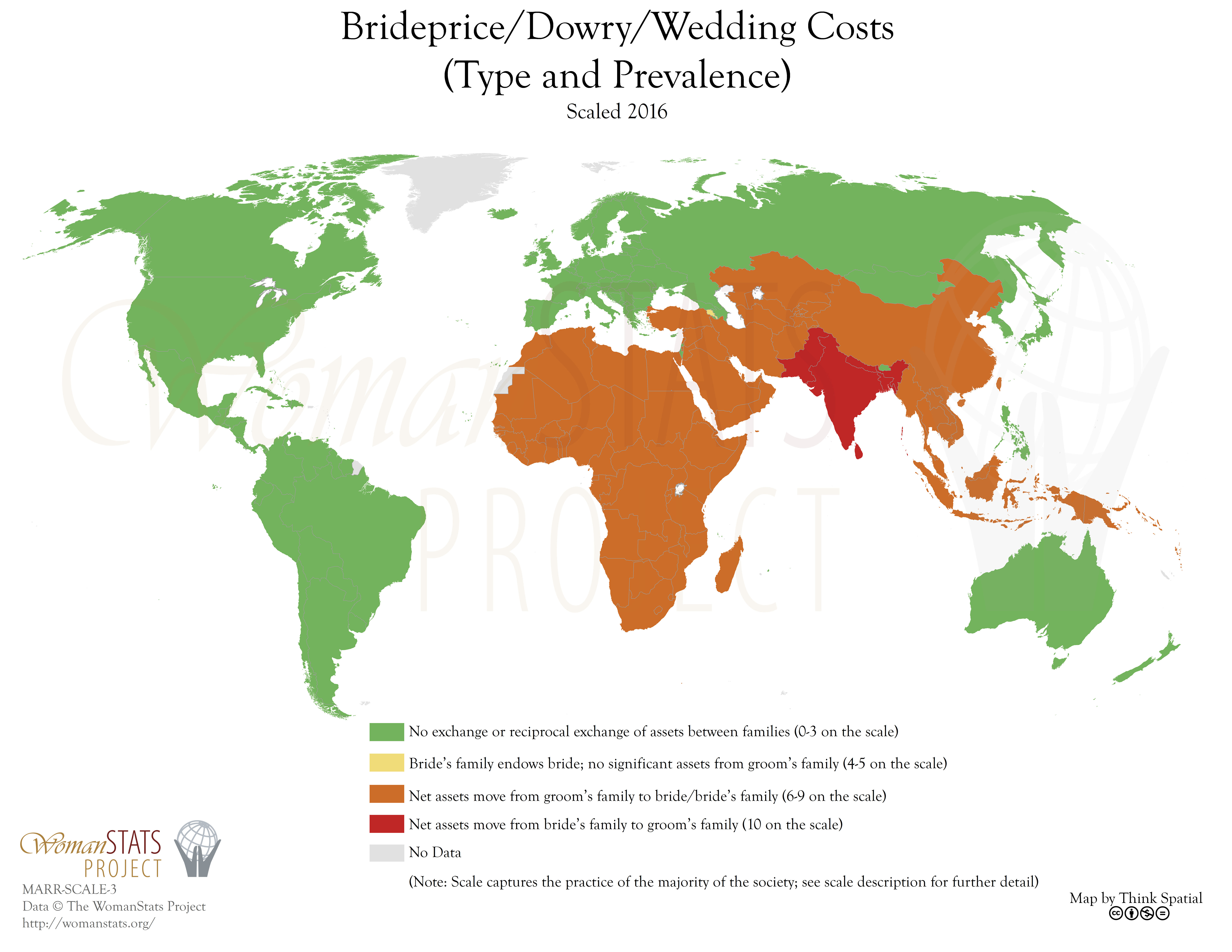
A brideprice is a payment (monetary or non-monetary) from the family of the groom to the family of the bride, on the occasion of their wedding. It is the norm throughout Africa, and most of Asia (excepting South Asia), as the following map shows (though note that sub-national heterogeneity is not shown, and there are areas in Africa where brideprice is not the norm):


In a recent article published in the journal International Security (ungated version here), Valerie Hudson (Texas A&M University) and Hilary Matfess (Yale) explain the economics of brideprice, and there is a lot of good economics in the article (so forgive the number of quotes, but the story is interesting):
The status of males in patrilineal societies is strongly linked to marriage. Not only does marriage mark the transition to manhood in patrilineal societies, but it establishes the male as a source of lineage and inheritance within the larger patriline. The marriage imperative is thus deeply felt among males in such cultures. And yet, marriage is unobtainable without assets...
Marriage in patrilineal societies is accompanied by asset exchange, wherein brideprice offsets the cost to the natal family of raising the bride... In addition to patrilocal marriage and the lack of female property rights mentioned above, these societies are characterized
by arranged marriage in the patriline’s interest; a relatively low age of marriage for girls; profound underinvestment in female human capital; intense son preference, resulting in passive neglect of girl children or active female infanticide/sex-selective abortion; highly inequitable family and personal status law favoring men; and chronically high levels of violence against women as a means to enforce the imposition of the patrilineal system on often recalcitrant women...
In patrilineal systems, brideprice is essentially an obligatory tax on young men, payable to older men...
...men pay for their sons’ brideprices by first collecting the brideprice for their daughters. Such transactions are another force pushing down the age of marriage among girls in brideprice societies, in addition to the desire to stop providing for daughters who, socially, will become the responsibility of another family. Unless a family is very wealthy, daughters in general must be married off first, so that the family can accumulate enough assets to pay the sons’ brideprices... If brideprice were not standardized within the society, families could not count on the brideprices brought in by their daughters being sufficient to cover the costs of their sons’ marriages. Thus, over time, a fairly consistent brideprice emerges for the community at any given time, though the actual cost may vary somewhat over time depending on local conditions...
Given the tendency toward brideprice inflation, an unequal distribution of wealth will amplify market distortions by facilitating polygyny...
Given both low investments in women’s health and the early age of marriage for girls in these societies, maternal mortality rates in most patrilineal societies tend to be egregiously high...
Thus, both polygyny and higher rates of post-marriage female mortality increase the ratio of marriageable males to marriageable females. Sometimes this scarcity produces extreme downward pressure on the marriage age of girls in a given society, with some marrying off girls as young as eight...
The patrilineal syndrome, therefore, is primed to produce chronic marriage market obstruction because (1) brideprice acts as a flat tax on young men that they cannot refuse to pay without suffering profoundly adverse social consequences; (2) brideprice catalyzes polygyny among the wealthier segments of society; and (3) the devaluation of women’s lives leads to high female mortality...
Marriage market obstruction, in turn, can be an important factor driving young men to join violent groups. The flat and inflationary nature of brideprice guarantees that poor young men will be hard-pressed to marry... These young men are not taking up arms against the institution of brideprice. Rather, at the individual level, a young man engages in violence to become more successful within the patrilineal system...
Furthermore, if a family has many sons, it may strive mightily to get the first son married, but then the younger, higher birth-order sons (such as the third, fourth and fifth sons) are typically expected to find their own sources of funding to pay brideprice...
Being unemployed is never good, but being unemployed in a society where you can only become an adult man by marrying and in which marriage requires significant financial resources produces a clear intensification of vexation and desperation...
High levels of grievance open up an opportunity for anti-establishment groups to exploit young men attempting to gain the status and the assets needed to marry. Delayed marriage and, importantly, the threat that one may never father a son in a culture defined by patrilineality are common elements exploited by groups seeking young adult men interested in redressing the injustice they feel on a personal level, by force if necessary.
Hudson and Matfess illustrate their article with examples of Boko Haram in the Lake Chad Basin and northern Nigeria, and militia groups in South Sudan. In both cases, brideprice inflation has led armed groups to offer incentives in the form of wives to militants willing to sign up. Hudson and Matfess also offer the counter-example of Saudi Arabia, where the government has capped brideprice and also acted to reduce the cost of weddings.

The article argues that polygyny increases the scarcity of potential brides, and prices increase when 'resources' are scarcer, and this pushes up the brideprice. That puts brides out of reach of low-income men, particularly second and later sons who can't rely on their family to be able to pay the brideprice for them. This is not just a flat tax. Because the brideprice is the same regardless of income (it's not an example of the 'law of one price' I would have considered), it is a regressive tax (it takes up a higher proportion of the income of a lower income man than a higher income man). This regressive tax incentivises low income men to: (1) take up arms in order to have the insurgent group find them a wife (e.g. Boko Haram); or (2) to engage in cattle raiding with armed groups (e.g. South Sudan). Either way, their inclusion in the armed group is a way for the young men to get a wife that they otherwise could not afford.

Finally, economists usually frown on the use of price controls, since they tend to lower economic welfare (they create a deadweight loss). As the case of Saudi Arabia shows, this might be one of the few exceptions. Without controls on the brideprice, Saudi Arabia might have faced a whole lot more problems.

[HT: Marginal Revolution]

Thursday, 9 August 2018

Compensating differentials are alive and well in Tokoroa

The New Zealand Herald reports:
A South Waikato District Councillor is puzzled as to why they're struggling to fill a well-paid job in the region.
The local district council is advertising for a health and safety manager in the town of Tokoroa, paying around $90,000 a year.
The council's last manager lasted just 12 weeks in the role and the officer before that 18 months.
Chairman of the Finance, Audit and Risk Committee Gray Baldwin told Larry Wiliams he's surprised more people haven't applied.
Some readers might remember a very similar story in 2016 about a general practitioner (also in Tokoroa) who was unable to attract a doctor for $400,000 per year (around double the going rate for a GP). Or the tourist operator in Taumarunui last year, offering an 'Auckland salary' of over $150,000 and similarly unable to find a good candidate.

At the risk of repeating myself, economists recognise that wages may differ for the same job in different firms or locations. Consider the same job in two different locations. If the job in the first location has attractive non-monetary characteristics (e.g. it is in an area that has high amenity value, where people like to live), then more people will be willing to do that job. This leads to a higher supply of labour for that job, which leads to lower equilibrium wages. In contrast, if the job in the second area has negative non-monetary characteristics (e.g. it is in an area with lower amenity value, where fewer people like to live), then fewer people will be willing to do that job. This leads to a lower supply of labour for that job, which leads to higher equilibrium wages. The difference in wages between the attractive job that lots of people want to do and the dangerous job that fewer people want to do is called a compensating differential.

So, why would people be unwilling to take a job in Tokoroa for $90,000? Perhaps the job comes with undesirable non-monetary characteristics (living in Tokoroa might be high on that score for many of us). You have to wonder why the last two people in the job lasted just 12 weeks and 18 months respectively. If this job was worth it for the salary on offer, why did the last two people leave so soon?

Read more:

Tuesday, 7 August 2018

Book Review: The Flaw of Averages

I just finished reading The Flaw of Averages, by Sam Savage. Reading the blurb, I would have thought this was a book that presented arguments that I would have a lot of sympathy for. The core argument that underlies the book is that so often decision-makers are looking for a single number that they can use for decision-making (often this is the average), but using that single number results in flawed and costly mistakes, because it ignores the fact that the single number is drawn from a distribution of possible numbers. Savage essentially argues for using simulation modelling, a particular form of which he has developed, called probability management.

In my own work, preparing population projections for local councils and other decision-makers, I often struggle with the decision-makers' needs for a single magic number that they can use for decision-making. Along with Jacques Poot, we pioneered the use of stochastic models for sub-national population projections in New Zealand (see this paper, for one example, or the longer ungated version here). Stochastic models explicitly display the uncertainty in future projections of the population, and there are a few regularities that Jacques and I noticed, such as projections being more uncertain for areas with smaller populations, and surprisingly more uncertainty for slower-growing or stable populations (compared with faster growing populations).

Towards the end of the book, there is a good quote that illustrates why decision-makers prefer not to have to deal with uncertainty, and prefer to focus on a single magic number:
Unfortunately, most organizations don't know how to deal with distributions. They generally ignore that part of the forecast, relying instead on the single number, and, presto, they're back to square one with the Flaw of Averages...
So, as has been my experience, you can provide decision-makers with the extra information on the uncertainty of a projection (or forecast), but you can't make them use it!

Savage's book can essentially be broken down into three parts. In the first part of the book, he essentially tries to make us forget all of the complicated terminology used in what he refers to as 'steam era' statistics, and instead replace the complicated 'red words' with 'green words' that have the Savage stamp of approval. However, in my opinion the green words are more ambiguous and sometimes plain wrong. For instance, Savage would have us replace "utility theory" (a red word) with "risk attitude" (a green word). Now, risk attitudes and utility theory are related, but not so much that you can replace both terms with one of them! Savage is also highly uneven in his disdain for complicated 'red words' - academic terms from finance such as the Capital Asset Pricing Model seem to get a free pass. Given that a lot of the book uses examples drawn from finance, this seems a little biased.

The second section of the book is the highlight. In these chapters, Savage uses personal stories of decision-makers and firms such as the oil company Shell and the pharmaceutical company Merck, to illustrate how simulation modelling can substantially improve the quality of decision-making. This is the really interesting stuff, and if the book had stuck to this, I feel it would have been much better.

The third section is essentially an extended infomercial for Savage's particular implementation of simulation modelling, probability management. While the examples extend those from earlier in the book, they're really just trying to sell the reader on the tools that Savage has developed.

Overall, I found that the personal stories of models in the real world are great. However, the book seems to have too many purposes and as a result, it doesn't execute as well on any of them as it might. In particular, it's a pity the first part of the book was essentially just a rant against terminology that Savage finds offensive. Moreover, Savage hasn't been as careful as he might with his examples. Fairly early in the book, he presents decision-making based on decision trees. However, despite his strong encouragement for us not to reduce decision-making to single numbers, in that chapter he uses expected value calculations - which reduces the decision to being based on a single number!

Overall, I wouldn't recommend this book for the general reader. If you want to understand why simulation modelling is important (or why it is important not to reduce analyses to a single number), it is useful for that, but I would skip through and start reading from about Chapter 16, and stop when your tolerance for the infomercial at the end is exhausted.